Bidspirit auction | “We Have Succeeded in Restoring
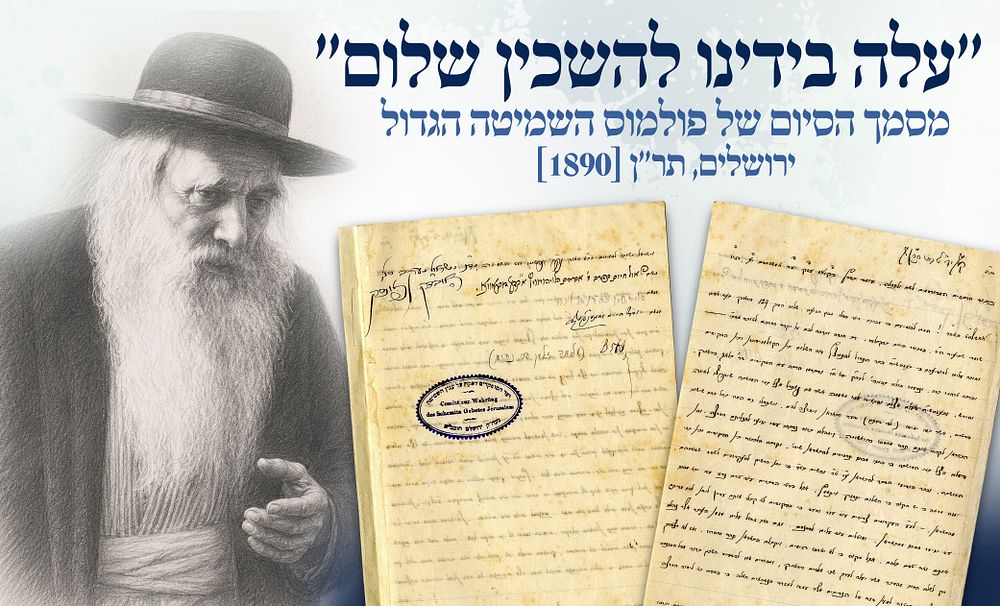
“We Have Succeeded in Restoring Peace” — The Document that Brought the Great Shemittah Controversy of Ekron to Its Close. Signed by Rabbi Yosef Chaim Sonnenfeld and the Leading Rabbis of Jerusalem. Jerusalem, 1890. - A historical document of the highest order, signed by the foremost rabbis of Jerusalem, headed by the holy gaon Rabbi Yosef Chaim Sonnenfeld, concerning one of the greatest public and religious crises in the history of the New Yishuv in Eretz Israel—the Shemittah controversy in the colony of Ekron (later Mazkeret Batya) during the Sabbatical year of 1888–1889. Jerusalem, 1890. The letter is addressed to the Pekidim and Amarkalim of Amsterdam, administrators of the halukkah funds and among the principal supporters of the Jewish settlement in Eretz Israel. In it, the signatories announce with evident joy and relief that they have succeeded in restoring peace between the officials of Baron Edmond de Rothschild and the settlers of Ekron, following a prolonged struggle that had stirred the entire Jewish world. The document bears the signatures of: Rabbi Yosef Chaim Sonnenfeld Rabbi Yisrael Yaakov Segal, Av Beth Din of Plonsk Rabbi Shaul Chaim HaLevi Horowitz, Av Beth Din of Dubrovna Rabbi Shlomo Zalman Baharan Before us is a document of extraordinary significance, directly connected to one of the formative events in the history of modern Jewish settlement in Eretz Israel. Background The colony of Ekron had been founded only a few years earlier through the initiative of Rabbi Shmuel Mohilever and the financial support of Baron Edmond de Rothschild. It was intended to be a settlement of God-fearing Jewish farmers. As the Sabbatical year approached, a fierce dispute erupted over the newly proposed Heter Mechirah (“sale permit”). The Baron’s officials insisted that the farmers continue cultivating the land under the permit, arguing that otherwise the colony would collapse economically. Opposing them were the farmers of Ekron, who followed the rulings of the leading rabbis of Jerusalem, headed by Rabbi Yehoshua Leib Diskin and Rabbi Shmuel Salant, and refused to work the land during the Sabbatical year. The controversy escalated into what later became known as the “Revolt of Ekron.” The Baron’s officials suspended support to the colony, withheld essential resources, exerted heavy pressure upon the settlers, and even brought in replacement laborers to cultivate the fields. The farmers, for their part, remained steadfast in their commitment to observing Shemittah according to its traditional requirements, despite hunger, hardship, and confrontations with the authorities. The affair captivated the Jewish world and occupied the attention of leading rabbinic authorities in both Eretz Israel and Europe. This is not a polemical broadside, a protest letter, or a halachic manifesto, as so many contemporary documents were. Rather, it is a letter announcing the conclusion of one of the fiercest disputes in the history of the renewed Jewish settlement in Eretz Israel. A Remarkable Historical Revelation The document also reveals a fascinating historical fact that is little known today. Its contents show that the rabbis of Jerusalem did not limit themselves to offering spiritual and halachic support to the farmers of Ekron. Deeply concerned for the future of the Shemittah observance, and alarmed by the controversy surrounding the Heter Mechirah—a question that would remain at the center of rabbinic debate for generations—they assumed an enormous practical responsibility. The letter demonstrates that these Jerusalem rabbis, who themselves lived in poverty and possessed virtually no independent financial resources, effectively stepped into the role of Baron Rothschild. They undertook substantial financial obligations in order to sustain the Shemittah-observant farmers of Ekron. The document details the debts and expenditures they assumed in order to support the colony and provide for the families who refused to cultivate their land during the Sabbatical year. No less remarkable is the revelation that the Pekidim and Amarkalim of Amsterdam quietly came to their aid. While the public struggle over Shemittah and the Heter Mechirah unfolded in Eretz Israel, a parallel effort was taking place behind the scenes: financial assistance and organized support designed to enable the farmers to endure their difficult ordeal without abandoning their observance of Shemittah. From a historical perspective, this document completes a central chapter of the great Shemittah controversy of 1888–1889, a struggle whose influence continues to be felt in the worlds of halachah, settlement, and Religious Zionism to this day. Very few original documents record the end of the crisis and the achievement of a compromise; rarer still is a genuine “peace document” bearing the signatures of Jerusalem’s leading rabbis, headed by Rabbi Yosef Chaim Sonnenfeld. [1] Leaf, written on both sides, 20 × 14 cm. Fine-quality paper.