Bidspirit auction | The Estate of Sir Moses
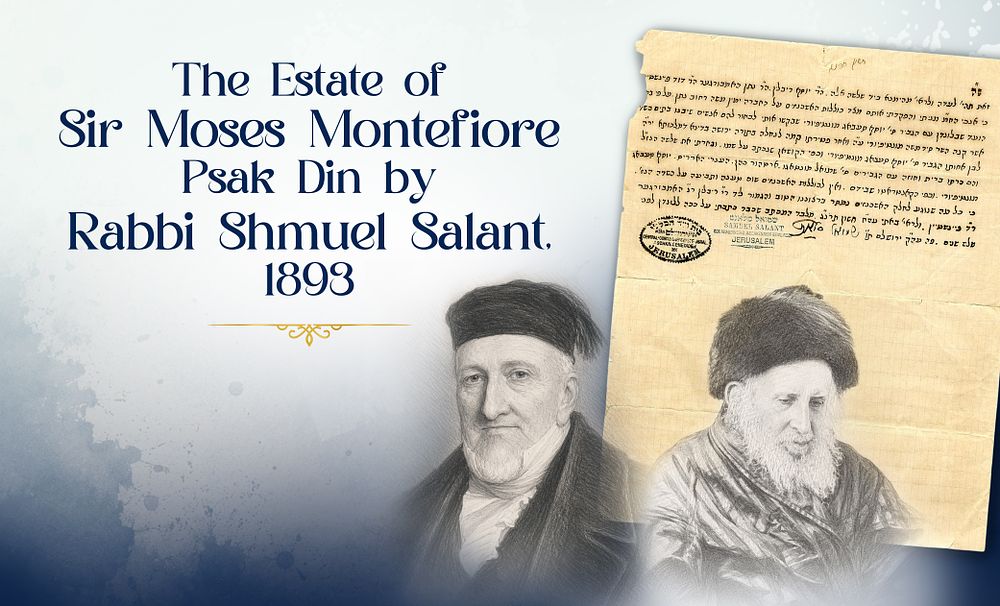
The Estate of Sir Moses Montefiore – Fascinating Rabbinic Ruling by Rabbi Shmuel Salant, Chief Rabbi of Jerusalem. 1893 - Rare Rabbinic Document of Great Historical Importance – Beit Din Ruling Signed by Rabbi Shmuel Salant Concerning the Estate of Sir Moses Montefiore. Jerusalem, 1893 A rare rabbinic document of exceptional historical significance, bearing the autograph signature of Rabbi Shmuel Salant, the revered Chief Rabbi of Jerusalem, concerning the estate of Sir Moses Montefiore. Jerusalem, 1893. To his great sorrow, the legendary Jewish philanthropist Sir Moses Montefiore left no surviving descendants. Consequently, his vast fortune was bequeathed to his nephew, Joseph Sebag, who was also required to adopt the family name “Montefiore” in accordance with his uncle’s will. The present document concerns Montefiore’s holdings in Jerusalem, specifically the land upon which the neighborhood of Yemin Moshe was established. It was there that Montefiore erected the famous windmill—an enduring symbol of his vision to create economic opportunity and self-sufficiency for the Jews of Jerusalem. Nearby stands, to this day, under protective glass, Montefiore’s celebrated carriage, used during his journeys throughout the world. In this rabbinic document, Rabbi Shmuel Salant, who was among Montefiore’s close personal friends, appoints three prominent Jerusalem communal leaders as trustees of the “Yemin Moshe” company, which, following Montefiore’s passing, undertook the construction of homes on the open land adjacent to the windmill. At the heart of the Beit Din document is a direct reference to Montefiore’s will and his legal heir: “...And after his passing, the inheritance devolved, according to the law of the kingdom, upon his nephew, the distinguished Joseph Sebag-Montefiore, as recorded in the title deed issued in his name... And in testimony thereof I have affixed my signature, Cheshvan 5653, in addition to the letter I wrote regarding this matter to London three years ago. Here in the Holy City of Jerusalem, may it be rebuilt and established, Shmuel Salant.” Condition: Good. Fold marks. Minor tears to the margins, affecting a few individual letters. Biography Rabbi Shmuel Salant (1816–1909) served as the revered Chief Rabbi of Jerusalem for approximately seventy years and was the foremost leader of the Ashkenazic Jewish community in the Land of Israel. In 1841 he was invited to settle in Jerusalem and assume leadership of the Perushim community. He established educational and charitable institutions, founded a rabbinical court, and played a central role in strengthening and organizing the Ashkenazic community of Jerusalem. Renowned as a leading halachic authority, he was equally celebrated for his prodigious memory and exceptional wisdom. Rabbi Shmuel Auerbach, in his approbation to Aderet Shmuel (Jerusalem, 2014), described him as: “A giant of Israel whose glory illuminated the land, renowned throughout the world for his Torah scholarship and wisdom as the foremost sage of the Jewish people, unparalleled in matters of halachic decision-making. He was likewise famed for his extraordinary holiness.” Joseph Sebag Montefiore (1784–1885) was the son of Sarah Sebag, sister of Sir Moses Montefiore. In accordance with Montefiore’s will, and in the absence of direct heirs, he inherited both Montefiore’s fortune and family name. Following Montefiore’s passing, Sebag Montefiore was responsible for administering the estates and properties left behind by his distinguished uncle. He maintained a particularly close relationship with Rabbi Shmuel Salant, stemming from the warm friendship that had existed between Salant and Sir Moses Montefiore. During his visits to the Land of Israel, Montefiore regularly consulted Rabbi Salant on matters of communal and public concern.