Bidspirit auction | Manuscript Ledger of the “Rechovot
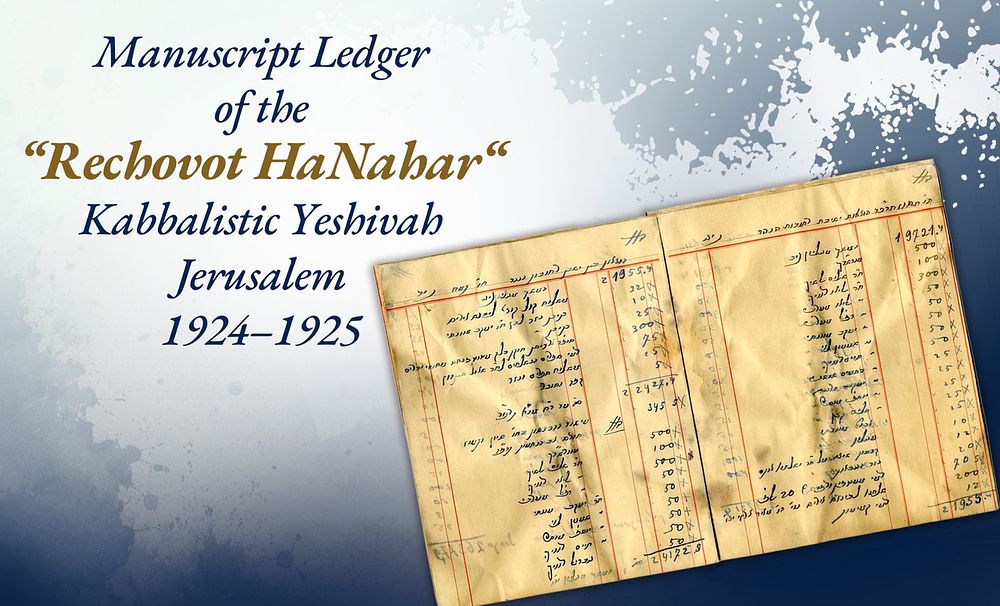
Manuscript Ledger of the “Rechovot HaNahar” Kabbalistic Yeshivah – Jerusalem, 1924–1925. With the stamp of Rabbi Chaim Shaul Dweck HaKohen [the Sadeh]. - The original financial ledger of the renowned Rechovot HaNahar Kabbalistic Yeshivah, covering the years 1924–1925. The ledger contains detailed records of the institution’s income, operating expenses, and stipends paid to its scholars, providing a unique window into the daily life, financial structure, and spiritual leadership of the yeshivah during its golden era under the guidance of Rabbi Chaim Shaul Dwiek HaKohen (the Shadah). The opening page bears a certification and approval of the accounts by the heads of the institution: Rabbi Chaim Shaul Dwiek HaKohen (with his official stamp), the philanthropist Rabbi Nissim Nahum, and Rabbi Meir HaKohen Arazi. The ledger reveals that substantial sums deposited into the yeshivah’s treasury were donated by Nissim Nahum, the prominent benefactor and son-in-law of the Shadah, who is listed among the institution’s leaders. The manuscript documents many of the leading kabbalists of Jerusalem who studied regularly at the yeshivah, including: Rabbi Chaim Shaul Dwiek HaKohen, Rabbi Shalom Alshich, Rabbi Eliyahu Dwiek, Rabbi Eliyahu Ma’aravi, Rabbi Yaakov Monsa, Rabbi Raphael Ma’aravi, Rabbi Yaakov Sofer, and Rabbi Yaakov Katzin. Also appearing is Rabbi Rahamim Shoshani, a lesser-known figure whose name receives valuable historical documentation here. The ledger offers fascinating insights into the life of the yeshivah. Among its entries are: A payment of 250 grush to Rabbi Avraham Salem for blowing the shofar on Rosh Hashanah. A record indicating that in 1924, Rabbi Yaakov Katzin served as the yeshivah’s principal shofar blower. Payments to Rabbi Yaakov Monsa for writing a Nezer Gabbayut register and for a Megillah. Payments to Rabbi Eliyahu Dwiek for Torah reading and additional prayer services. Expenses for books sent to Rabbi Shaul Sitton. Payments for correspondence sent to Aleppo and Beirut. An entry recording a telegram sent to New York on the eve of Rosh Hashanah 1925. Payments to a non-Jew who lit the Lux lamp on Shabbat during the months of Cheshvan and Kislev. This ledger is a rare and important primary source for the study of the history of Rechovot HaNahar Yeshivah and the personalities associated with it. It preserves precise financial records that shed light on the economic standing of Jerusalem’s kabbalistic scholars and the communal support network that sustained Kabbalistic institutions in the early twentieth century. [30] pages. 21 cm. Condition: Fair. The ledger was discovered in an attic and subsequently underwent cleaning and conservation. Time stains and dark discoloration are present but do not interfere with the text, which remains entirely clear and legible throughout.