Bidspirit auction | Manuscript of Shirat HaBakashot in
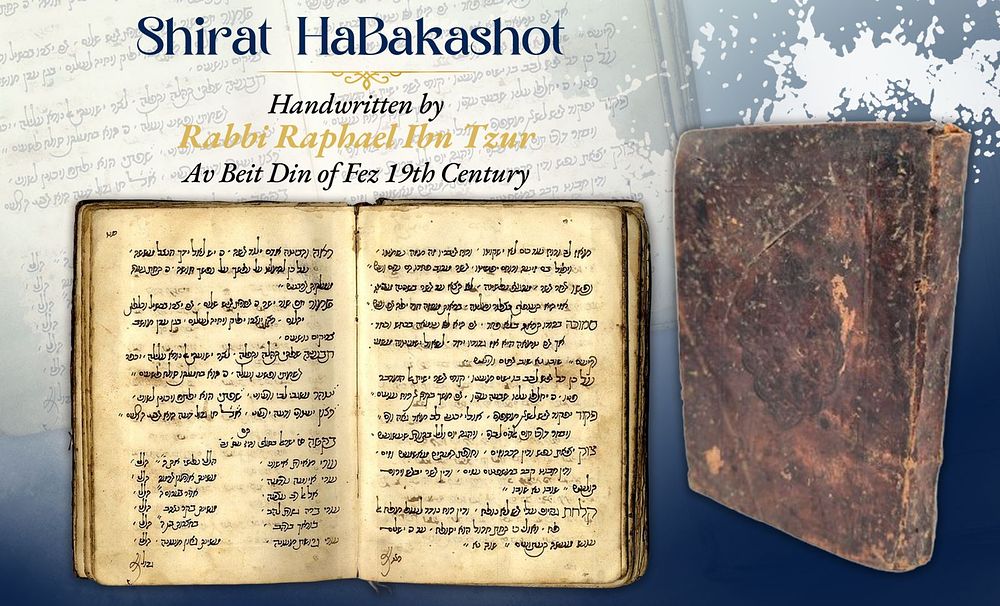
Manuscript of Shirat HaBakashot in the Handwriting of Rabbi Raphael Ibn Tzur, Av Beit Din of Fez. 19th Century - A manuscript of Shirat HaBakashot and liturgical poems, compiled and written from beginning to end in the elegant autograph hand of the rabbinic leader of nineteenth-century Fez, Rabbi Raphael Ibn Tzur. Several headings are embellished with calligraphic ornamentation surrounding the word or title. The manuscript belonged to and was used by the distinguished Siriro family of sages—one of the oldest and most prominent families descended from the Spanish Expulsion in Fez, which produced generations of dayanim and chief rabbinic judges. At the beginning of the manuscript, Rabbi Raphael Ibn Tzur prepared a detailed and precise alphabetical index of the poems, listing approximately 120 piyyutim. Among the compositions included: A fascinating allegorical poem opening with the words “Din u-Devarim Shamati Tokh Adat Kodesh” (“I heard a dispute among the holy congregation”), presenting a “controversy for the sake of Heaven” and founded entirely upon sayings of Chazal. A sequence of piyyutim by Rabbi Avner Yisrael HaTzarfati (1827–1880), one of the renowned sages and kabbalists of Fez: “Asher Gemalam Tzur, ” “Ani Odeh Le-Elohei Chasdi, ” and “Et Pi Eftzach Be-Shir Ve-Todah.” A valuable collection of poems by members of the illustrious Elbaz family, headed by the unique composition of Rabbi Shmuel Elbaz, “Seridim Yitenu LaShem Kol”, concerning the four categories obligated to give thanks to Hashem, alongside his well-known piyyut “Yom Zeh Li Na’eh Levarekh, ” and the composition of his brother, Rabbi Amram Elbaz, Av Beit Din of Sefrou: “Shomer Mah Malal Gorali U-Menat Chelki.” Also included are: “Yotzer HaKol Le-Mi Yachpotz” by Rabbi Israel Najara, and an accurate version of the piyyut “Yah Masi Kivin Rachmana” by Rabbi David Pardo, author of Maskil Le-David. On folio 56b appears the note: “I shall now begin to write the weekday bakashot, with the help of Him Who distinguishes between the holy and the mundane.” Immediately thereafter, Rabbi Raphael copied a unique and rare bakashah “without a sign” (lacking an acrostic), intentionally composed of exactly twenty-six stanzas, corresponding to the numerical value of the Divine Name. Also included is the bakashah “Yah Rav Chesed Noseh Pesha” by Rabbi Yaakov Ibn Tzur. Rabbi Raphael Ibn Tzur further copied into this manuscript an exceptionally rare Purim piyyut composed by the early dayan Rabbi Yehoshua Siriro. The composition follows the structure of the Yom Kippur Seder Ha-Avodah liturgical poems and bears a complete acrostic signature of its author: “Pizmon Le-Mikra Megillah Ba-Laylah — Siman: Ani Yehoshua Siriro, Chazak Ematz.” This feature demonstrates that the manuscript was either produced within, or passed as a treasured family heirloom among, the leading sages of Fez. The entire manuscript was written, edited, and arranged in the autograph hand of Rabbi Raphael Ibn Tzur. Several headings are decorated with calligraphic flourishes surrounding the titles, ornamentation characteristic of his manuscripts. On the front flyleaf appears the ownership inscription: “Shefal Ruach HaTza'ir... Ve-Ein Kol Hu, Chaim David Siriro.” On the final flyleaf appears a second ownership inscription: “HaTza'ir Reuven Siriro.” [200] pages (including several blank leaves). 16 × 11 cm. Original binding with minor defects and wear. Condition: Generally good. age stains. Several leaves detached. In two places within the volume, a single leaf appears to be lacking. Written in a fluent, attractive, and highly legible hand on strong, high-quality paper.