Bidspirit auction | Practical Kabbalah — A Rare
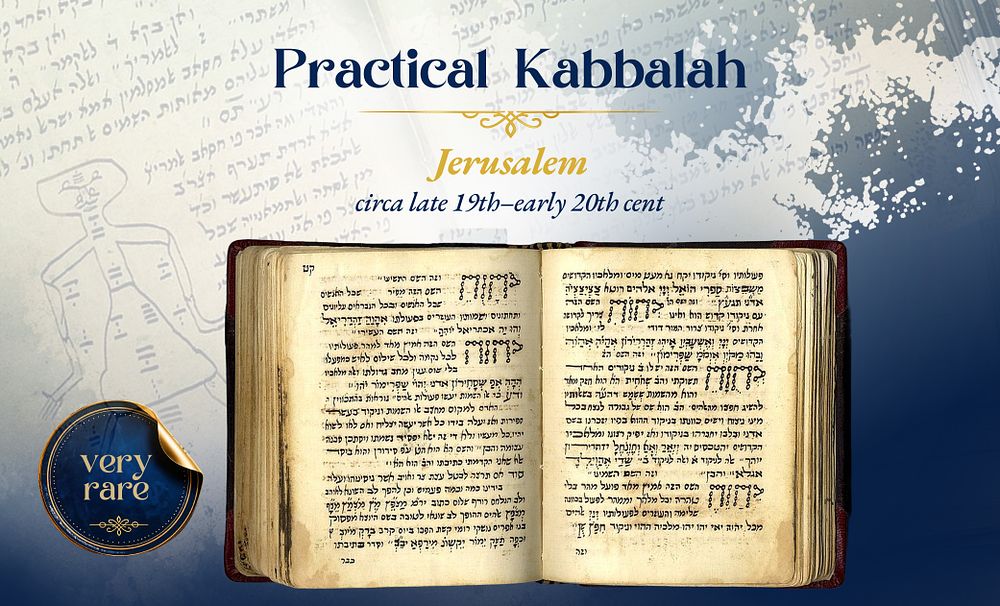
Practical Kabbalah — A Rare and Beautiful Manuscript Spanning Hundreds of Pages [Jerusalem, circa late 19th–early 20th century] - A substantial and exceptional Kabbalistic manuscript comprising hundreds of pages written in a beautiful, clear, and professional hand. A comprehensive compendium of Practical Kabbalah, containing hundreds of segulot, amulets, invocations, lots, remedies, names of angels and demons, incantations, secret formulas, and various mystical practices. The manuscript is adorned with Kabbalistic diagrams, mystical illustrations, and texts written in “angelic script.” [Apparently Jerusalem, late nineteenth or early twentieth century.] Presented here is one of the most extensive and impressive collections of Practical Kabbalah preserved from this period, reflecting traditions transmitted among the circles of Jerusalem’s Kabbalists during the late Ottoman era and the beginning of the twentieth century. Among the hundreds of segulot and practices recorded in the manuscript: An amulet and incantation for restoring harmony in the home and returning a wife to her husband: “She shall remain under her husband’s authority and never depart from him forever” (fol. 29). A segulah to see one’s destined spouse in a dream: “To see your intended spouse in a dream, namely the one decreed for you, take an egg...” (fol. 33). “This Name was transmitted by the Angel of Death to Moshe Rabbeinu, for killing an enemy” (fol. 33b). A segulah for opening the heart and strengthening memory: “That you shall not forget anything that you learn” (fol. 46). An amulet for favor, grace, and success in business, “prepared by the sages of the early generations” (fol. 53b). Detailed lists of demons and their kings for purposes of adjuration: “And the harmful spirits that are in the earth, and these are the names of their great kings...” (fol. 86). A segulah: “If you wish to bring a person from a distant land” (fol. 92). A formula for nullifying sorcery using “living silver” [mercury] (fol. 96). The author also records rare traditions from ancient sources and various circles of Kabbalists. Among other things, he cites the work Aliyot Eliyahu and transmits a family tradition in the name of a descendant of the Vilna Gaon regarding a segulah for preventing infant mortality (fol. 219). The manuscript bears witness to the fascinating meeting point between the traditions of the sages of Yemen and the Ashkenazic sages of Jerusalem during that period. The manuscript is written in a remarkably beautiful, professional, and highly legible hand, in both Hebrew and Judeo-Arabic, on thick, high-quality paper that has survived in excellent condition over many years. It was apparently written by a Yemenite Kabbalist who settled in Jerusalem at the end of the nineteenth century [based on the handwriting style and page format, which were not typical of Yemen], and it is evident that the compiler was exceptionally well versed in Kabbalistic literature, particularly Practical Kabbalah. A substantial manuscript volume. Approximately 460 written pages on thick, durable paper. 12 × 9 cm. Hebrew and Judeo-Arabic.