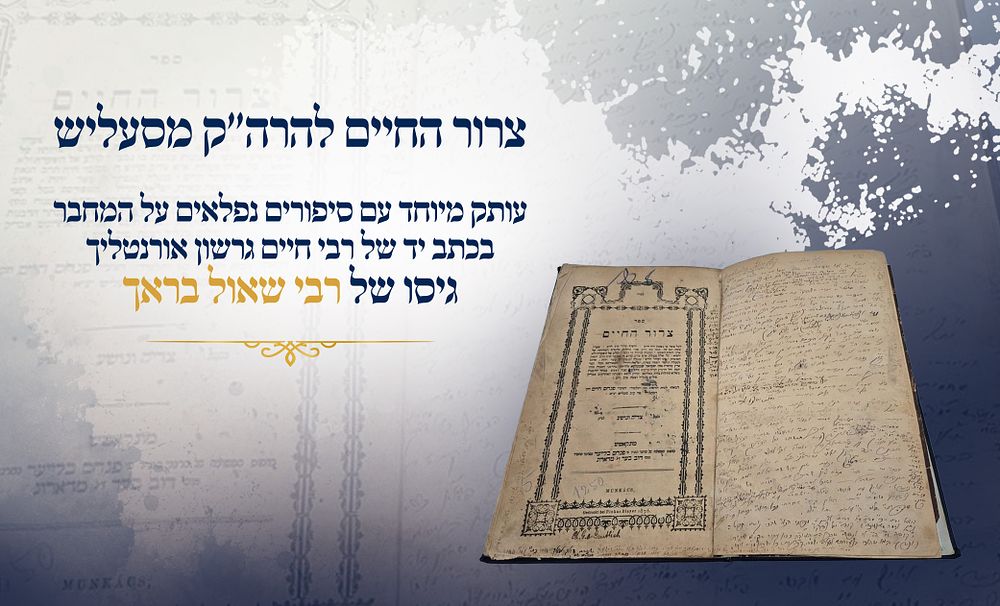
Bidspirit auction | Tzror HaChaim by the Rebbe
Tzror HaChaim by the Rebbe of Selish – A Unique Copy with Remarkable Handwritten Anecdotes by Rabbi Chaim Gershon Orentlich, Brother-in-Law of Rabbi Shaul Brach - Tzror HaChaim, containing Talmudic novellae by the renowned Gaon Rabbi Shmuel Shmelka Klein, Rabbi of Selish, one of the most celebrated Hungarian Torah authorities of his generation. Munkács, 1876. The sole published work of the author. First edition. An exceptional copy, bound with several handwritten leaves containing fascinating and previously unpublished anecdotes about the author and other leading rabbinic figures of the era. The writer of these notes was Rabbi Chaim Gershon Orentlich, whose father, Rabbi Mordechai, was a close disciple of the author of Tzror HaChaim. Rabbi Chaim Gershon was also the brother-in-law of the famed Gaon Rabbi Shaul Brach of Košice. On the front flyleaf appears his full inscription: “This book was given to me as a gift by the grandson of the author of blessed memory, my distinguished friend... R. Yosef Klein... Chaim Gershon son of R. Mordechai... Iklad, Transylvania.” The notes were evidently written over many years. They span six large manuscript pages (three before the printed text and three after it), as well as extensive marginalia throughout the first seven pages of the book. Several entries are signed with the initials חג”א, standing for Chaim Gershon Orentlich. Highlights from the Manuscript Notes Among the remarkable accounts recorded in this volume: How the author of Tzror HaChaim accepted the rabbinate after initially refusing it. Teachings of the Chasan Sofer (the writer’s teacher) and Rabbi Hillel of Kolomyia concerning the obligation to serve as a rabbi. A personal anecdote involving Rabbi Shaul Brach during a summer visit to a spa resort. A Torah discussion with Rabbi Moshe Pahrend while studying in Mattersdorf. Blessings received from the Shaarei Tzedek of Deés and from Rabbi Hillel of Kolomyia. A tradition from Rabbi Israel of Ruzhin praising the author. Testimony heard from the writer’s father regarding the author’s Torah study. The famous shtreimel of the Yismach Moshe, which he instructed his grandson, the Yitav Lev, to place upon the author’s head. Traditions concerning the Yitav Lev, the Chasan Sofer, and the custom of wearing a shtreimel. Accounts of the humble lifestyle of Maharam Schick. Stories concerning Rabbi Moshe David Ashkenazi of Tolcsva and Safed. Discussions regarding the custom of wearing a gartel. Insights into the relationships between Maharam Schick, the Yitav Lev, and the author of Tzror HaChaim. The author’s views regarding cigarette smoking. Additional Torah and Chassidic teachings attributed to the Kedushat Levi, Menachem Tzion of Rimanov, Ma’aglei Tzedek of Deés, Chasan Sofer, and others. These manuscript anecdotes were later printed—sometimes with transcription errors—in an exceedingly rare booklet entitled Divrei Torah VeSippurei Tzaddikim, apparently issued only in a very limited private edition. We have found no record of it in major bibliographic databases such as Otzar HaChochmah or the National Library. Summary A first-edition copy of Tzror HaChaim, presented by the author’s grandson to Rabbi Chaim Gershon Orentlich, son of a disciple of the author. Upon this very copy, Rabbi Orentlich recorded in his own hand a wealth of traditions, stories, teachings, and historical recollections concerning the author and many of the foremost Chassidic and rabbinic leaders of nineteenth-century Hungary, including material heard directly from his father and from his brother-in-law, Rabbi Shaul Brach. Rabbi Chaim Gershon Orentlich Rabbi Chaim Gershon Orentlich (c. 1860–1944), son of Rabbi Mordechai, disciple of the Rebbe of Selish, was a beloved student of the Chasan Sofer of Mattersdorf. He is cited in several responsa works of his contemporaries. From approximately 1882 he served as Rabbi of Mezőtelegd, later moved to Grosswardein (Oradea), and eventually settled in Jerusalem. He signed public proclamations alongside leading rabbis of Hungary and later alongside the foremost rabbinic authorities of Jerusalem. Physical Description The printed book contains [10], 94, [2] leaves, lacking the final leaf (the second leaf of the errata). Two leaves are bound at the front and two at the rear, containing six pages of manuscript text; the first and last manuscript pages are blank, having originally been attached to the old binding.