Bidspirit auction | The Foundational Document of Yeshivas
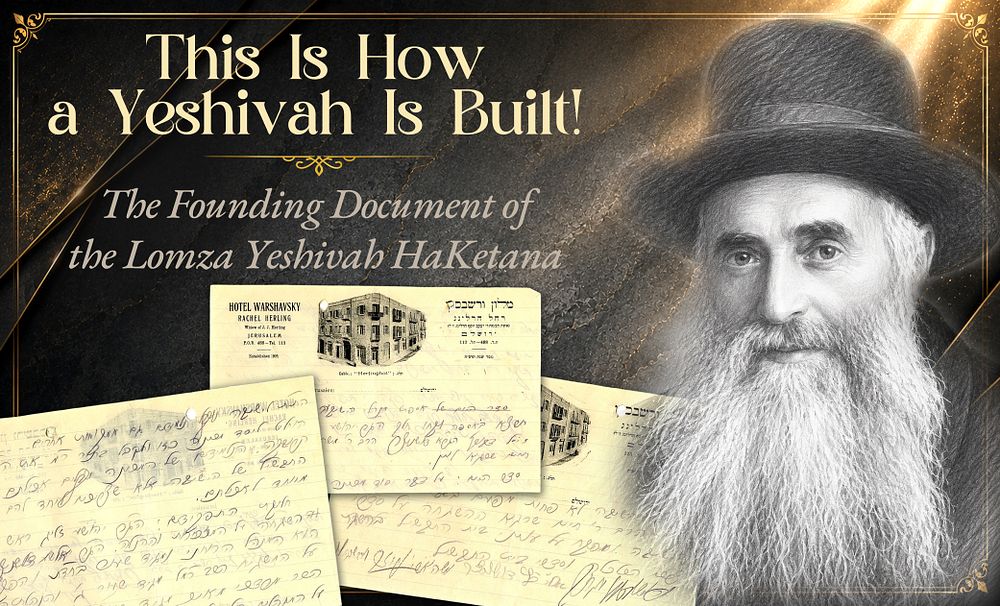
The Foundational Document of Yeshivas Lomza HaKetana, as the Leaders of the Torah World Meticulously Chart the Establishment of the Yeshivah, Step by Step. - A historical document of the highest importance, bearing the sacred signatures of the saintly gaon Rabbi Eliyahu Dushnitzer and the other heads of the Lomza Yeshivah. The document records, stage by stage, the establishment of the preparatory division of the Lomza Yeshivah in Petach Tikvah—the yeshivah from which many of the greatest Torah leaders in Eretz Israel would later emerge, among them Rabbi Shmuel Rozovsky, Rabbi Chaim Kanievsky, and many others. Jerusalem, Tishrei 5691 [1930]. Only on the rarest of occasions are we granted the opportunity to look behind the scenes and witness how a yeshivah is actually established—not once it is already standing in all its glory, but at the very first moment, when the idea still lies upon the table and the leaders of the Torah world sit together, make decisions, assign responsibilities, descend to the smallest details, and masterfully sketch the form of the yeshivah that is about to arise. At that time, the Lomza Yeshivah functioned as a yeshivah gedolah. Between the Talmud Torah schools, where children received their early education, and the advanced yeshivah, which students entered at a later age, an intermediate stage was lacking. The heads of the yeshivah sought to create a new link that would serve as a bridge between these two worlds—a preparatory division for the Lomza Yeshivah, the framework now commonly known as a yeshivah ketannah. For this purpose, the heads of the Lomza Yeshivah traveled specially from Petach Tikvah to Jerusalem and convened for an exceptional meeting at the renowned Warschavsky Hotel. Around a single table sat leading Torah scholars, headed by the saintly gaon Rabbi Eliyahu Dushnitzer, the yeshivah’s spiritual director, together with the other heads and administrators of the institution. At that historic meeting, the new yeshivah takes shape before our very eyes. Three pages of the Warschavsky Hotel’s official stationery were filled with their decisions. The captains of the Torah world—master educators who understood better than anyone the inner life of a yeshivah and everything required for its establishment and success—sat together and mapped out, detail by detail, the plan for the spiritual edifice they were about to build. Just as an architect designs a structure before the first stone is laid, so too did they plan a yeshivah here—from its foundations to its final detail. Almost nothing was overlooked. Who would stand at its head? Who would deliver the lectures? Who would direct its spiritual education? Who would supervise the mashgiach? Who would be responsible for the finances and secretarial administration? How would the preparatory students be fed? Where would they eat? Who would supervise the communal kitchen? How often would the administration convene to discuss the affairs of the institution? The document opens: “Meeting of the administrators of the Petach Tikvah Yeshivah on the 26th of Tishrei…” Immediately after the names of the participants appears the agenda: “Concerning the establishment of a preparatory division that will serve as a bridge between the Talmud Torah schools and the yeshivah.” Then comes the decisive sentence from which everything begins: “It was resolved to establish such a preparatory division.” In those few words, the Lomza Yeshivah Ketannah was effectively born. From that point onward, the yeshivah is constructed before our eyes. It was decided to accept students from other localities as well; Rabbi Shlomo Krovka was appointed as a ram; the students of the preparatory division would receive their meals from the yeshivah’s communal kitchen, though a separate dining area would be designated for them; and then comes one of the most fascinating sections of the document—the division of responsibilities. Each of the yeshivah’s leaders was assigned a precisely defined role: Rabbi Yehoshua Zelig Ruch was appointed head of the yeshivah and also entrusted with oversight of the secretariat and administration; the saintly gaon Rabbi Eliyahu Dushnitzer was appointed spiritual director and lecturer, and was also charged with supervising the mashgiach; Rabbi Moshe Leib Ozer was appointed lecturer for the third class and placed in charge of financial administration; Rabbi Mordechai Meir was appointed lecturer for the second class; and Rabbi Chaim Shraga Levi was entrusted with the daily order of the yeshivah, the communal kitchen, the acquisition of provisions, and the practical management of the institution. Nor did they stop there. The heads of the yeshivah stipulated that the full administration convene for a fixed working meeting at least once each week, on Thursday, in order to discuss all matters concerning the institution. Presented here is a complete plan for establishing a yeshivah—from beginning to end. From education to finance;