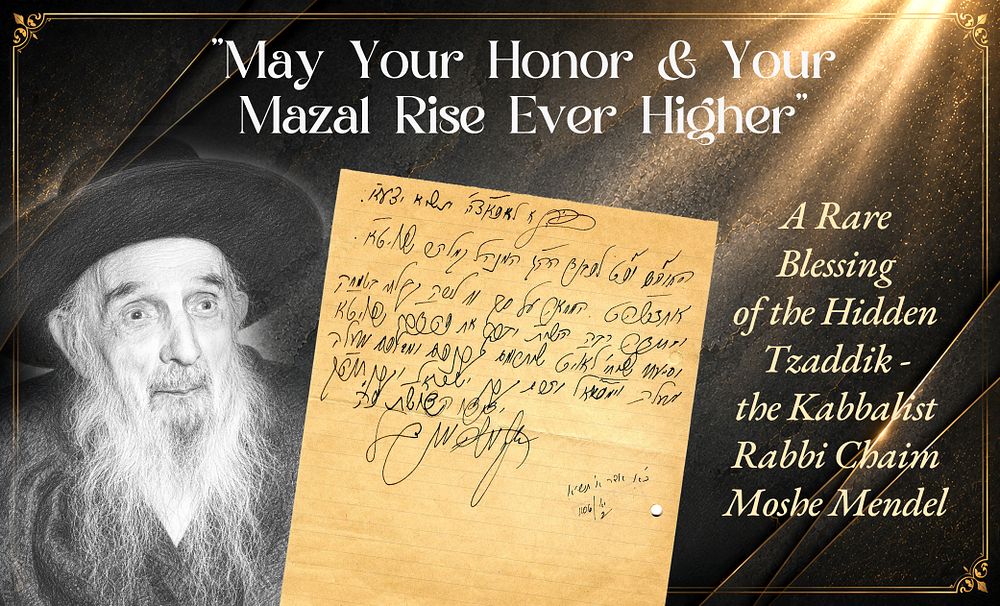
Bidspirit auction | ”May Your Honor and Your
”May Your Honor and Your Mazal Rise Ever Higher” – A Rare Blessing in the Handwriting and Signature of the Hidden Tzaddik, the Kabbalist Rabbi Chaim Moshe Mendel - Autograph letter of blessing, entirely handwritten and signed by the hidden tzaddik and kabbalist Rabbi Chaim Moshe Mendel. 5721 [1961]. One of the earliest known letters of Rabbi Chaim Moshe Mendel, and apparently the earliest ever to appear at public auction. The letter was written in Adar 5721, approximately a year and a half after his arrival in Eretz Israel, at a time when he still lived in complete obscurity, years before his name spread by word of mouth and thousands began flocking to his home to seek his blessing. Those were years of extreme poverty and hardship. The letter was sent to a benefactor who had donated the sum of one Israeli lira. In return, the kabbalist bestowed upon him an extraordinary blessing—one of the most comprehensive and exalted blessings to be found in the writings of righteous men: ”May your honor and your mazal rise ever higher.” This is not a blessing directed toward one specific matter, but rather an all-encompassing blessing. The Sages teach: ”Children, life, and sustenance depend not upon merit, but upon mazal” (Moed Katan 28a). Accordingly, a blessing for elevated mazal has long been regarded in Jewish tradition as encompassing every form of Divine beneficence—life, livelihood, success, salvation, and Heavenly assistance. Throughout the generations, handwritten letters of righteous men have been cherished throughout the Jewish world. Letters penned and signed in their own hand were preserved as sacred heirlooms and passed down from generation to generation, reflecting the enduring belief in the power of a tzaddik's blessing to arouse Heavenly mercy and bring blessing, success, and deliverance. [1] Large paper leaf. 20 × 25 cm. Very fine condition. Filing holes. Rabbi Chaim Moshe Mendel (1902–1996) was born in Bistrița, Romania. From his youth he devoted himself to Torah study and, at an early age, immersed himself in the study of Kabbalah. In 1938 he was appointed rabbinical judge in Timișoara. During the Holocaust he was sent to a forced labor camp in Romania, while his daughters were placed in an orphanage. The harsh conditions left him permanently disabled, and he bore his suffering with extraordinary faith throughout his life. After the war he immigrated to Eretz Israel, first settling in Safed and later in Bnei Brak. For many years he lived in severe poverty, concealing his lofty spiritual stature and remaining among the hidden righteous. According to the tradition preserved by his disciples and close associates, Rabbi Chaim Moshe Mendel merited revelations of the Prophet Elijah. For many years he remained virtually unknown to the public, but after Rabbi Yisrael Abuhatzeira and the kabbalist Moshe Yaakov Rabikov began directing people to seek his blessing, his reputation spread rapidly. Thousands came to his home to receive his counsel, prayers, and blessings, and he became renowned as one of the outstanding wonder-working tzaddikim of his generation. Among those who sought his blessing were leading Torah authorities and Hasidic rebbes, including the Rebbes of Vizhnitz, Amshinov, and Belz, Rabbi Elazar Menachem Man Shach, as well as Rabbi Yosef Waltuch, Rabbi Avraham Fish, Rabbi Yehuda Ze'ev Leibowitz, and many others. His son-in-law was the kabbalist Rabbi David Stern, and among his distinguished disciples in Kabbalah was Rabbi Yisrael Eliyahu Winter z”l. In 2011, his grandson, Rabbi Meir Yosef Stern, published Hareh La'Anav, a volume devoted to Rabbi Mendel's life, spiritual conduct, and the many accounts of wondrous salvations associated with him.