Bidspirit auction | Sha'arei Orah – One of
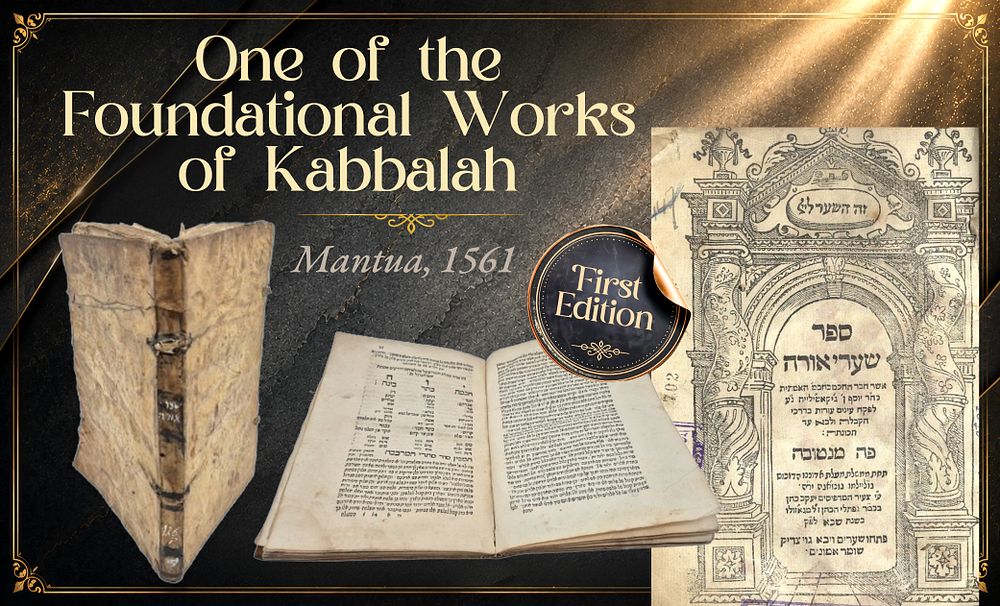
Sha'arei Orah – One of the Foundational Works of Kabbalah. First Edition. Mantua, 1561 - Sha'arei Orah – One of the Foundational Works of Kabbalah. First Edition. Mantua, 1561. Sha'arei Orah, one of the most fundamental and influential works of Kabbalah, by the eminent kabbalist Rabbeinu Yosef Gikatilla. Mantua, 1561. First edition. For centuries, Sha'arei Orah has been regarded as one of the foundational texts for the study of Kabbalah. In this systematic and lucid work, the author expounds upon the Ten Sefiros, the Divine Names, and the spiritual structure and governance of the worlds. It served as the principal gateway to the study of Kabbalah for generations of kabbalists and Torah scholars. Rabbeinu Yosef Gikatilla (c. 1248–1305), one of the foremost kabbalists of medieval Spain and a leading disciple of Rabbi Avraham Abulafia, composed this work during the earliest period of the dissemination of the Zohar. In several places he cites teachings attributed simply to ”Chazal, ” whose only known source is the Zohar, an important indication of both the antiquity of the work and its close connection to the formative era of Kabbalah in Spain. Leading Torah authorities throughout the generations praised the work and recommended its study. The Kesav Sofer records that his father, the Chasam Sofer, instructed him that if he wished to study Kabbalah, he should begin with Sha'arei Orah (She'eiris Tzion, at the end of Shem HaGedolim by R. M. M. Krengel, no. 115). A similar recommendation is attributed to Rabbi Chaim of Volozhin (Kesser Rosh, no. 60), who regarded this work as an essential foundation for the study of Kabbalah. The book is likewise cited with great esteem by the Ramak, the Beis Yosef, Rabbi Chaim Vital, and the Shelah HaKadosh. The influence of Sha'arei Orah extended well beyond the realm of Kabbalah. The Beis Yosef cites Rabbi Yosef Gikatilla as a halachic authority, including the ruling that Kiddush Levanah should not be recited until seven days after the molad (Orach Chaim 426), and that the head tefillin should not be removed from their pouch before donning the arm tefillin (Orach Chaim 25). In 1561, the work appeared in two distinct first editions—one printed in Mantua and the other in Riva di Trento. Although the Riva edition may have preceded the Mantua edition by a short time, both were printed directly from manuscript sources and are therefore regarded as first editions of the work. Stefansky, Sifrei Yesod, no. 340. 192 leaves. 20 cm. Condition: Very good. Minor age stains. Contemporary vellum binding, slightly worn.