Bidspirit auction | Autograph Manuscript of Netzach Yisrael
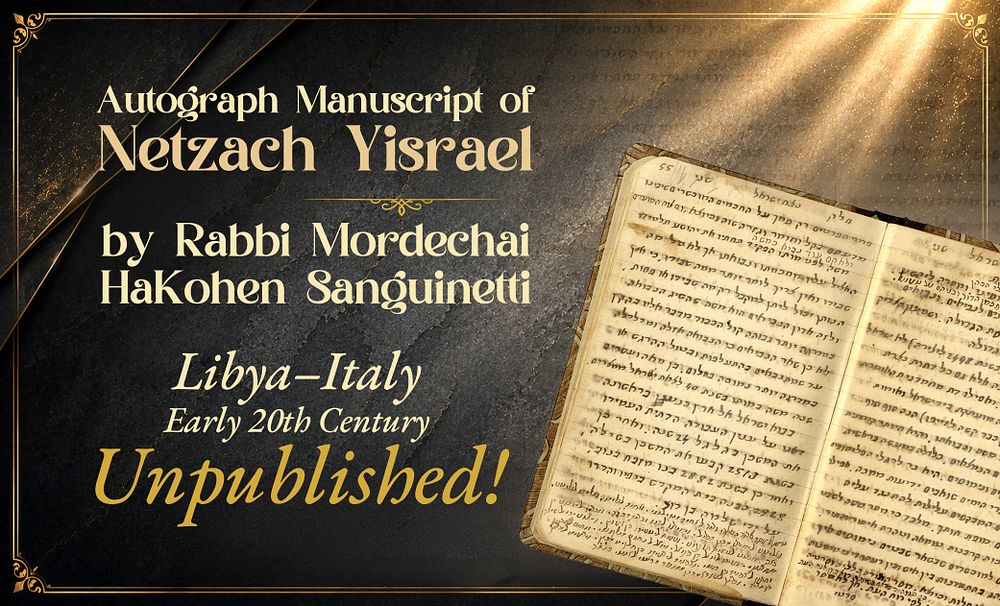
Autograph Manuscript of Netzach Yisrael by Rabbi Mordechai HaKohen Sanguinetti – Libya–Italy, Early 20th Century. Unpublished - Autograph Manuscript of Netzach Yisrael – An Unpublished Historical Survey of the Jewish People, Including a Remarkable Rationalist Critique of the Origins of Christianity. By Rabbi Mordechai HaKohen of Tripoli. Presented here is an important autograph manuscript in the clear hand of the distinguished scholar, dayan, historian, and ethnographer Rabbi Mordechai ben Yehudah HaKohen of Tripoli (1856–1929), author of the celebrated HaGid Mordechai and the foremost chronicler of Libyan Jewry. The work was composed in response to a request for ”a concise account of the history of the Jewish nation from the time it became a people.” Seeking to avoid an exhaustive chronological narrative, the author deliberately arranged the work as a series of succinct thematic chapters, based primarily on the Tanach and supplemented by additional sources, making Jewish history accessible in a clear and engaging format. The title, Netzach Yisrael, was chosen to express the eternal continuity of the Jewish people throughout the upheavals of history. This complete manuscript, comprising approximately 100 densely written pages, preserves the work exactly as conceived by the author. It is divided into two distinct sections, ”so that the subjects should not become intermingled, ” as the author himself explains: Part I – The Political History of the Jewish Nation, tracing the national story from Jacob's descent to Egypt through the successive periods of Jewish sovereignty, exile, wars, and historical developments. Part II – The History of the Jewish Religion, surveying the transmission and development of Torah, faith, and halachah, accompanied by extensive scholarly notes and original observations in the author's own hand. A particularly remarkable section appears on page 67, where Rabbi Mordechai HaKohen presents an extensive rationalist analysis of the origins of Christianity and the birth narrative of Jesus. In a lengthy autograph note, he rejects the New Testament's account of the virgin birth, arguing instead that the tradition developed through the natural process of oral transmission and historical embellishment. Employing an original philosophical analogy, he compares the spread of miraculous narratives to the nature of air—intangible, expansive, and difficult to contain. Just as air disperses beyond its boundaries, so too stories transmitted privately and without public scrutiny gradually expand through repeated retelling until historical reality becomes obscured. Applying this theory to the Christian tradition, he argues that a concealed historical event ultimately evolved into a miraculous narrative through generations of oral transmission. He further supports his position by pointing to internal chronological contradictions within the New Testament, including differing accounts regarding the day of Jesus' resurrection. On the front endpaper, the author carefully recorded the dates of appointment of the dayanim of the Rabbinical Court of Tripoli throughout the nineteenth century, creating an important documentary record of Libyan Jewish communal leadership. Rabbi Mordechai HaKohen Sanguinetti (1856–1929) was born in Tripoli to a family of Italian origin. Fluent in Hebrew, Judeo-Arabic, and Italian, he combined broad secular knowledge with profound Torah scholarship. Following his appointment as a dayan, he settled in Benghazi, where he served for many years as one of the community's leading rabbinic authorities. Today he is universally recognized as the most important historian and ethnographer of Libyan Jewry. His monumental work HaGid Mordechai remains the principal primary source for the history, customs, and institutions of the Jewish communities of Libya. Approximately 100 densely written pages. 17 cm. Entirely in the author's autograph hand, with numerous autograph notes and additions in the lower margins. Condition: Good. Some staining and occasional faded ink stains, though the text remains fully legible throughout. Preserved binding.