Bidspirit auction | Rare Historical Autograph Manuscript –
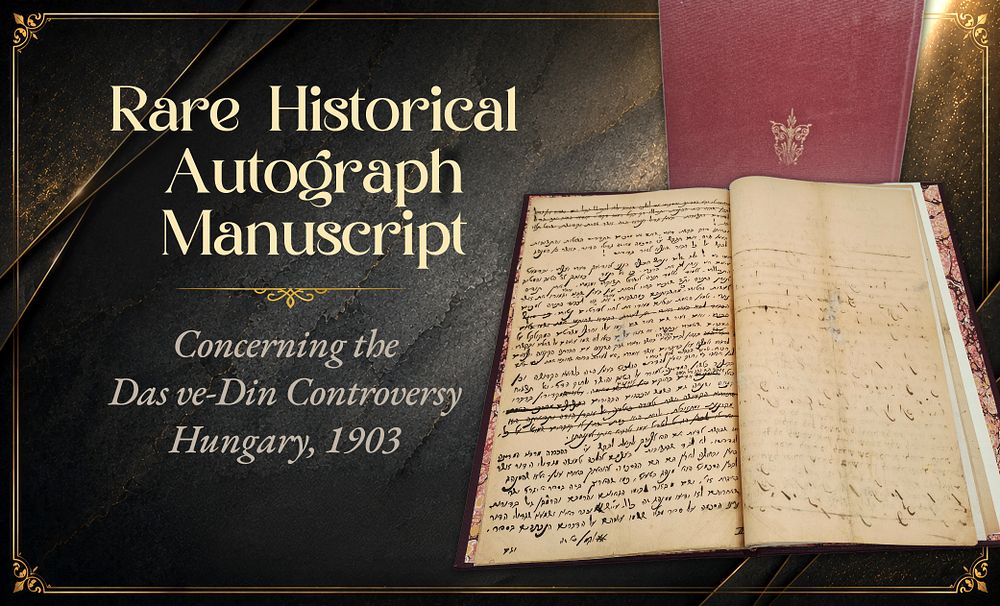
Rare Historical Autograph Manuscript – Correspondence Between Rabbi Shlomo Tzvi Schick (the Rashban), Av Beis Din of Karcag, and His Son Rabbi Berachyah Schick, Av Beis Din of Temesvár, Concerning the Das ve-Din Controversy. Hungary, 1903 - Autograph Manuscripts by Rabbi Shlomo Tzvi Schick, Author of Responsa Rashban – The Foundational Correspondence Behind the Publication of Das ve-Din (Religion und State). Hungary, 1891–1903. Unpublished. Presented here are two substantial autograph letters by the eminent Hungarian Torah authority Rabbi Shlomo Tzvi Schick, Av Beis Din of Karcag and author of the celebrated Responsa Rashban. Together they constitute an extraordinary documentary record illuminating the ideological and halachic struggle against assimilation in Hungary at the turn of the twentieth century. The principal letter, extending over approximately twelve large manuscript pages, was addressed to his beloved son, Rabbi Berachyah Schick, then serving as rabbi of Temesvár (Timișoara). It was written during the fierce communal controversy that ultimately led to the publication of Rabbi Berachyah's celebrated polemical work Das ve-Din (Hit és Állam / Religion und Staat). The letter opens: ”My beloved son, the delight of my soul and heart... You have asked my opinion and advice whether to publish the responsa you have received from the elders of Israel, both in the Holy Land and abroad...” Rabbi Shlomo Tzvi Schick responds to the grave communal crisis that had erupted in Temesvár, where civil marriage laws enabled mixed marriages without conversion. In uncompromising language he rules that children born to a non-Jewish mother may under no circumstances be registered as Jews in the government civil registers, declaring: ”So long as he has not converted according to the Law of Moses and Israel, he is not a Jew. Heaven forbid that anyone should commit such an injustice as to declare a non-Jew to be a Jew!” He further prohibits their burial in a Jewish cemetery, forbids teaching them Torah, and denounces anyone recognizing such children as Jews, insisting that they must remain separate from the Jewish community. Rabbi Schick urges his son to publish the responsa of the leading rabbinic authorities not only in Hebrew, but also in Hungarian and German, so that government officials, liberal communal leaders, and educated readers unable to read Hebrew would clearly recognize that this represented established halachah. He encourages his son to ignore those attempting to discourage him out of jealousy or personal animosity. The letter contains deeply moving paternal blessings: ”With tears in my eyes I bless you... My lifelong aspiration has been to teach Torah to Israel, and I have merited in my lifetime to see my sons and sons-in-law complete what I began...” He recounts the persecution he himself endured in Karcag because of his uncompromising halachic positions, quoting Isaiah's words: ”I gave my back to those who struck me...” In another remarkable section, Rabbi Berachyah asks whether he should seek rabbinic approbations (haskamos) for his forthcoming work. Rabbi Schick emphatically replies that no such requirement exists, explaining that the custom arose only after the burning of the Talmud in Rome in 1553, when Italian rabbis introduced rabbinic approbations as a form of internal censorship to protect Hebrew printing—not as an honor for authors. He cites numerous historical precedents and recalls the controversy surrounding David Friesenhausen's Mosdos Tevel, revealing that even the Chasam Sofer later regretted having granted an approbation to that work. The letter concludes with an impassioned call for his son to wage a ”Milchemes Mitzvah” against assimilation and intermarriage, invoking the biblical injunction: ”Neither shall you give your daughters unto their sons, nor take their daughters for your sons...” To strengthen his son further, Rabbi Schick appends an original Torah discourse analyzing the enigmatic passage in Gittin 7b concerning the four winds and the indispensable north wind, presenting four penetrating questions and an original interpretation. Bound together with this manuscript is an earlier autograph letter dated 1891, addressed to Rabbi Eliezer Patach, rabbi and preacher of Budapest, devoted entirely to a complex halachic discussion concerning the laws of Jewish divorce (Get), and signed in the author's hand: ”HaKatan Shlomo Schick.” Together, these manuscripts provide an exceptional window into the personal correspondence, halachic leadership, and ideological battles of one of Hungary's foremost rabbinic authorities. 14 manuscript leaves. 35 cm. Includes: First letter (1891): To Rabbi Eliezer Patach of Budapest, concerning the laws of Get. Two large autograph leaves, signed ”HaKatan Shlomo Schick.” Second letter (1903): To Rabbi Berachyah Schick concerning the Das ve-Din controversy in Temesvár. Approximately 12 large autograph leaves. Condition: Generally good.