Bidspirit auction | The Secret of Livelihood and
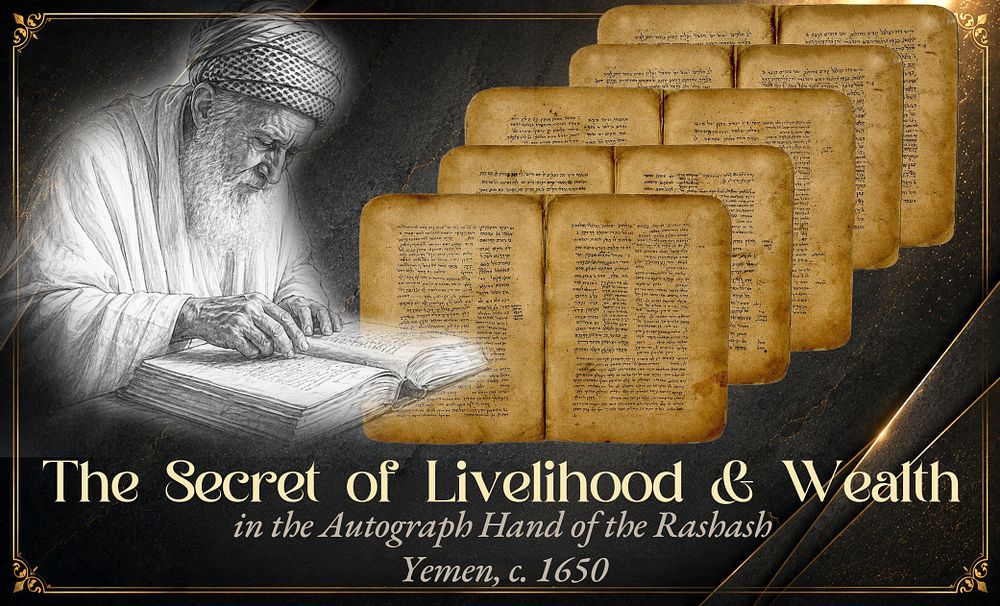
The Secret of Livelihood and Wealth in the Autograph Hand of Rabbeinu Shalom Shabazi (the Rashash) – A Rare Kabbalistic Manuscript from Midrash Chemdas Yamim on Parashas Terumah and the Vessels of the Mishkan. Yemen, c. 1650. Autograph - Autograph Manuscript of Rabbi Shalom Shabazi (the Rashash) on Parashas Terumah – The Original Version of Midrash Chemdas Yamim. Including Extensive Unpublished Additions. This remarkable 12-page autograph manuscript preserves the original draft of the Rashash's commentary on Parashas Terumah, from his monumental work Midrash Chemdas Yamim, composed in 1646. Unlike later manuscript copies, the present volume was written and edited by the Rashash himself. It is richly supplemented with numerous Tosefos Ta'amim (T”T)—expanded discussions and explanatory additions inserted by the author in the margins. These autograph additions, including an extensive mystical discussion on the spiritual source of livelihood and prosperity, have never been printed and are absent even from the most recent scholarly edition of Midrash Chemdas Yamim published by Machon HaMaor. ”They Shall Take for Me an Offering” The manuscript opens with an interpretation of the verse ”Veyikchu Li Terumah, ” explaining that wherever the Torah employs the word ”Li” (”for Me”), it signifies something eternal. From this point the Rashash develops a profound exposition connecting the verse with the celestial world of angels and the structure of the Sefiros. Discussing the famous statement of Chazal that ”Jerusalem will one day extend as far as Damascus, ” he interprets it allegorically: the Heavenly Jerusalem represents the perfected human soul, which in the Messianic era will ascend and unite with the transcendent intellect symbolized by Damascus, the place from which spiritual illumination emerges. The Ark of the Covenant and the Shechinah The Rashash reveals the inner meaning of the vessels of the Mishkan, explaining that the Ark of the Covenant corresponds to the angel who led the Jewish people through the wilderness—the Redeeming Angel—identified with the Shechinah dwelling among Israel. He proceeds to develop an extraordinary symbolic correspondence between the vessels of the Mishkan and the celestial order: The Twelve Showbreads correspond to the twelve signs of the Zodiac, divided into six northern and six southern constellations. The twenty-eight rods of the Table correspond to the twenty-eight celestial divisions. The thirty-six molds represent the thirty-six ”faces” of the zodiacal sphere. The Golden Altar corresponds to the Ninth Sphere, encompassing all the heavenly spheres ”like an eggshell surrounding both yolk and white.” The Mystical Secret of Livelihood and Wealth Among the most significant unpublished passages is a lengthy autograph Tosefes Ta'amim concerning the mystical source of parnassah. The Rashash poses a profound theological question absent from all printed editions: ”Why is livelihood rooted in the attribute of Gevurah—the side of strict judgment—rather than in Chesed, the attribute of kindness?” His answer is striking. Since Divine sustenance must reach the entire world—righteous and wicked alike, it cannot emanate solely from absolute kindness, which would properly belong only to the righteous. Instead, Hashem channels sustenance through Gevurah, operating within the natural order, while sweetening judgment through mercy so that all creation may be sustained. Building upon the verse in Yechezkel, ”I shall judge between the fat sheep and the lean sheep, ” together with the translation of Yonasan ben Uziel, the Rashash develops a remarkable kabbalistic explanation distinguishing the spiritual roots of wealth and poverty. He explains that the wealthy receive their sustenance through the attribute of mercy operating within the natural order, whereas the righteous poor draw directly from the highest source of pure Divine kindness. He concludes by interpreting the teaching of Chazal that ”The Holy One possesses only four cubits in His world, ” explaining that these ”four cubits” allude to the body of the righteous individual, who alone merits direct sustenance from pure Chesed. The discussion concludes with a passage from the Zohar on the verse: ”You satisfy every living being with favor” which the Rashash interprets as referring to the spiritual source of prosperity and abundance. This extraordinary mystical explanation—linking the verses of Tehillim to the roots of wealth and livelihood—survives exclusively in the present autograph manuscript and is absent from every printed edition. 12 pages. 21 cm. Condition: Good. Entirely in the holy autograph handwriting of Rabbi Shalom Shabazi (the Rashash). Beautiful script throughout, richly supplemented with numerous autograph marginal notes and Tosefos Ta'amim (T”T), the majority of which have never appeared in print.