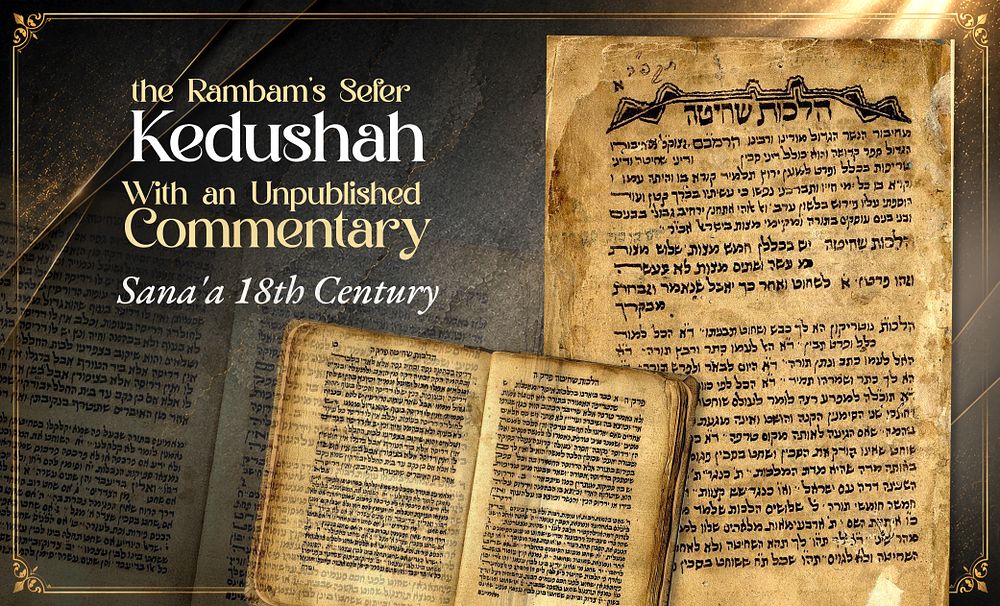
Bidspirit auction | Yemenite Manuscript of the Rambam's
Yemenite Manuscript of the Rambam's Sefer Kedushah – With an Unpublished Commentary. Sana'a, 18th Century - Complete Yemenite Manuscript of the Rambam's Hilchos Shechitah – With an Extensive Judeo-Arabic Commentary Throughout. Early 20th Century. A complete Yemenite manuscript, preserved from beginning to end, containing all fourteen chapters of the Rambam's Hilchos Shechitah from Sefer Kedushah of the Mishneh Torah. The text of the Rambam appears in the upper section of each page, with an extensive Judeo-Arabic commentary written beneath it throughout the manuscript. At the beginning of the manuscript, the compiler introduces his work in his own words: ”Hilchos Shechitah from the composition of the Great Eagle, our master and teacher, the Rambam... so that the student who reads it may run through it, and it shall remain with him all the days of his life... I have arranged it in a small volume and have added a commentary in the Arabic language.” He concludes his introduction with the prayer: ”To G-d I pray that He enlarge my borders with sons and grandsons who occupy themselves with Torah and fulfill the commandments among Israel. Amen.” Following the introduction, the author enumerates the five mitzvos relating to the laws of shechitah (three positive commandments and two prohibitions), introducing them with homiletic interpretations and acrostic explanations of the word Halachos. He presents numerous mnemonic devices and symbolic interpretations, including kabbalistic allusions such as ”Ha Lecha Keves VeShechot Tavniso” and references to Kesser, Rabbanan, and Torah, repeatedly emphasizing the pedagogical principle of ”klal u'prat” (general and particular). Among the mnemonic phrases appearing in the introduction are: ”Hakol Lamud Klal U'Prat Tavin.” ”HaKel Le'Amo Kasav VeNasan Torah.” ”HaYom LeVa'er LeFaresh Torah.” ”Ha Lecha Kesser U'Shemarehu Tamid.” ”Hakol Lefi Kavvanah VeHaShochet Talmid.” The author also provides an acrostic interpretation of the word Shechitah before beginning his commentary. The commentary itself opens on the first leaf and is written in a characteristic mixed Hebrew–Judeo-Arabic style, combining Hebrew terminology with flowing Judeo-Arabic explanation, typical of Yemenite Torah scholarship. [108] written pages. 17 cm. Condition: Generally good. Minor worming. Some age stains. Marginal wear to the first few leaves, not affecting the text. Modern attractive binding.