Bidspirit auction | The Personal Siddur of Prayer
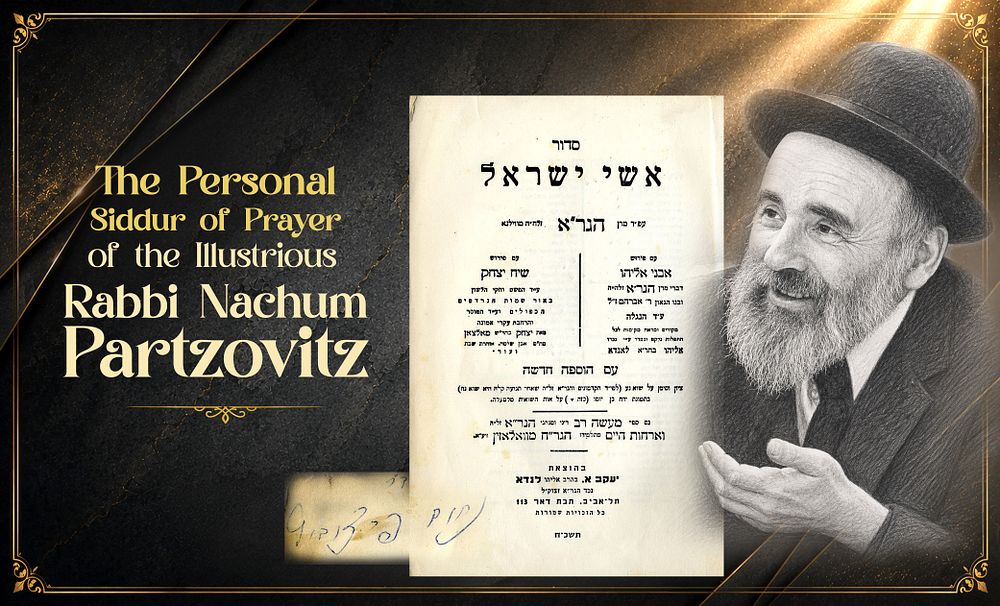
The Personal Siddur of Prayer of the Illustrious Rabbi Nachum Partzovitz, Rosh Yeshivas Mir - ”Whoever has a sick person in his household should seek out the Rosh Yeshivah and ask him to bless him.” (One of the earliest known sources for the custom of seeking the blessings and prayers of the great Torah sages.) The Personal Siddur of Rabbi Nachum Partzovitz, Rosh Yeshivas Mir Ishi Yisrael according to the Nusach of the Vilna Gaon – a substantial siddur in large format containing the prayers for weekdays, Shabbos, festivals, and the High Holy Days, together with the blessings for marriage, circumcision, and more. Appended are Ma'aseh Rav on the customs of the Vilna Gaon and Orchos Chaim by Rabbi Chaim of Volozhin. Published by Rabbi Eliyahu Landa, great-grandson of the Vilna Gaon. 1968. Presented here is the personal siddur of the illustrious Rabbi Nachum Partzovitz, Rosh Yeshivas Mir and one of the foremost roshei yeshivah of his generation, author of the classic series Chiddushei Rabbi Nachum and Shiurei Rabbi Nachum. This is the siddur that accompanied the Rosh Yeshivah throughout many years of prayer. Within its pages he poured out his heart before his Creator, praying for himself, his students, and the Jewish people. Extensive signs of use appear throughout the volume, providing tangible testimony to the daily prayer of one of the greatest Torah giants of the last generation, whose extraordinary diligence in Torah study was matched by his profound devotion to prayer. Although the leaves themselves remain complete and well preserved, many have loosened—and several have detached entirely from the binding through constant use—particularly in the weekday Shacharis section. This serves as living evidence that this was the Rosh Yeshivah's regular daily siddur for many years. Numerous wine stains appear in the section containing the blessings for Bris Milah, indicating that the siddur accompanied Rabbi Partzovitz when he served as sandek at the circumcisions of his students and their families. The special significance of objects used by great tzaddikim has long been recognized in Jewish tradition. The Jerusalem Talmud (Moed Katan 3:1) relates: ”Rabbi Meir's staff was in his hand, and it taught him wisdom.” The Chasam Sofer (Parashas Toldos) writes that a person's holiness becomes imbued within his garments and possessions, while the Panim Yafos explains that the belongings of the righteous are permeated with a spirit of sanctity. Likewise, the Minchas Elazar of Munkacs writes (Divrei Torah, Mahadura I, §22): ”An object used by a tzaddik, although entirely physical, enables one to attain spiritual understanding—and certainly serves as a source of blessing in the affairs of this world.” Ishi Yisrael, according to the Nusach of the Vilna Gaon. 584 pages. 24 cm. Condition: Good. Several leaves detached. Bearing the autograph signature of Rabbi Nachum Partzovitz on the title page. Extensive signs of use throughout, attesting to its many years of personal use by the Rosh Yeshivah. Broken Original binding. Rabbi Nachum Partzovitz (1923–1987) was one of the outstanding Torah scholars and roshei yeshivah of the twentieth century. Born in Trakai, Lithuania, he was the son of Rabbi Aryeh Tzvi Partzovitz and a grandson of the renowned Rabbi Nachum Greenhaus. He studied under Rabbi Elchanan Wasserman and Rabbi Baruch Ber Leibowitz, and later became the son-in-law of Rabbi Chaim Shmuelevitz, Rosh Yeshivas Mir. His monumental works, Chiddushei Rabbi Nachum and Shiurei Rabbi Nachum, became foundational texts in yeshivah study halls throughout the Torah world. His son-in-law is Rabbi Asher Arieli, one of the leading roshei yeshivah of Mir. Few are aware that the earliest source for the custom of requesting prayers from a great Torah scholar refers specifically to a Rosh Yeshivah. The Talmud (Bava Basra 116a) teaches: ”Whoever has a sick person in his household should go to a sage and ask him to pray for mercy on his behalf.” The Nimukei Yosef (ad loc.) records that this was the accepted custom in medieval France: ”Whoever has a sick person seeks out the rabbi who heads the yeshivah and asks him to bless him.” This early testimony highlights the unique role of the Rosh Yeshivah as one whose prayers were sought on behalf of the Jewish people.