Bidspirit auction | The Segulah of Segulot –
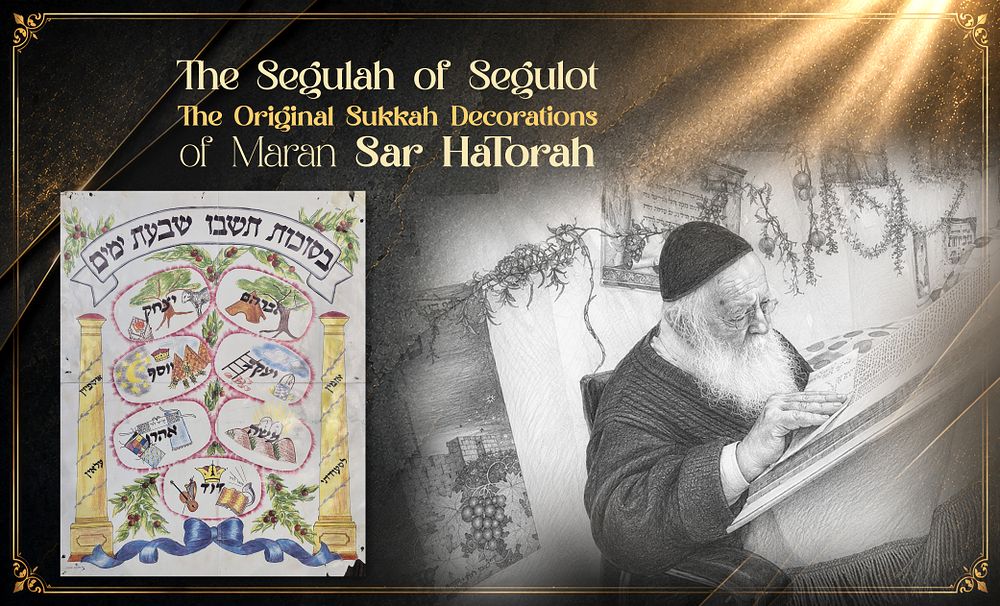
The Segulah of Segulot – The Original Sukkah Decorations That Hung for Years in the Sukkah of Maran Sar HaTorah, Rabbi Chaim Kanievsky - Rare and Exceptional Sacred Objects – Five Large Sukkah Decorations from the Sukkah of Maran Sar HaTorah, Rabbi Chaim Kanievsky A rare and exceptional group of sacred objects: five large-format posters, printed on especially thick coated cardboard, which served for years as decorations in the personal sukkah of Maran Sar HaTorah, the Gaon Rabbi Chaim Kanievsky. These are the very decorations that stood before Maran’s eyes throughout the days of Sukkot, in the sukkah where he remained almost continuously, day and night, immersed in Torah study and Divine service. Each of the five posters is accompanied by a handwritten and signed certificate of authenticity from Maran’s grandson, the Gaon Rabbi Avraham Yeshayahu Kanievsky. 1. “Ulu Ushpizin” – The Seven Ushpizin An enormous poster printed on thick coated cardboard, featuring illustrations of the Seven Ushpizin together with the traditional text inviting them into the sukkah. It was from this very poster that Maran would invite the holy Ushpizin into his sukkah each day, reciting: “I beseech you, Avraham, my exalted guest… that you sit with me, together with all the exalted guests – Yitzchak, Yaakov, Moshe, Aharon, Yosef and David.” 2. “BaSukkot Teishvu Shiv’at Yamim” Another large poster, decorated with portraits of the Ushpizin and bearing the verse “You shall dwell in sukkot for seven days.” 3. “Nishmat Kol Chai” An enormous poster bearing the complete text of the prayer “Nishmat Kol Chai.” Maran was well known for advising those in need of salvation to undertake to recite Nishmat after their salvation had occurred – a segulah he received from his father, Maran the Steipler, in the name of Rabbi Heschel, teacher of the Shach. Throughout the days of Sukkot, this very poster stood before Maran’s eyes in his sukkah. The Steipler’s daughter, Rebbetzin Tzivyon, related that Rabbi Chaim Kanievsky and his wife regularly followed this practice. Before childbirth, during a child’s illness, or whenever they required a salvation, they would undertake to recite Nishmat once the salvation occurred. She further related that her mother publicized this segulah among the women who came to her home, repeatedly advising: “Accept upon yourself, without a vow, to recite ‘Nishmat’ after the salvation comes!” Numerous accounts of remarkable salvations resulting from this practice have been related. One such story concerns a child who fell from a height and severely shattered his leg. Doctors determined that he would require a series of operations and could not guarantee that the leg would ever return to its previous condition. The child’s grandmother hurried to the Rebbetzin in distress. After hearing the story, the Rebbetzin instructed her to undertake the recitation of Nishmat and declared: “There will be no need for an operation!” Throughout the recovery she continued to inquire after the child and instructed that Nishmat be recited for every improvement. Contrary to the physicians’ expectations, the child ultimately recovered completely without undergoing any operation. (From the Moked Tehillim Artzi website.) How great is the segulah of reciting “Nishmat Kol Chai” from the original poster that hung in Maran’s own sukkah and upon which his holy eyes gazed repeatedly throughout the festival of Sukkot. 4. “VeHayu Einecha Ro’ot Et Morecha” – An Enormous Portrait of the Alter of Slabodka A large-format portrait of the Alter of Slabodka. In Shamanu Ken Ra’inu, a collection of questions and answers from Rabbi Chaim Kanievsky (Jerusalem, 2025, p. 116), the following exchange is recorded: Question: Is there significance in looking at a picture of a Tzaddik? Does it bring about fear of Heaven? Answer: Yes. Today they show [a film of] the Chafetz Chaim walking. Question: Did the Rav see it? Answer: Yes. Question: What does the Rav say about it? Answer: It is significant. Before us, therefore, is the very portrait that hung for years in Maran’s sukkah, standing before his eyes during the hours he spent studying Torah, praying and serving his Creator throughout Sukkot. 5. “Galgal HaMazal” – The Zodiac Wheel An especially large poster depicting the zodiac wheel, the names of the Hebrew months, letters of the Hebrew alphabet, illustrations of the twelve signs of the zodiac and symbols of the Twelve Tribes. Could there be a greater segulah for opening one’s mazal?! “I Cannot Bear to Lose Even a Moment Outside the Sukkah” The book LeHidabek BeDrachav Shel Rabbeinu Chaim Kanievsky (Vol. II, chapter on Sukkot) describes Maran’s extraordinary devotion to the mitzvah of sukkah. Throughout the entire festival he endeavored not to lose even a single moment of sitting in the sukkah. On one occasion, when the time came for Minchah,