Bidspirit auction | Manuscript – Passages from “Midrash
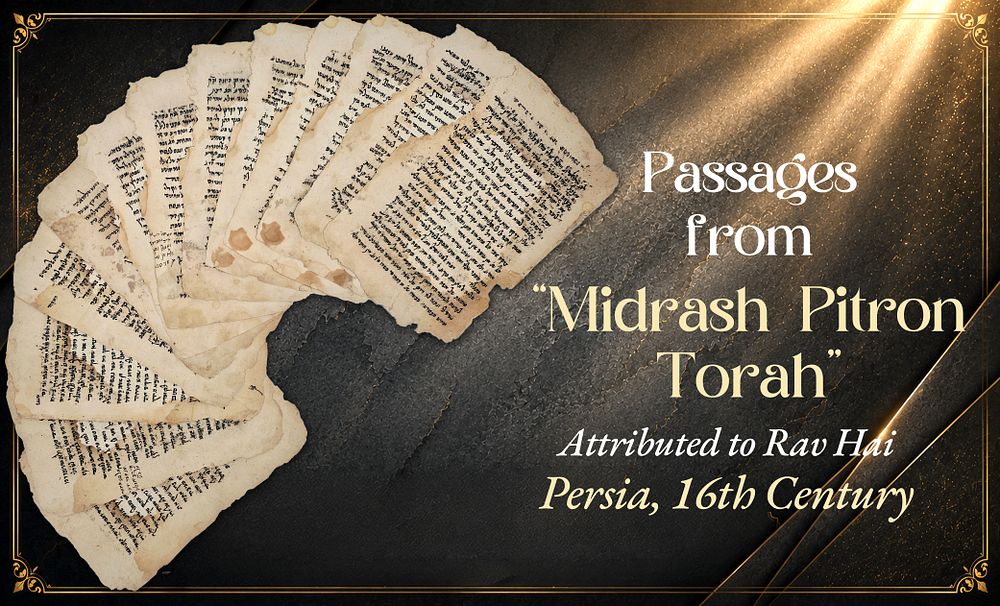
Manuscript – Passages from “Midrash Pitron Torah, ” Attributed to Rav Hai – Persia, 16th Century - Early Manuscript Containing Passages from “Midrash Pitron Torah” – A Collection of Midrashim on the Torah Attributed to Rav Hai. Persia, 16th Century “Midrash Pitron Torah” is an anthology of Midrashim on the Five Books of the Torah, apparently compiled in Babylonia during the Geonic period. The identity of its author is uncertain; various scholarly hypotheses attribute it either to Rav Hai ben Nachshon or to Rav Hai Gaon. The present manuscript contains incomplete passages relating to the Torah portions of Acharei Mot, Emor, Behar, Beha’alotcha, and Shelach Lecha, including Midrashim and introductory liturgical poems characteristic of the work. A particularly distinctive feature of “Midrash Pitron Torah” is the poem appearing at the beginning of each Torah portion. These poems are divided into four-line stanzas, each concluding with a biblical verse connected to its subject. The verse concluding the final stanza is the opening verse of the Torah portion under discussion. The poems generally praise the Creator and address the reward of the righteous, the punishment of the wicked, the history of the Jewish people, and the observance of the commandments. In their concluding stanzas, the poet transitions from the general theme to the specific subject matter of the weekly Torah portion. Unusually for early Hebrew liturgical poetry, the passages concerning the weekly portion rely very little on rabbinic Midrash and are based primarily on the plain meaning of the biblical verses. The acrostics of the poems are also of particular interest. Each poem follows the order of the Hebrew alphabet, generally with the letters shin and tav repeated, after which the name “Hai” appears. This feature served as the basis for attributing the poems and the work itself to Rav Hai. Following the introductory poem, the compiler presents a collection of rabbinic homilies on the Torah portion, generally quoting them in their original wording. These rabbinic passages constitute the greater part of the Midrash. The compiler did not usually identify his sources, employing different texts in each section according to his needs. His sources are diverse and include the Mishnah, Tosefta, Babylonian and Jerusalem Talmuds, Tannaitic halachic Midrashim, Amoraic aggadic Midrashim, and later Midrashic works. The latest source cited in the work is the She’iltot of Rav Achai of Shabcha. The compiler also had access to early Midrashim that have since been lost and whose contents have survived solely through their inclusion in this work. In 1977, Yeshayahu Chassida published the booklet Reshuyot Rav Hai Gaon, containing the introductory poems to the Torah portions from the manuscript of the Midrash. In 1978, Prof. E. E. Urbach published a complete critical edition of Pitron Torah, accompanied by an introduction and notes. In 1985, Prof. Malachi Beit-Arié published a facsimile edition of the manuscript with an introduction. The work was subsequently published in an annotated edition by Machon Zichron Aharon. The present manuscript was compared with the Zichron Aharon edition and found to correspond to the text of “Midrash Pitron Torah.” [17] leaves. Approximately 15–20 cm. Condition: Fair. Stains and wear. The first ten leaves have defects and tears along the margins, with no loss of text. Unbound.