Bidspirit auction | Hebrew Calendar for the Year
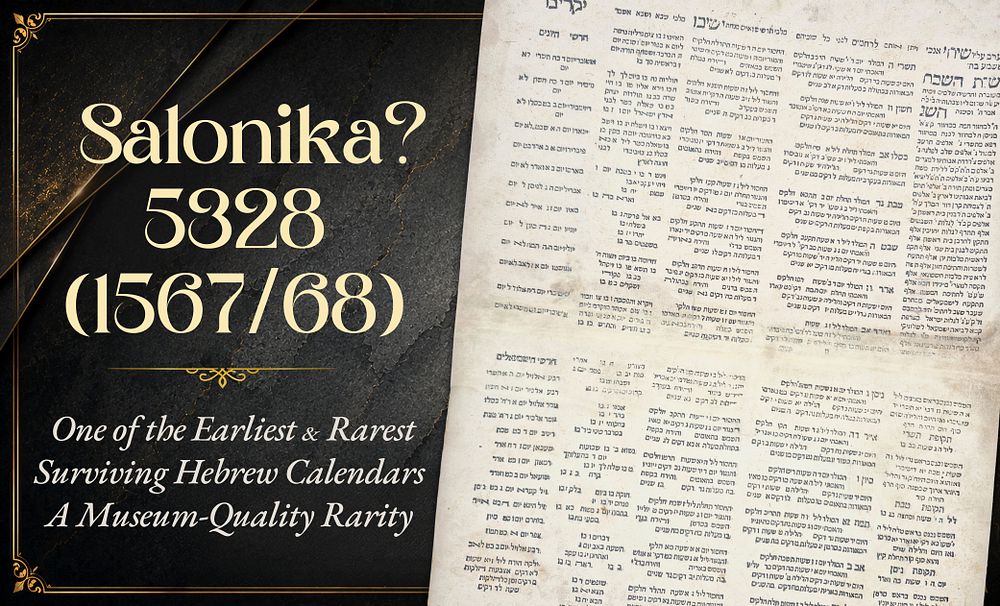
Hebrew Calendar for the Year 5328 (1567/68). Salonika [?] – One of the Earliest and Rarest Surviving Hebrew Calendars. A Museum-Quality Rarity - Hebrew Calendar for the Year 5328 (1567/68) – Salonika [?]. One of the Earliest and Rarest Surviving Hebrew Calendars. A Museum-Quality Rarity. A printed Hebrew calendar for the year 5328 (1567/68), apparently printed in Salonika (possibly Constantinople). One of the earliest surviving Hebrew calendars known, and an item of extraordinary rarity. The calendar is printed in five columns. The leftmost column includes the names of the Greek and Islamic months, reflecting its use in a multicultural environment where synchronization between the various calendar systems was essential. At the head of the sheet appear several biblical verses of blessing, with highlighted letters forming the chronogram for the year 5328. The calendar includes the molados (new moon calculations), tekufos (seasonal calculations), the annual schedule of Torah readings, together with additional astronomical and halachic information required throughout the year. The right-hand column contains a fascinating chronological list of major historical events, calculated retrospectively from the year 5328, beginning with the Flood, Jacob's descent to Egypt, and the birth of Moshe Rabbeinu, continuing through later events including the Expulsion from Spain and the Expulsion from Portugal. It also records the corresponding years according to both the Christian and Islamic calendars. Judging by its format and dimensions, the calendar was intended to be displayed in a synagogue, where it would serve the community throughout the year. Hebrew calendars printed during the sixteenth century rank among the rarest survivals of early Hebrew printing. Produced in very small numbers and intended for use during a single year only, they generally lost their practical value once the year had passed, and almost all were discarded. As a result, only a handful have survived, and in many cases only a single copy is known. The present calendar is recorded in Yisrael Mehlman's Genuzos Sefarim (Jerusalem, 1976), with supplementary notes by Avraham Yaari (p. 107, no. 3), where it was tentatively attributed to the Yaabetz Press, possibly in Constantinople or Salonika. It was later catalogued in the Hebrew Bibliography Project and the National Library of Israel as a Salonika imprint. All previous scholarship relied upon the only copy then known. It is therefore possible that only two copies of this remarkable calendar survive today: the imperfect example preserved in the National Library of Israel, and the present copy. Other Hebrew calendars of this period are likewise frequently known from a single surviving example (see Ginzei Yisrael, Sale 1817), underscoring the exceptional rarity of such ephemeral prints. Single printed leaf. 39.5 × 29 cm. Condition: Professionally conserved. Approximately 10% of the text has been restored by high-quality facsimile infill. Age stains. Overall good condition.