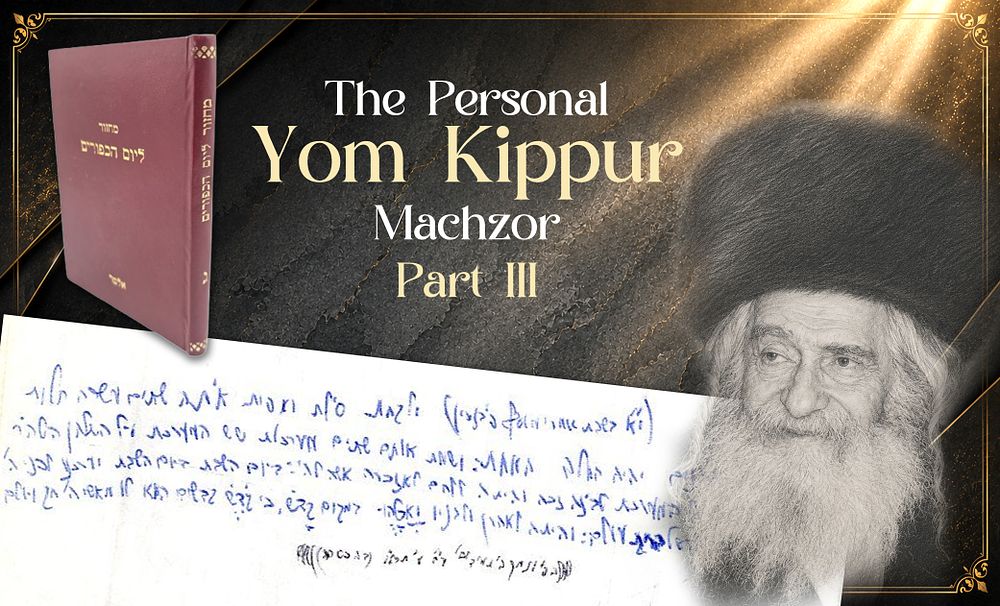
Bidspirit auction | The Personal Yom Kippur Machzor
The Personal Yom Kippur Machzor of the Gerrer Rebbe, the “Pnei Menachem, ” Used by Him in His Divine Service on the Holiest Day, with Additions in His Holy Handwriting – Part III - The Personal Yom Kippur Machzor of the Gerrer Rebbe, the “Pnei Menachem, ” Used by Him in His Divine Service on the Holiest Day, with Additions in His Holy Handwriting Machzor for Yom Kippur – Machzor Kol Bo HaShalem, with commentary by the sages of Ashkenaz, Nusach Sefard. Jerusalem, 1981. Before us is one of the most personal and moving sacred objects from the spiritual world of the Gerrer Rebbe, the “Pnei Menachem.” The complete Machzor comprised approximately one thousand pages. The Rebbe divided it into four separate volumes in order to facilitate its use during the lengthy Yom Kippur prayers. On the binding of each volume his name was embossed: “Machzor LeYom HaKippurim – Alter, ” indicating that the set was specially bound for his personal use. The present volume contains the Torah reading and Mussaf service for Yom Kippur. On the rear flyleaf of this volume appears an ownership inscription in the Rebbe’s holy handwriting: “With Hashem’s help, in His abundant goodness and kindness, Hashem has favored me, ” followed by his signature: “Pinchas Menachem Alter, of the holy city of Jerusalem, may it be rebuilt and established speedily in our days.” He further wrote: “I received [this], with Hashem’s help, from my son R. Y.D., shlita, ” alongside an additional handwritten line which we have been unable to decipher. The Rebbe’s Personal Resolutions for His Yom Kippur Avodah The principal distinction of this Machzor lies in the remarkable list of spiritual principles that the Rebbe wrote for himself, so that they would remain before his eyes throughout his service on the holiest day: “With Hashem’s help, to endeavor to pray, recite blessings, study, and do everything for the sake of Heaven and to bring satisfaction to Hashem – and to be ashamed before Him.” On the penultimate leaf, the Rebbe inscribed the sacred Divine Names “Havayah” and “Ehyeh” in his own holy handwriting – a brief inscription bearing inner significance according to Kabbalistic tradition. Beneath the Divine Names, the Rebbe once again wrote the resolutions appearing at the beginning of the volume: “With Hashem’s help, to endeavor to pray, recite blessings, study, and do everything for the sake of Heaven and to bring satisfaction to Hashem – and to be ashamed before Him.” He then listed seven concise and fundamental principles in his own holy handwriting, reflecting his innermost spiritual world: 1) Hashem has greater compassion upon me than anyone who could have compassion upon me, and He protects me even when I do not protect myself. 2) All good that comes from anyone is entirely from Hashem; they are all His emissaries. 3) All goodness is bestowed through Hashem’s kindness, and not because we are deserving. 4) Hashem knows whether our trust in Him is complete, and nothing can be concealed from Him. 5) Nothing can be added to or subtracted from Hashem’s decree, except through prayer to Him. 6) To endeavor to fulfill the teaching of Chazal: “Make your will like His will, ” etc. 7) To rejoice and thank Hashem that He did not make me a non-Jew. These are not merely scholarly annotations, but a personal program of spiritual conduct written by the Rebbe for himself, intended to accompany him throughout every stage of his Yom Kippur avodah. The inscriptions open a rare window into the inner world of one of the great Jewish leaders of the previous generation and reveal the fundamental principles upon which he sought to reflect repeatedly during the most exalted hours of the holy day. The Passage of the Showbread – Handwritten by the Rebbe On the rear flyleaf, the Rebbe wrote a lengthy five-line inscription in his holy handwriting, beginning with the words: “There are those who say, on Shabbat after Mussaf…” He then copied out in his own hand the verses of the passage concerning the Lechem HaPanim [Showbread], customarily recited when Yom Kippur falls on Shabbat, even adding vowel points to portions of the text. The very fact that the Rebbe copied these verses in full, rather than merely noting a reminder to recite them, indicates that he wished his personal Machzor to contain everything required for his avodah, precisely in accordance with his own practice. In this manner, he transformed the printed prayer book into a personal book of Divine service, fashioned according to his own spiritual path. In Kabbalistic literature, the Lechem HaPanim is regarded as a source of the Divine abundance that flows into the world, and many were therefore meticulous to recite the passage of the Lechem HaPanim on Shabbat. What greater segulah could there be than to recite these verses directly from the holy handwriting of the Rebbe himself?! Before us, therefore,