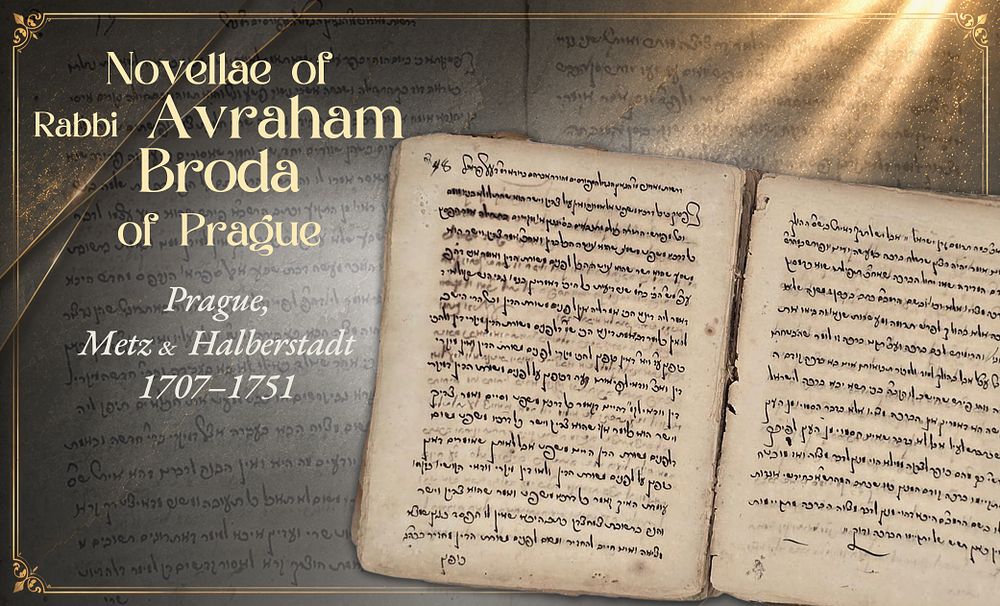
Bidspirit auction | Important Manuscript – Novellae of
Important Manuscript – Novellae of Rabbi Avraham Broda of Prague, One of the Foremost Roshei Yeshiva – Additional Novellae from the Rabbis of Halberstadt – Prague, Metz and Halberstadt, 1707–1751 - An important manuscript comprising over [200] handwritten pages, written by several different scribes and containing Torah sermons, Talmudic novellae, sermons for special Sabbaths, siyum discourses and additional Torah teachings by leading Ashkenazic scholars. The contents of the manuscript fall into three distinct groups: I. Novellae of Rabbi Avraham Broda – Prague–Metz, 1707–1709 Approximately [130] pages, written by students. The majority is in a single hand, with additional leaves written in two other hands. Rabbi Avraham Broda was one of the most renowned Torah giants of Ashkenaz some three centuries ago. He served as Av Beit Din of Prague, Metz and Frankfurt, and wherever he served he established great yeshivot in which thousands of students studied. He was held in such extraordinary esteem that already during his lifetime he was accorded the exceptional title “Rabban Shel Kol Bnei HaGolah” – “Teacher of All the Exiles.” Indeed, many of his disciples went on to become communal rabbis, Roshei Yeshiva, Talmudic commentators and leading halachic authorities whose works became pillars of Torah scholarship. Before us is a remarkable surviving record of the Torah teachings of Rabbi Avraham Broda of Prague, preserved in the handwriting of students of his yeshiva. Three passages bear the dates 1707, 1708 and 1709, when the yeshiva was still located in Prague. At the end of 1709, the yeshiva relocated to Metz, a fact explicitly reflected in the heading of another discourse by Rabbi Avraham: “Av Beit Din and Rosh Metivta of the holy community of Prague, presently in the holy community of Metz.” On leaf [59]b the writer records: “All of this was expounded by my master and teacher, the Gaon, on Shabbat Shuvah 5467 [1707]. Up to this point permission was given to copy, for in the midst of these words the time for the Minchah prayer arrived, and he was compelled to cease expounding further on this subject; and that which he did not expound publicly in the synagogue was not permitted to be copied for his yeshiva. Understand this well.” On leaf 74b appears an inscription/signature: “The humble Avraham, son of my father, the distinguished R. Eliezer of the holy community of Olkusz in Lesser Poland, studying … in the holy community of Prague in the winter of 5468 [1708], in the yeshiva of the great Gaon, Rabban Shel Bnei HaGolah, Rosh Metivta, Moreinu HaRav Rabbi Avraham Broda, may his Rock and Redeemer protect him.” One passage records a novella in the name of Rabbi Avraham Broda’s father-in-law, the Gaon Rabbi Eliezer Lipman Graetz, Av Beit Din of Bumsla. II. Novellae of Rabbi Meir Barby, Av Beit Din of Halberstadt – 1741 More than [20] pages, written by students. Rabbi Meir Barby served as rabbi of Halberstadt from 1738 until 1763. He subsequently moved to Pressburg, where he taught thousands of students until his passing in 1789. Among his distinguished disciples were Maharam Banet and Rabbi Daniel Prostitz. Before us is an exceptionally early record of his Torah teachings, dating only four years after he began serving as rabbi of Halberstadt, when he was approximately twenty-six years old. Some of the sermon headings explicitly mention Maharam Barby by name. Others identify the speaker only as “Av Beit Din of the holy community of Halberstadt.” It is therefore possible that some of these teachings are instead by Rabbi Tzvi Hirsch Biala, known as “Rabbi Tzvi Hirsch Charif, ” Av Beit Din of Halberstadt and one of the foremost Roshei Yeshiva of his generation, who passed away in 1748. Among his disciples were Maharam Barby, the first Rabbi Akiva Eiger – grandfather of the celebrated Rabbi Akiva Eiger – Rabbi Yeshayah Pick-Berlin, and others. III. Novellae of Rabbi Shmuel, Son of the Chaver Rabbi Tzvi Hirsch Katz of Halberstadt – 1725–1751 More than [40] pages in the author’s own handwriting, bearing five of his signatures in various places. He may have been a disciple of Rabbi Avraham Broda. In one passage he mentions the wedding of his niece, daughter of his brother-in-law Rabbi Wolf; elsewhere he delivers a eulogy for Rabbi Wolf, who passed away in 1751. The latter two sections – the novellae of Maharam Barby and those of Rabbi Shmuel of Halberstadt – were written intermittently throughout the manuscript: a leaf in Rabbi Shmuel’s hand is followed by a Chiluka DeRabbanan of Rabbi Meir, then again by Rabbi Shmuel’s handwriting, and so forth. The two groups can be distinguished both by the headings of the discourses and by Rabbi Shmuel’s distinctive and readily identifiable handwriting. The Torah novellae contained in this manuscript require thorough scholarly examination in order to determine whether any have previously appeared in print. Over [200] handwritten pages, by several different writers.