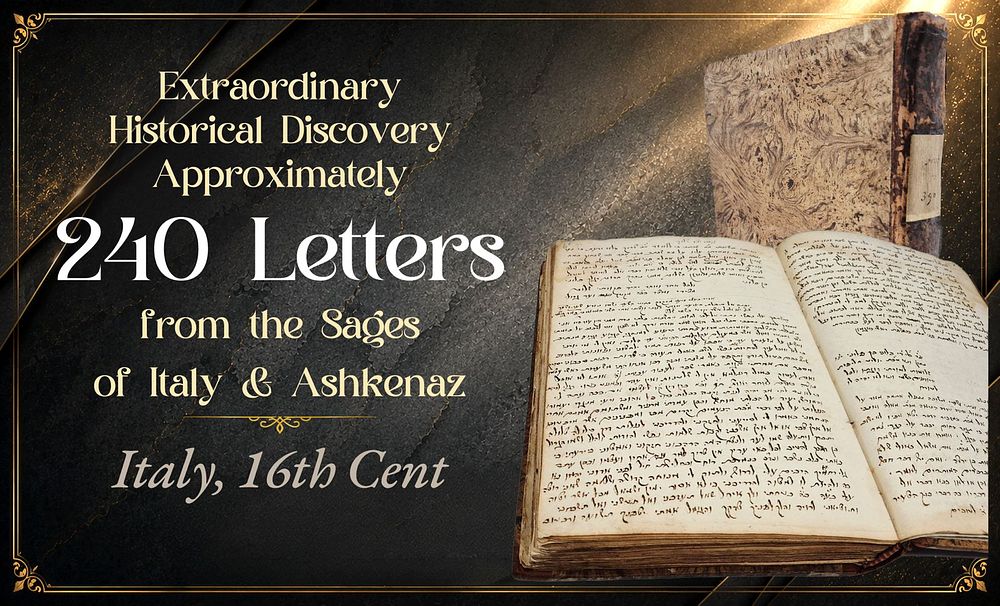
Bidspirit auction | Historic Discovery – Manuscript Containing
Historic Discovery – Manuscript Containing Approximately 240 Letters by Sages of Italy and Ashkenaz – A Rare Healing Segulah Transmitted by the Kabbalist Rabbi Israel Sarug;, the Rema MiPano, the Maharal of Prague, Author of Shefa Tal, Maharashik – Italy, 16th – Centuries. - An extensive manuscript of exceptional importance, containing approximately 240 letters and epistles. All the letters in the manuscript were written between the years שכ”ה - שס”א [1565–1601], spanning a period of approximately thirty-six years. The letters were collected and written by Rabbi Gershom Katz, son of Rabbi Kalonymus of Asola, who served as a dayan in the Padua community from שמ”ה [1585]. The manuscript constitutes a treasure trove of primary sources for the history of Italian Jewry in the 16th century, containing extensive documentation concerning the rabbinate and communal leadership, controversies and excommunications, Halachah and Kabbalah, family relationships, as well as correspondence with some of the leading rabbis and kabbalists of the generation. Among the leading rabbis and kabbalists to whom the letters are addressed are: the eminent kabbalist Rabbi Israel Sarug [five letters addressed to him]; the eminent kabbalist Rabbi Menachem Azariah of Fano – Rema Mi-Pano [one letter addressed to him]; the kabbalist Rabbi Shabtai Sheftel, son of Rabbi Akiva HaLevi Horowitz of Prague, author of “Shefa Tal” – Hanau, שע”ב [one letter addressed to him and one letter from him]; Rabbi Shmuel Yehuda Katzenellenbogen – Maharashik, Chief Rabbi of Venice [several letters from him and to him]; Rabbi Shmuel Archivolti, one of the leading sages of Italy and Rabbi of Padua, author of “Arugat HaBosem” – Venice, שס”ב [thirteen letters from him and three letters addressed to him]; Rabbi Yehuda Leib Saraval, Rabbi of Venice; Rabbi Natan Ottolenghi, one of the rabbis of Venice; Rabbi Avigdor Cividal, one of the rabbis of Venice; Rabbi Ben-Zion Sarfati, dayan in Venice; Rabbi Yaakov Reiner, one of the prominent rabbis of Mantua [several letters from him and to him]; Rabbi Baruch ben Baruch; Rabbi Mordechai Bassan, Rabbi of Verona [several letters from him and to him]; Rabbi Leib Schwab; Rabbi Yehuda Luzzatto, Rabbi in Venice; Rabbi Yaakov Halperin, author of “Nachalat Yaakov” [Padua, שפ”ג (1623)]; and others. In addition, one of the letters mentions Rabbeinu Yehuda Loew – the Maharal of Prague, during his lifetime, in the context of a request to obtain his approbation for a book of responsa (Shu”t). The Katz Family Letters – A 16th-Century Family Correspondence The first part of the manuscript contains numerous family letters. The central figures in this section are the head of the family, Rabbi Kalonymus Katz, and his sons – Rabbi Gershom Katz, the writer and editor of the present collection of letters, who settled in Padua in שמ”א [1581]. Upon his arrival in the city, he served the community in several religious capacities – as shaliach tzibbur, scribe, and shochet u-bodek. In שמ”ה [1585], upon the retirement of Rabbi Shmuel Archivolti from his position as dayan, Rabbi Gershom Katz was appointed dayan in his place. Other letters consist of correspondence between members of the family, including Rabbi Gershom Katz’s brothers, brothers-in-law, and relatives by marriage, among them some of the leading rabbis of Italy in their generation: Rabbi Shmuel Yehuda Katzenellenbogen – Maharashik, Chief Rabbi of Venice; Rabbi Mordechai Bassan, Rabbi of Verona; and Rabbi Shmuel Archivolti, Rabbi of Padua. Alongside the family correspondence, the manuscript gradually expands into a rich record of the rabbinic and communal world surrounding the Katz family and of their extensive network of connections with the leading sages of Italy and Ashkenaz. The Venice Get Controversy – The Tamari–Venturozzo Affair Several of the early letters relate to the “Venice Get Controversy”—the Tamari–Venturozzo Affair, one of the most turbulent halachic disputes in the history of 16th-century Italian Jewry. The affair began in ש”כ [1560 ], with the betrothal of Shmuel Venturozzo to Tamar, daughter of the Venetian physician Rabbi Yosef Tamari. After a bitter dispute arose between Venturozzo and his betrothed’s father, Venturozzo left Venice. Several years later, Tamari approached the leading Italian rabbi, Rabbi Meir Katzenellenbogen—the Maharam of Padua. On the 4th of Adar שכ”ד, the Maharam ruled that Venturozzo must either marry his betrothed or divorce her within one month. After a lengthy series of events, Venturozzo returned to Venice and delivered a get. He subsequently claimed, however, that the get had been given against his will and that he had previously issued a moda’ah declaring it invalid. This led to a major controversy concerning the validity of the divorce. The rabbis of Venice upheld the validity of the get, sided with the Tamari camp, and placed Venturozzo under excommunication. On the opposing side stood Rabbi Moshe Provenzalo,