Bidspirit auction | “Sefer Tikkun HaShovavim VeHu Tikkun
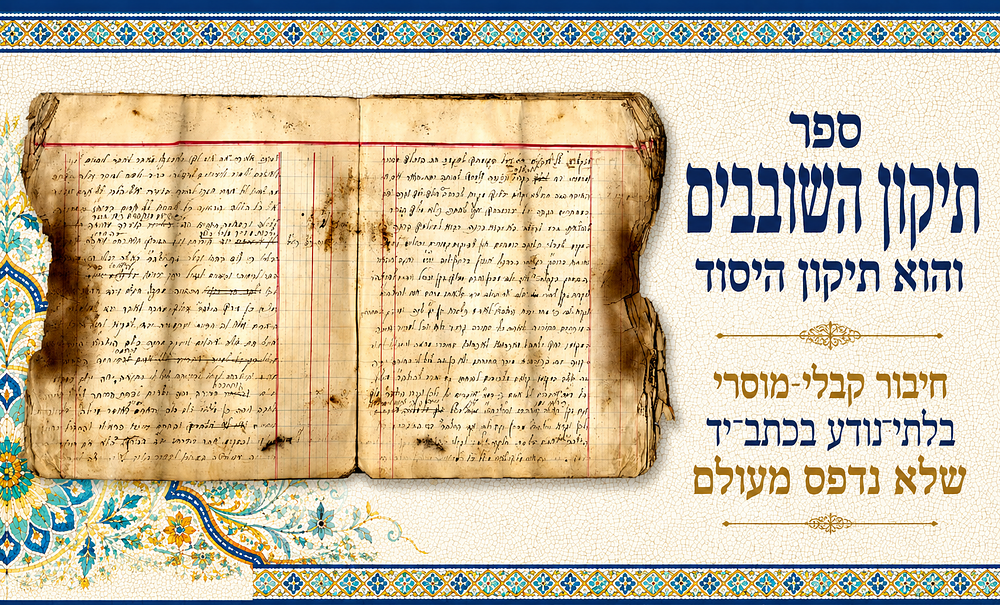
“Sefer Tikkun HaShovavim VeHu Tikkun HaYesod” — An Unpublished and Previously Unknown Kabbalistic-Ethical Manuscript - An original and extensive manuscript devoted to the rectification of Pegam HaBris and the spiritual practices associated with the Shovavim period, authored by an otherwise unknown kabbalist from Safed who later resided in Warsaw. To the best of our knowledge, the work was never printed and remained preserved solely in manuscript form. Safed–Warsaw, circa 5600 [1840]. At the beginning of the work appears the author's title page, bearing the following introduction: “Sefer Tikkun HaShovavim VeHu Tikkun HaYesod… small in quantity yet great in quality, which I have compiled from the writings of the Kabbalists and from numerous works of ethical instruction and spiritual rectification for the Shovavim period, whereby every God-fearing individual may repair that which he has corrupted through sin. I have also prefaced it with words of admonition, to teach the people knowledge of the paths of repentance concerning this transgression…” This is followed by a lengthy introduction, at the conclusion of which the author identifies himself: “The humble Avraham Menachem, son of Rabbi Yaakov David, a native of Safed, and presently residing here in Warsaw.” The section entitled “Introduction of the Author” spans many pages and contains ethical teachings, kabbalistic concepts, and discussions of repentance. Embedded within it is an acrostic of the author’s name. Particularly striking is the opening of the introduction, where the author describes a remarkable vision in which his revered teacher appeared to him: “And as the sun was setting, a deep sleep fell upon me, and behold, a great darkness and awe came upon me. Then there appeared to me my holy and pure master and teacher, the sacred luminary, the righteous Rabbi Ze’ev Wolf, son of the holy and pure Rabbi Yaakov Dov Ber, of blessed memory...” According to the author, this spiritual revelation served as the catalyst for the composition of the work. Following the introduction are discourses and spiritual rectifications on the Shovavim Torah portions—Shemos, Va’eira, Bo, Beshalach, Yisro, and Mishpatim—combining ethical instruction, penitential practices, kabbalistic teachings, and methods for the rectification of the covenant. To the best of our knowledge, this manuscript was never published, and the author himself is unknown in the standard bibliographic literature. We thus have before us a previously unknown kabbalistic work that remained hidden for generations and never reached print. The author's teacher, however, is far better known. He was the saintly Rabbi Ze’ev Wolf, son of Rabbi Yaakov Dov Ber, one of the revered righteous figures of Safed and the son of the famed Rabbi Yaakov Dov Ber, among the distinguished Chassidim associated with the House of Ruzhin. Rabbi Ze’ev Wolf occupied a prominent place among the Chassidic circles of Safed, and a surviving letter from the holy Rebbe of Ruzhin is addressed to him, referring to his father as: “My friend, the renowned Chassidic rabbi, sharp and erudite, the distinguished scholar Rabbi Yaakov Dov Berish, may his light shine, Av Beis Din of the holy community of Ramin.” The author's identification of Rabbi Ze’ev Wolf as his master and the central role accorded to his revelation lend the manuscript particular significance for the study of nineteenth-century Chassidism and Kabbalah in the Land of Israel. (See also: Winners Judaica Auction Catalogue, Nissan 5774, Lot 199.) Before us is an unknown Chassidic-Kabbalistic composition devoted to one of the central themes of ethical and mystical literature—Tikkun HaYesod and the Shovavim rectifications—combining ethical teachings, Kabbalah, penitential guidance, personal revelations, and traditions preserved among the kabbalists and Chassidim of the Holy Land and Poland. Description Autograph manuscript in a lined notebook. [104] pages. Entirely handwritten by the author. Condition: Fair. Signs of use, staining, and marginal wear. Several leaves at the end of the notebook are adhered together and have not been opened. Several final leaves of the manuscript are lacking. An unpublished manuscript of considerable Torah, Kabbalistic, and historical significance.