Bidspirit auction | “Behind the Curtain” — An
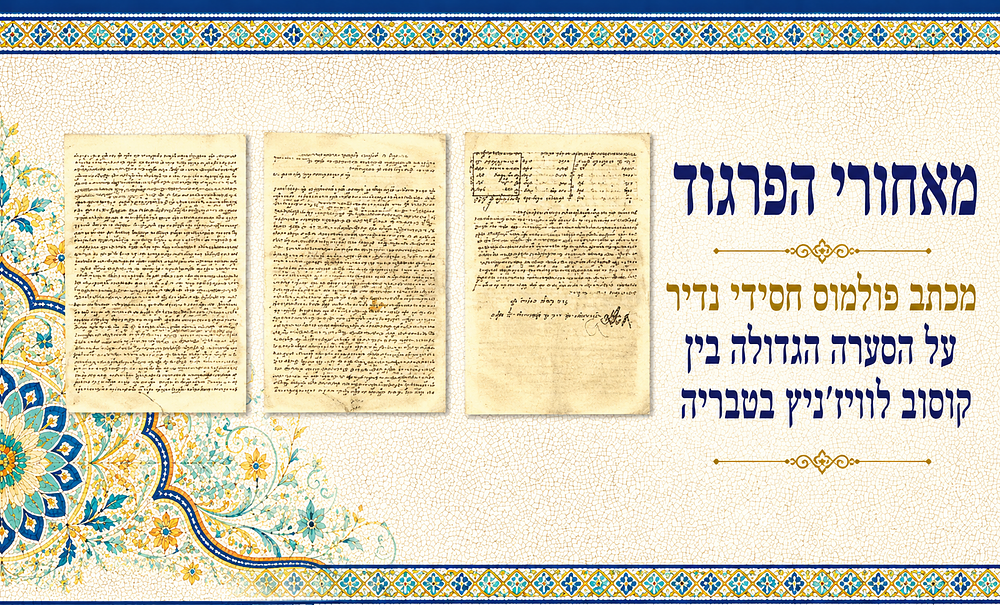
“Behind the Curtain” — An Exceptionally Rare Chassidic Polemical Letter Concerning the Great Kosov–Vizhnitz Controversy in Tiberias - “I had heard that the son of the holy Rabbi of Kosov, of blessed memory, who now occupies his father's seat, is greatly fond of the natural sciences... And I saw indeed that it was so, that the Rabbi loves all precious things, making no distinction between young man and maiden, between girl and woman, between servant and noble lady—save only for matters outside the realm of nature. Yet those who surround him and watch his every step mislead him and make merchandise of him. At their head stands that hypocritical scoundrel and denier of all, Yechiel Bunimus. He greatly deceives and persuades the elderly Rebbetzin to take him into her home and treat him as a son and trusted adviser, telling her that he can elevate the Rabbi’s stature and make him renowned among the greatest leaders... Thus a spirit of falsehood has entered the mouths of all the followers of his saintly father, claiming that his father speaks to him in dreams...” An extraordinary, exceptionally rare, and historically important polemical letter relating to one of the fiercest controversies to shake the Chassidic settlement of Tiberias during the 1880s—the prolonged conflict between the followers of Kosov and those of Vizhnitz. This extensive manuscript spans three large, densely written pages and contains a wealth of invaluable historical information, including names, descriptions, testimonies, and firsthand accounts recorded in real time by one of the individuals directly involved in the affair. The author is R. Ze’ev Wolf Beck, grandson of the holy Rabbi Ze’ev Wolf of Tsherni-Ostroh, after whom he was named. The letter bears his full signature and is not concealed behind a pseudonym or anonymous authorship, as was common in much of the polemical literature of the period. The unique value of this document lies in the fact that it presents the controversy not through printed broadsides or traditions preserved by later generations, but through a vivid and personal contemporary account written in the midst of the events themselves. Throughout the letter, the author recounts various episodes connected with the struggle between the rival factions, describing leading personalities, administrators, communal activists, rebbes, and Chassidim, while painting a fascinating picture of life within the Chassidic courts of both the Holy Land and Eastern Europe during the late nineteenth century. Between its lines are revealed numerous details concerning internal communal affairs, the balance of power between the various courts, and the factional struggles that occupied the Chassidic community of Tiberias during those years. From a historical perspective, the importance of the letter is immense. Very little of the Chassidic polemical literature of the 1880s has survived. Most of the correspondence generated during these bitter public disputes has long since disappeared, and what remains today consists primarily of a handful of printed polemical pamphlets, themselves exceedingly rare. Here we have a primary, firsthand source that was never intended for publication but rather for private correspondence, making it of exceptional value for historical research. The letter is filled with explicit references to rabbis, rebbes, communal officials, activists, and lay leaders of the period. Precisely this abundance of names, details, and concrete references lends the document exceptional historical weight, transforming it into a virtual “snapshot” of the Chassidic world of Tiberias during one of the most dramatic crises in its history. Beyond its historical significance, the document is also a fascinating literary artifact. Its style reflects the vivid, sharp, and colorful language characteristic of polemical writings in Eastern Europe and the Holy Land during the late nineteenth century—a rich, dramatic, and highly engaging prose that draws the reader directly into the heart of the conflict. Before us is one of those rare documents capable of illuminating an entire chapter in the history of Chassidism in the Land of Israel. Not a retrospective account composed decades later, but an authentic voice emerging from the storm itself—a living testimony from the years in which the balance of power among the Chassidic courts of Tiberias was being shaped and dramatic chapters in the history of the Old Yishuv were being written. An exceptionally rare Chassidic-historical document of the highest importance for the study of Chassidism, the struggles between the kollelim, and the public controversies of nineteenth-century Palestine. Description [3] large manuscript pages. 33 × 21 cm each. Dense manuscript text. Full signature of R. Ze’ev Wolf Beck. Condition: Very good. Age stains. Fold marks. Several tiny marginal tears, without any loss of text.