Bidspirit auction | “As Though the Earth Had
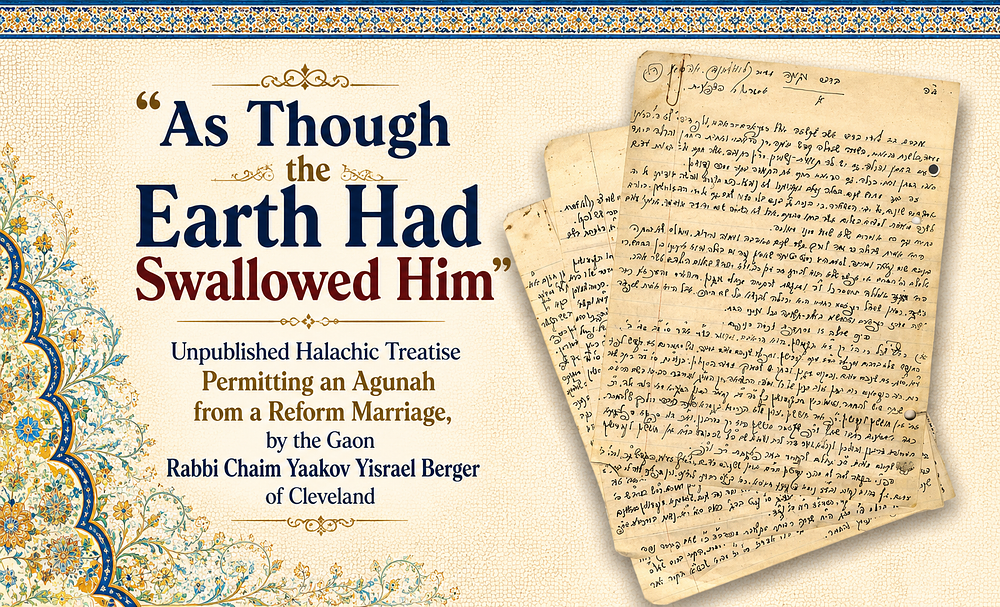
“As Though the Earth Had Swallowed Him” — Unpublished Halachic Treatise Permitting an Agunah from a Reform Marriage, by the Gaon Rabbi Chaim Yaakov Yisrael Berger of Cleveland - “As Though the Earth Had Swallowed Him” — A Halachic Permit for an Agunah from a Reform Marriage by the Gaon Rabbi Chaim Yaakov Yisrael Berger, Rabbi of Cleveland — Complete Unpublished Treatise An important and comprehensive halachic treatise dealing with one of the gravest and most complex questions in all of Jewish law — the release of an agunah, a matter traditionally entrusted only to the foremost halachic authorities of each generation. From the era of the Rishonim until modern times, the greatest Torah scholars grappled with such cases, for tragically, in every generation circumstances of this kind arose, and no two cases were ever identical in their particulars or legal complexity. In the overwhelming majority of instances, even after a leading posek had reached a ruling permitting the woman to remarry, the matter would commonly be referred to additional Torah authorities for their agreement before the woman would be allowed to remarry. The immense caution with which the sages approached these questions stemmed from the severe fear of mamzerut — a tragic status described by the Sages as “a wrong that cannot be corrected.” For should the missing husband later reappear alive after the woman had remarried and borne children from her second marriage, those children and their descendants for generations would bear the irreversible stigma of illegitimacy and be forbidden to marry into the Jewish people. This important manuscript addresses precisely such a grave and sensitive case. The entire treatise is written in the autograph hand of the renowned gaon Rabbi Chaim Yaakov Yisrael Berger, rabbi of Cleveland and one of the foremost halachic authorities in America in his generation. The manuscript extends over six large pages in dense scholarly handwriting and has never been printed. The case discussed concerns a woman who entered into a Reform marriage in the United States. After approximately ten years of marriage, her husband disappeared under mysterious circumstances, and despite extensive efforts by the authorities, the police, and members of his own family, no trace of him could be found — “as though the earth had swallowed him.” The woman, who remained an agunah for many years, wished to remarry, yet according to Jewish law she could not do so without receiving a get from her missing husband. Herein lay the central halachic issue: since the marriage had been conducted within a Reform framework, did the marriage possess any halachic validity at all according to Orthodox Jewish law? If the marriage lacked valid halachic standing, it was possible that the woman had never attained the status of a married woman in the first place, and consequently would not require a get at all. This aspect grants the present manuscript exceptional significance. While the responsa literature concerning agunah cases spans many centuries, the question of the halachic validity of Reform marriages was an entirely new phenomenon, never discussed by the earlier authorities and scarcely addressed by most later authorities, since Reform marriage ceremonies themselves did not exist in previous generations. Before us is therefore one of the early halachic confrontations with an entirely modern Jewish reality, one that became increasingly prevalent throughout the twentieth century. Rabbi Berger analyzes the matter at great length, demonstrating remarkable mastery of the laws of kiddushin, the qualifications of witnesses, the practices of Reform officiants, and the broader halachic validity of modern non-Orthodox marriage ceremonies. The manuscript is filled with profound halachic dialectics, extensive analysis, and numerous citations from earlier and later authorities. Following a lengthy and detailed discussion, the author reaches a practical ruling permitting the woman to remarry despite the absence of a get from her vanished husband. Even in this exceptionally grave matter, the author did not rely solely upon his own ruling. In accordance with the longstanding practice among the leading halachic authorities in agunah cases, he submitted the question for review to his mechutan, the gaon Rabbi Avraham Binyamin Silberberg, rabbi of Pittsburgh and author of the responsa Divrei Avraham. After extensive halachic analysis from every possible perspective, Rabbi Silberberg likewise concurred with the ruling permitting the woman to remarry. His responsum and formal approval of the היתר were later printed in Divrei Avraham, סימן מ”ב. The original and extensive treatise of Rabbi Chaim Yaakov Yisrael Berger presented here, however, has never been printed. Before us is a manuscript of considerable public, historical, and halachic importance,