Bidspirit auction | “The Portrait of My Life”
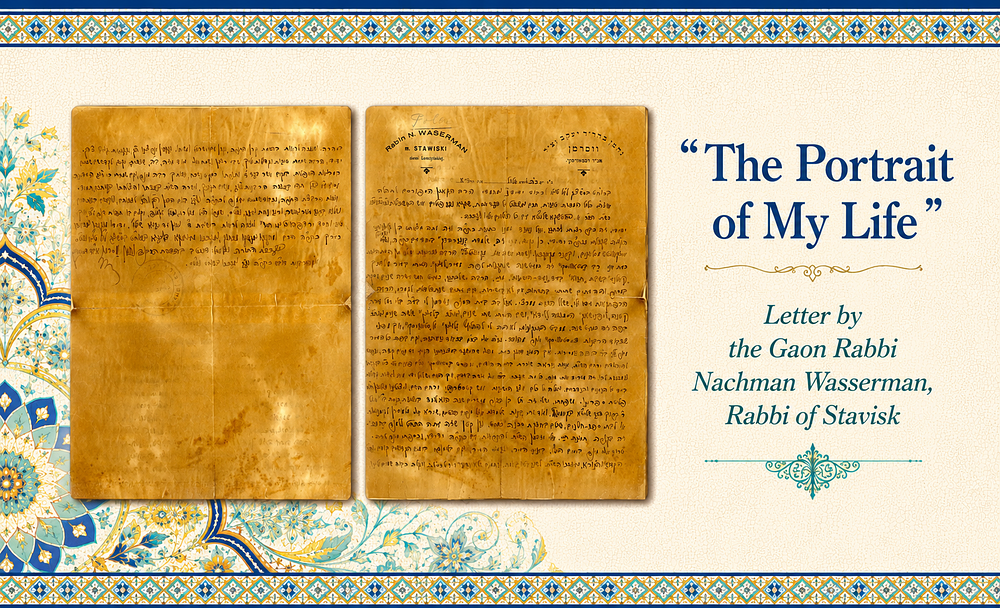
“The Portrait of My Life” – A Rare and Important Letter by the Gaon Rabbi Nachman Wasserman, Rabbi of Stavisk. - A Rare Autograph Letter by Rabbi Nachman Wasserman, One of the Leading Lithuanian Rabbis Before the Holocaust – Rich in Personal and Historical Content A rare and highly significant letter, entirely in the holy hand and bearing the signature of Rabbi Nachman Shmuel Wasserman, Rabbi of Lipnishok and later Stavisk, dated 25 Elul 5691 (1931). Letters by Rabbi Wasserman are exceedingly rare. Moreover, his extensive Torah writings were almost entirely lost during the Holocaust, making surviving autograph material of exceptional importance. The letter is addressed to his longtime friend and former study companion from the Novardok Yeshiva, Rabbi Eliyahu Botschko, whom he had not seen for decades. At the opening of the letter, Rabbi Wasserman nostalgically recalls their years together in yeshiva and mentions additional fellow students, including: “Shmuel Izkovitch of Slonim and Brenner of Koresin.” He proceeds to describe his family life in remarkable detail. He relates the births of his children over the years, mentions his eldest son who was then studying in the Kamenitz Yeshiva under Rabbi Boruch Ber Leibowitz, and speaks of his two unmarried daughters, whom he chose to educate privately at home. He expresses his deep concern about sending them to gymnasiums or secular schools, which he describes as: “all being almost certainly places of spiritual danger.” This rare and authentic document offers an unusually intimate glimpse into the life of a Lithuanian rabbi during the interwar period. In it, Rabbi Wasserman shares with his old friend the realities of his personal, familial, and spiritual world, transforming the letter into a valuable historical testimony regarding the yeshiva world and Jewish life in Eastern Europe on the eve of its destruction. The letter is written with striking candor—particularly unusual among the correspondence of leading Torah scholars, who generally refrained from discussing personal matters in detail. In retrospect, it may be viewed as an almost prophetic record of a life that would be brutally cut short only a few years later in one of the darkest chapters of human history. While the tragic circumstances of Rabbi Wasserman’s martyrdom have been documented and remembered, the story of his life before the Holocaust is revealed here in an exceptionally personal and revealing manner through this extraordinary correspondence with a cherished friend from his yeshiva years. [1] leaf, written on both sides, on official rabbinic stationery, entirely in his autograph hand, signed and stamped. Condition: Good. Age stains. Professionally restored tear along the central fold, without loss of text. Biography (Adapted from “Toratcha Lo Shachachti”) Rabbi Nachman Shmuel Wasserman Hy”d was among the foremost Lithuanian rabbis of the generation preceding the Holocaust. From childhood he was recognized as an exceptional prodigy. In his youth he studied in the yeshiva of Rabbi Boruch Ber Leibowitz in Slutsk and later in the famed Volozhin Yeshiva, where he came under the influence of Rabbi Raphael Shapiro and Rabbi Isser Zalman Meltzer. All three granted him rabbinic ordination and regarded him as one of the outstanding scholars of his generation. In 1910 he married Sarah, daughter of Rabbi Yeshaya Kushlevitz of Karelitz (mentioned in the present letter and signature). Following his marriage, he continued his Torah studies within the Novardok network of yeshivot, living a life of extraordinary dedication and self-sacrifice. During this period, he also established Torah frameworks for working youth. During the economic crisis of 1929—referred to in the letter—he demonstrated exceptional integrity. Even when creditors offered to forgive his debts, he insisted on repaying every obligation in full. As a result, his livelihood collapsed, and he accepted the burden of the rabbinate. He first served as Rabbi of Lipnishok, later of Lenin, and from 1933 as Rabbi of Stavisk. He became renowned as a gifted preacher; his eulogy for the Chafetz Chaim left a profound impression. His halachic rulings were respected not only by Jews but even by non-Jews who sought his judgment in disputes. His home was famously open to all, modeled after the tent of Abraham Avinu. He personally provided food, firewood, and medical assistance to dozens of needy families. Virtually all his possessions were distributed to charity, leaving him with almost nothing for himself. In his later years, he declined offers to serve larger and more prestigious communities—including opportunities in the United States—believing that he could exert greater influence over Jewish education and religious observance in a small town. When the Germans invaded in 1941, Rabbi Wasserman was in the study hall.