Bidspirit auction | “Have They Truly Forgotten Me?”
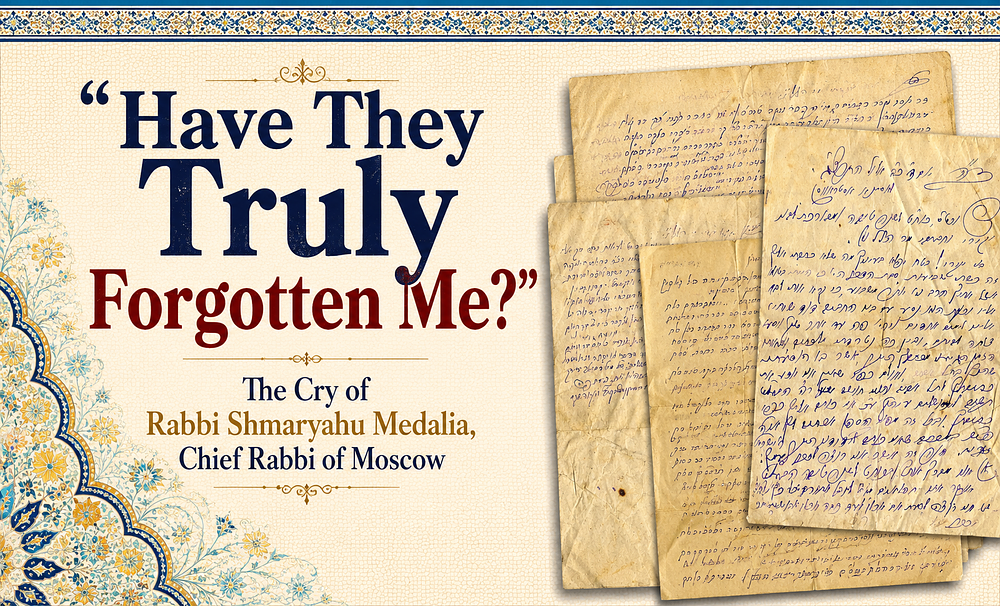
“Have They Truly Forgotten Me?” – A Rare and Apparently Unique Letter from Behind the Iron Curtain: The Cry of Rabbi Shmaryahu Medalia, Chief Rabbi of Moscow. - “The Lubavitcher Rebbe held Rabbi [Medalia] in exceptionally high esteem and would describe him, in Chassidic terminology, as: ‘Tiferes sheb’Tiferes’ (the pinnacle of splendor).” (Sefer Vitebsk) A remarkable four-page letter from the holy Gaon Rabbi Shmaryahu Yehuda Leib Medalia, Chief Rabbi of Moscow, together with his wife, the Rebbetzin, and his son, Rabbi Moshe Medalia, Rabbi of Rostov. Sent in 1933 to their son and brother Rabbi Hillel Medalia in Eretz Israel—later Chief Rabbi of Antwerp. Presented here is one of the most powerful and historically significant letters ever to emerge from Communist Russia beyond the Iron Curtain—and perhaps the most important of them all. It is the desperate cry of Rabbi Shmaryahu Yehuda Leib Medalia, one of the foremost rabbis of Russia, Chief Rabbi of Moscow and among the leading Chabad figures of his generation, pleading to be rescued from Soviet Russia. The letter was written despite the enormous danger involved, under the constant scrutiny of Soviet censorship. In retrospect, his silent cry remained unanswered. A few years later he was arrested by the Soviet secret police following a courageous sermon delivered at the conclusion of Yom Kippur and was executed by firing squad in the cellars of a Soviet prison. The letters were written in suffocating Moscow on the eve of the High Holidays of 1933. Beyond the “ordinary” details familiar from history books—here revealed through real names and personal experiences—they vividly describe the crushing realities of Jewish life under Soviet rule: families forced to share living quarters according to the arbitrary dictates of the authorities. Rabbi Shmaryahu reports that they had finally been rid of a “bad neighbor, ” only to have another family moved into their apartment by government decree. He asks that a letter written in Russian be forwarded to relatives in the Land of Israel, adding cryptically: “They are neighbors, and that should suffice for the wise...” The letter also reveals severe economic hardship. The distinguished rabbi finds himself compelled to ask his son abroad for financial assistance: “Since I arrived here, I have never lived in such poverty. May G-d have mercy.” Yet the true significance of the letter emerges only later—and it is almost unbearable to read. Rabbi Shmaryahu, Chief Rabbi of Moscow, and his son Rabbi Moshe, Chief Rabbi of Rostov, desperately appeal for assistance in escaping beyond the Iron Curtain. Because of Soviet censorship they cannot state their request openly, but the plea is unmistakable between the lines. The father writes: “We await with longing the arrival of the entry permits, and we are astonished that they have been delayed for so long. Have all my friends and acquaintances truly forgotten me and ceased making efforts on my behalf?” His son, Rabbi Moshe, adds: “I have a great request of you, my brother... Please also endeavor to obtain an entry permit for me. Until now I did not wish to burden you with additional work and trouble, but necessity leaves no choice. Please do everything possible in this matter.” It is clear that Rabbi Hillel—then still a young yeshiva student—understood the urgency of these words and undoubtedly did all he could to secure their rescue. Tragically, the longed-for permits never arrived. Both father and son would ultimately be murdered by the Soviet regime. Rabbi Shmaryahu was arrested after delivering a stirring sermon before thousands of worshippers in Moscow’s Great Synagogue on Yom Kippur, urging Jews to remain faithful to their religion and their people. He was executed by the Soviet secret police. His son Rabbi Moshe was arrested, exiled to Siberia, and later executed by the NKVD. May G-d avenge their pure blood. This is among the most moving and important surviving documents from the era of Jewish persecution under Communist rule—a rare first-hand testimony bearing within it the anguish, fear, and heroism of Soviet Jewry trapped behind the Iron Curtain. [4] pages. Approximately 25 cm per page. Condition: Good. Age stains and folds. Biography Rabbi Shmaryahu Yehuda Leib Medalia (1872–1938) served as Chief Rabbi of Moscow and was among the foremost Chabad leaders of his generation. Working closely with the Rebbe Rashab, he devoted himself to the welfare of Russian Jewry and the preservation of Jewish life under increasingly hostile conditions. As a young man he studied at the famed Slabodka Yeshiva, where he became known as “The Illui of Kartinga.” In 1890 he married Devorah, daughter of Rabbi Dovber Kresik of Karelitz. He later served as Rabbi of Vitebsk and acted as a trusted emissary of the Rebbe Rashab in numerous sensitive communal and rabbinic missions. He participated in major rabbinic conferences throughout the Russian Empire,