Bidspirit auction | Beit Yisrael – First Edition
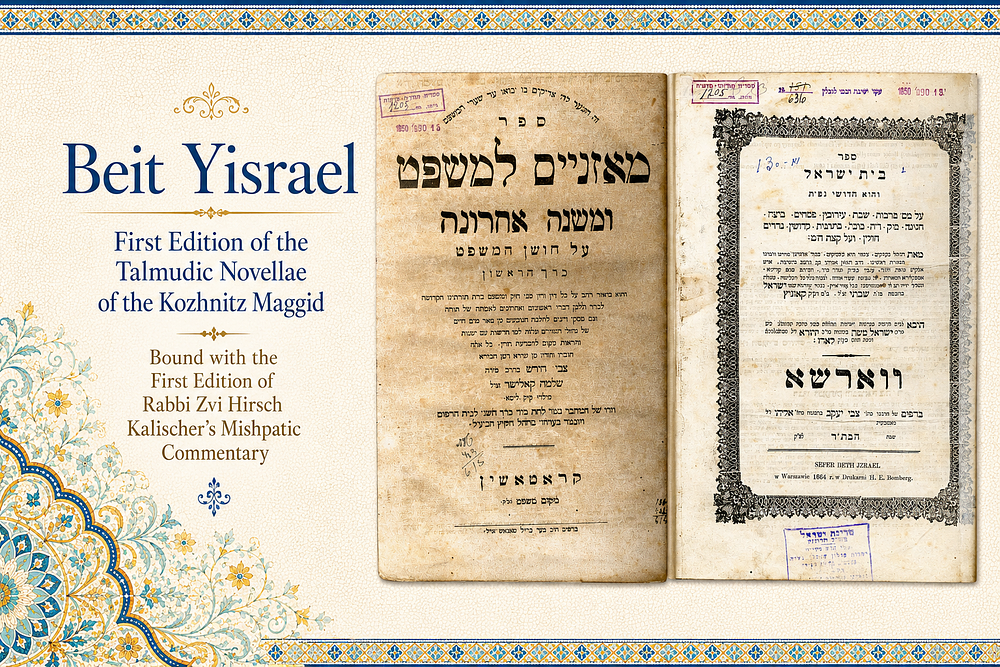
Beit Yisrael – First Edition of the Talmudic Novellae of the Kozhnitz Maggid | Bound with the First Edition of Rabbi Zvi Hirsch Kalischer’s Mishpatic Commentary - Beit Yisrael, novellae on Tractates Berachot, Eruvin, Rosh Hashanah, and Sukkah, by Rabbi Yisrael ben Shabbtai Hopstein, the famed Kozhnitz Maggid. Warsaw, 1864. First edition. The first edition of the Talmudic novellae of the holy Kozhnitz Maggid, one of the most revered Chassidic masters of all generations, whose sanctity, miracles, and spiritual stature left a profound impression upon the Jewish world. Chassidic literature abounds with accounts of his wondrous deeds and exceptional mastery of Kabbalah. The present work, however, reveals another dimension of his greatness—his extraordinary brilliance in the revealed disciplines of Torah scholarship. Already in his youth he was renowned as a prodigy and ranked among the foremost disciples of Rabbi Shmelke of Nikolsburg in Talmudic study, even before becoming a disciple of the Maggid of Mezeritch. Rabbi Yisrael Hopstein of Kozhnitz (1737–1814), universally known as the Kozhnitz Maggid (Der Kozhnitzer Maggid), was among the leading Chassidic masters of Poland at the beginning of the nineteenth century. A disciple of both the Maggid of Mezeritch and Rabbi Elimelech of Lizhensk, he authored numerous works on Chassidism and Kabbalah. He testified that he had studied approximately eight hundred kabbalistic works before joining the circle of the Maggid of Mezeritch. Following the passing of Rabbi Elimelech of Lizhensk, he assumed leadership of the Chassidic community in Kozhnitz and became renowned throughout the Jewish world for his mastery of both revealed and mystical Torah, as well as for his holiness and miraculous powers. Thousands flocked to seek his blessings, including non-Jews, particularly regarding matters of health and healing. Although physically frail for most of his life and often confined to bed, when the time for prayer arrived he would rise with remarkable strength, go to the synagogue, and pray and dance with the vitality of a young man. Stefansky, Chassidut, no. 84. [1], 12, [1]; 14–23, 25–26 leaves. As in other recorded copies, lacking the sixteen leaves of Tractate Shabbat, which originally followed Tractate Eruvin. 32.5 cm. Bound with: Moznayim LaMishpat and Mishneh Acharonah, an extensive commentary on the laws of Shulchan Aruch, Choshen Mishpat, together with practical halachic rulings, by Rabbi Zvi Hirsch Kalischer of Lissa. Two parts. Karatshin–Königsberg, 1855. First edition. With the text of the Shulchan Aruch. Rabbi Zvi Hirsch Kalischer (1795–1874), renowned rabbi of Thorn (Toruń), devoted much of his life to promoting the settlement of the Land of Israel. He took a prominent role in the famous halachic debate regarding the possibility of offering sacrifices in contemporary times and is regarded as one of the earliest rabbinic advocates of Jewish resettlement in Eretz Israel. He later published his influential work Derishat Zion (Thorn, 1866), a landmark text in the development of religious Zionist thought. [4], 163, [1] pages; [1], 68, [1] leaves. Very good condition. Time stains. Simple binding.