Bidspirit auction | “The Neglect of Torah Study
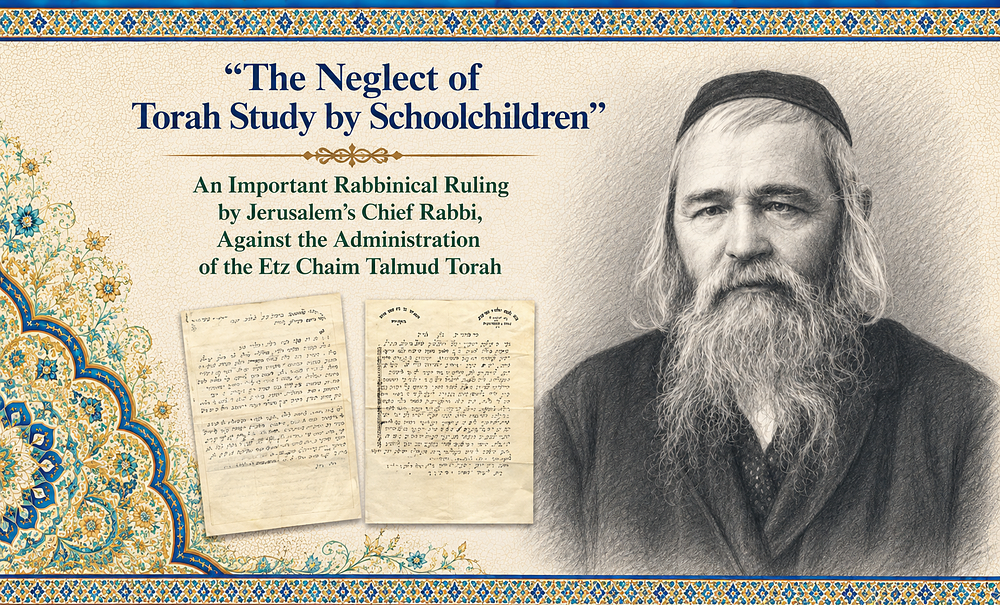
“The Neglect of Torah Study by Schoolchildren” — An Important Rabbinical Ruling by Jerusalem’s Chief Rabbi, Rabbi Tzvi Pesach Frank, Against the Administration of the Etz Chaim Talmud Torah. Jerusalem, 1949 - An important historical and public rabbinical ruling, written entirely in the autograph hand and signed by Jerusalem’s Chief Rabbi, the illustrious gaon Rabbi Tzvi Pesach Frank, author of Har Tzvi. Jerusalem, 19 Adar II 5709 [1949]. Presented here is a fascinating Din Torah that sheds light on a little-known chapter in the history of Torah education in Jerusalem and the struggles faced by the neighborhoods of the Old Yishuv during the early years of the State of Israel. On opposing sides stood two of Jerusalem’s most prominent figures. The defendant was the gaon Rabbi Yechiel Michel Tukachinsky, director of the Etz Chaim institutions and one of the leading personalities of Jerusalem’s Torah world. The plaintiff was the noted communal leader Rabbi Zalman Shachor, representing the residents of the Yemin Moshe neighborhood. At the center of the dispute was the neighborhood’s demand that the Etz Chaim Talmud Torah continue participating in the salary of the melamed who taught the local children. The residents argued that for many years the institution had paid one Palestine pound per month toward the teacher’s salary and therefore had no right to discontinue its support. The background to the dispute is revealing. Although the main Etz Chaim campus was located in the center of Jerusalem and served students from across the city, young children in outlying neighborhoods commonly studied within their own neighborhoods, usually in local synagogues. A teacher would come to them, sparing them the long journey into the city center. In practice, these classes functioned as local branches of the Etz Chaim Talmud Torah, and the institution had long participated in funding their teachers. The administration of the Talmud Torah, however, argued that its difficult financial condition no longer allowed it to continue bearing this expense. After hearing the claims and counterclaims, Rabbi Tzvi Pesach Frank ruled unequivocally in favor of the residents of Yemin Moshe. Among his remarks, he writes: “After hearing the arguments and counterarguments from both sides, and taking into consideration the condition of the neighborhood, which is isolated from the centers of the Jewish neighborhoods, and the fact that there is here a neglect of Torah study by schoolchildren that cannot be remedied in any other way...” He concludes: “Therefore, I have found that according to Torah law, the general Talmud Torah is not permitted to deprive them of the payment that has long been customary, and the residents of Yemin Moshe are entitled to collect from the Talmud Torah treasury the amount they have historically received.” The ruling concludes: “And upon this I affix my signature on the eve of the holy Sabbath, 19 Adar II 5709. Signed: Tzvi Pesach Frank.” This is a rare and highly important document, illuminating Rabbi Tzvi Pesach Frank not only as one of the foremost halachic authorities of his generation, but also as a communal leader deeply engaged with the practical realities of daily life in Jerusalem. Beyond its halachic significance, it is a fascinating social and historical document preserving an authentic glimpse of Torah life in Jerusalem during the closing years of the British Mandate and the formative years of the State of Israel. [1] leaf. 28 cm. Official stationery. Entirely in the autograph hand and signature of Rabbi Tzvi Pesach Frank. Condition: Good. Accompanied by a contemporary copy of the ruling. Biography Rabbi Tzvi Pesach Frank (1873–1960) served as Chief Rabbi of Jerusalem for decades and was among the foremost halachic authorities in Eretz Israel. A disciple of the leading sages of Jerusalem and one of the principal figures of the Old Yishuv, he authored the celebrated responsa series Har Tzvi, regarded as one of the foundational works of twentieth-century halachic literature. His authority was recognized throughout Jerusalem, and he served as a central address for public, financial, and halachic matters across the country. Alongside his towering scholarship, he was renowned for his practical wisdom and profound involvement in the needs of the community and the life of Jerusalem’s congregations.