Bidspirit auction | “A Severe Warning” — A
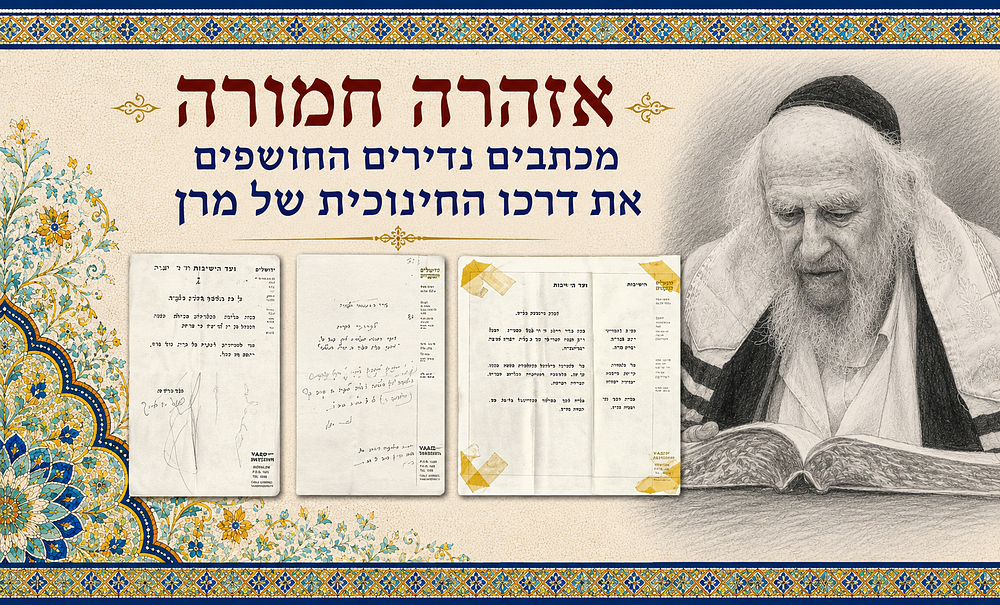
“A Severe Warning” — A Rare Collection of Letters Revealing the Educational Philosophy of Maran Rabbi Shmuel Auerbach - A collection of educational letters containing exceptionally rare and significant content, authored by Maran Rabbi Shmuel Auerbach zt”l. Shaarei Chesed, Jerusalem, circa 1995. Presented here is an extraordinary group of letters written on the official stationery of Yeshivat Ma’alot HaTorah, revealing the unique educational approach of Maran Rabbi Shmuel Auerbach. These are not public letters concerning ideology or communal struggles; rather, they address the subject that stood closest to his heart—educating students and cultivating future Torah scholars. The First Letter The first letter encapsulates the essence of Rabbi Auerbach’s educational philosophy. Its purpose was to ensure that the students of Yeshivat Ma’alot HaTorah remain in the yeshiva for Shabbat Chanukah. True to his approach, Rabbi Auerbach viewed Chanukah as a period that, in some circles, carried the character of a yoma depagra—a time when a degree of laxity could develop. Precisely for that reason, he demanded that his students strengthen themselves during this period and issued a stern warning against leaving the yeshiva. The original manuscript before us reveals a remarkable aspect of his educational method. With the insight of a master educator, Rabbi Auerbach writes as though he were a student who had discerned the wishes of the Rosh Yeshiva and understood that he did not want the students to leave for home that Shabbat. In his own handwriting he writes: “We have understood his opinion... that it is very much his desire that they remain this Shabbat of Parashat Miketz in our holy yeshiva according to all its schedules, with Hashem’s help.” These words were written by Rabbi Auerbach himself. More strikingly still, he signs the letter—in his own hand—as though on behalf of the students: “The Students of the Yeshiva.” Before us is a rare and revealing glimpse into his educational worldview, demonstrating the extent to which he was prepared, so to speak, to depart from a strictly literal presentation of reality in order to achieve the desired educational outcome. The Second Letter The second letter was written on the eve of Rosh Chodesh Nisan, when the entire yeshiva world traditionally enters the bein hazmanim recess following the long and demanding winter semester. At precisely that moment, Rabbi Auerbach demanded that his students remain in the yeshiva for an additional week, declaring unequivocally: “The students must be careful to comply with the above, without any exception whatsoever.” Significantly, it is this particularly demanding letter that he signs in full: “Rosh HaYeshiva, Shmuel Auerbach.” The Remaining Letters The remaining two letters are unsigned and written in the third person. Nevertheless, they too were authored by Rabbi Auerbach, who was renowned for weighing every word with extraordinary care. In these deeply moving letters, Rabbi Auerbach asks the students to remain in the yeshiva for Shabbat Parashat Vayechi, the yahrzeit of his wife, the Rebbetzin a”h. The couple never merited children of their own, and the students of the yeshiva were regarded by them as their sons in every sense. Details: [4] letters, various sizes. Condition: Good to very good overall. .................................................. ..... The significance of these letters is exceptional. Owing to his central role in the leadership of the Torah world—first during the era of Maran Rabbi Elazar Menachem Man Shach and Maran Rabbi Yosef Shalom Elyashiv, and later as the recognized leader of the Jerusalem Faction—Rabbi Auerbach was called upon to sign countless public letters concerning ideology, elections, and communal struggles, foremost among them the battle against military conscription. Yet beyond the public leader stood a man whose true calling lay elsewhere: the cultivation of students. This was his passion, his life’s work, and the mission to which he devoted himself. All other aspects of public leadership and communal struggle were, in his eyes, obligations imposed by circumstance. Shortly before his passing, he reportedly requested that no praise or titles be written about him other than a single fact: that he had raised students. It is precisely for this reason that the letters before us are so rare and important. Among the thousands of letters that emerged from his pen over the years, these do not deal with politics, public controversies, or communal leadership. Rather, they concern the field in which he saw the true purpose of his life’s mission—educating students and building the next generation of the Torah world. What we have here is a rare window into the inner world of one of the greatest educators of the last generation, reflected in the very words he wrote to his own תלמידים.