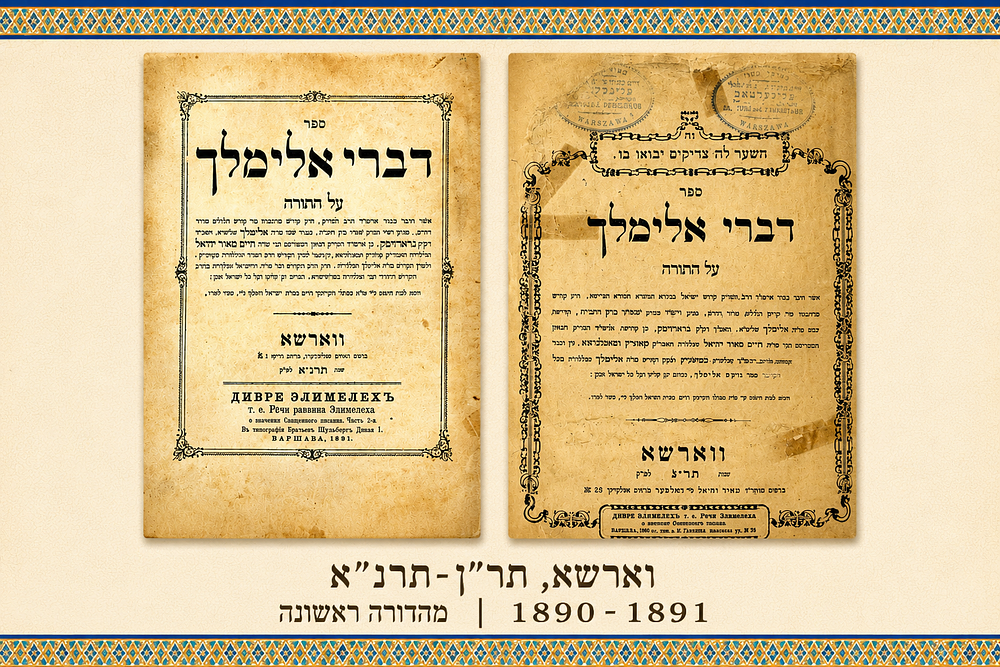
Bidspirit auction | Divrei Elimelech – First Edition
Divrei Elimelech – First Edition Published During the Author’s Lifetime | The Foundational Work of the Grodzisk Dynasty - Divrei Elimelech, two parts. Chassidic discourses on the weekly Torah portions by the Rebbe, Rabbi Elimelech Shapira of Grodzisk. Warsaw, 1890–1891. First edition. The first edition of the principal work of one of the foremost Polish Chassidic leaders of his generation, published during the author’s lifetime. The book is regarded as a cornerstone of Grodzisk Chassidic thought and contains the Rebbe’s teachings, insights, and profound interpretations on the Torah portions. Rabbi Elimelech Shapira of Grodzisk (1824–1892) was among the leading Chassidic masters of nineteenth-century Poland and the founder of the Grodzisk dynasty. He was the son of Rabbi Yisrael Yitzchak Shapira, the famed “Saraf of Mogielnica, ” and a grandson of the holy Maggid of Kozienice. Through his mother he was descended from the family of Rabbi Elimelech of Lizhensk, after whom he was named. His distinguished lineage united three of the most important dynasties of Polish Chassidism—Kozienice, Mogielnica, and Lizhensk—and he himself became one of the most influential Chassidic leaders of his era, drawing thousands of followers who sought his counsel, blessings, and spiritual guidance. His first wife was a daughter of Rabbi Yerachmiel of Peshischa, son of Rabbi Yaakov Yitzchak of Peshischa, the celebrated “Yehudi HaKadosh” (Holy Jew). In his later years he married Chana Bracha, daughter of Rabbi Chaim Shmuel Horowitz of Chencin. From this marriage was born his renowned son, Rabbi Kalonymus Kalman Shapira of Piaseczno, author of Chovat HaTalmidim, Esh Kodesh, and other foundational works of Piaseczno Chassidism. The publication of Divrei Elimelech during the author’s lifetime grants the work special significance among Chassidic classics, serving as an authentic and authoritative source for the teachings of the Rebbe as they were transmitted and arranged during his own lifetime. 240; [2], 241–504 pages. 26.5 cm. Very good condition. Professionally restored tears to the first title page. Simple binding.