Bidspirit auction | A Proven and Tested Segulah!
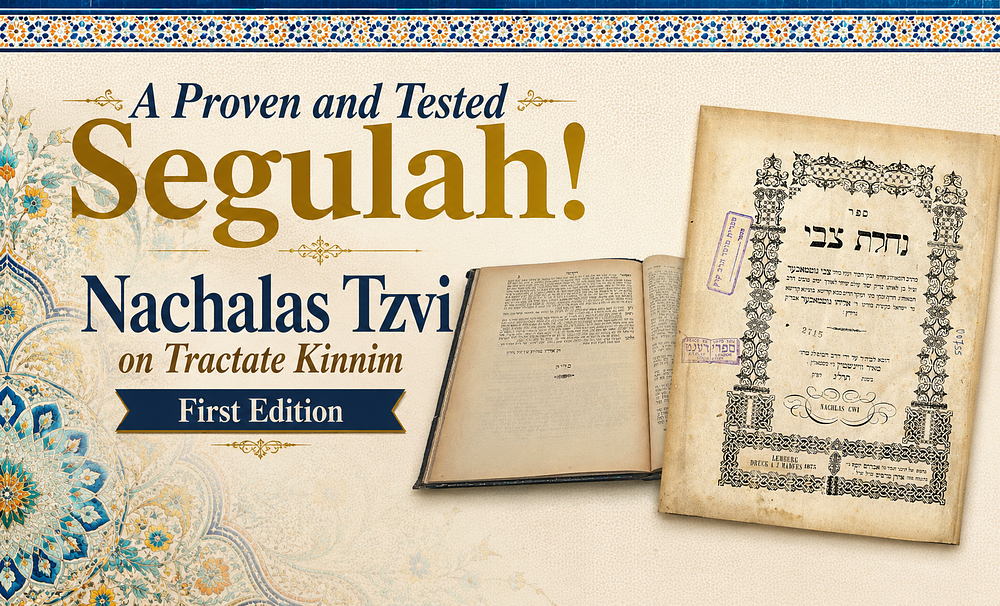
A Proven and Tested Segulah! Nachalas Tzvi on Tractate Kinnim. First Edition - ”When a person requires salvation from Hashem... he should study the Mishnah with the commentary, Tosafos Yom Tov, and my son's commentary of blessed memory... afterward he should pray in whatever language is familiar to him... and specify his request, and he will be answered...” (The Tzaddik of Graetz) Sefer Nachalas Tzvi. Ken Meforashet, a commentary on the Mishnayos of Tractate Kinnim. By Rabbi Tzvi Gutmacher, together with additional works. Lemberg, 1873. First edition. Segulah book. The book includes four works: Nachalas Tzvi on Tractate Yevamos, by the gaon Rabbi Tzvi Gutmacher. Ken Meforashet on the Mishnayos of Tractate Kinnim, by the gaon Rabbi Tzvi Gutmacher. Tzafnas Paneach, by the gaon Rabbi Eliyahu Gutmacher – the Tzaddik of Graetz. [In chapter 8, the author relates astonishing stories of salvations that occurred through him.] Shalom BePamalya Shel Maalah, by the gaon Rabbi Eliyahu Gutmacher – the Tzaddik of Graetz. A Segulah Book: The study of Ken Meforashet is considered a segulah for salvation, based on the promise written by the author's father, the renowned wonder-worker known as the “Tzaddik of Graetz, ” in his introduction to the work: ”It is possible that when a person requires salvation from Hashem, he should arouse himself and study a Mishnah with the commentary, Tosafos Yom Tov, and my son's commentary of blessed memory. Afterwards he should stand and pray in whatever language is familiar to him... and he will be answered. If salvation does not come, he should do so for three days, once each day.” In Sukkas Shalem (folio 107), it is written: ”And we have heard of distinguished Jewish families who are accustomed to this practice and are not accustomed to physicians.” In recent years, this segulah has again become widely known, and in many places public study sessions are held in the holy work Ken Meforashet. Rabbi Chaim Kanievsky held this segulah in very high regard and advised many people to study the tractate together with the present commentary. Rebbetzin Kanievsky testified that ”hundreds and thousands of people were helped through the segulah of studying Tractate Kinnim with the commentary Ken Meforashet” (Me'Hashem Yatza HaDavar, p. 379). The gaon and tzaddik Rabbi Eliyahu Gutmacher, Av Beis Din of Graetz (1796–1874), was among the earliest disciples of Rabbi Akiva Eiger in Posen. He served as Av Beis Din of Pleschen and Graetz. A gaon and kabbalist, in his later years he became renowned as a worker of salvations, and people streamed to Graetz from many lands to receive his blessings and seek deliverance. The phenomenon became so widespread that he was compelled to publish notices in the newspapers of the time requesting that people cease doing so. His glosses on the Talmud were printed in the Vilna Shas. His son, the gaon Rabbi Tzvi Hirsch Gutmacher (1818–1870), was born to Rabbi Eliyahu, the “Tzaddik of Graetz.” He became especially renowned through the present work, Ken Meforashet on Tractate Kinnim, concerning which his father writes in the introduction that his son left something for future generations: whoever requires salvation should study a Mishnah in Tractate Kinnim together with the commentary, Tosafos Yom Tov, and the commentary Ken Meforashet, then stand and pray in whatever language is familiar to him, and he will receive salvation; if it does not help, he should do so for up to three days. 28, 42 leaves. 28 cm. Very fine condition.