Bidspirit auction | Exceptional Copy: Mishnat DeRabbi Eliezer
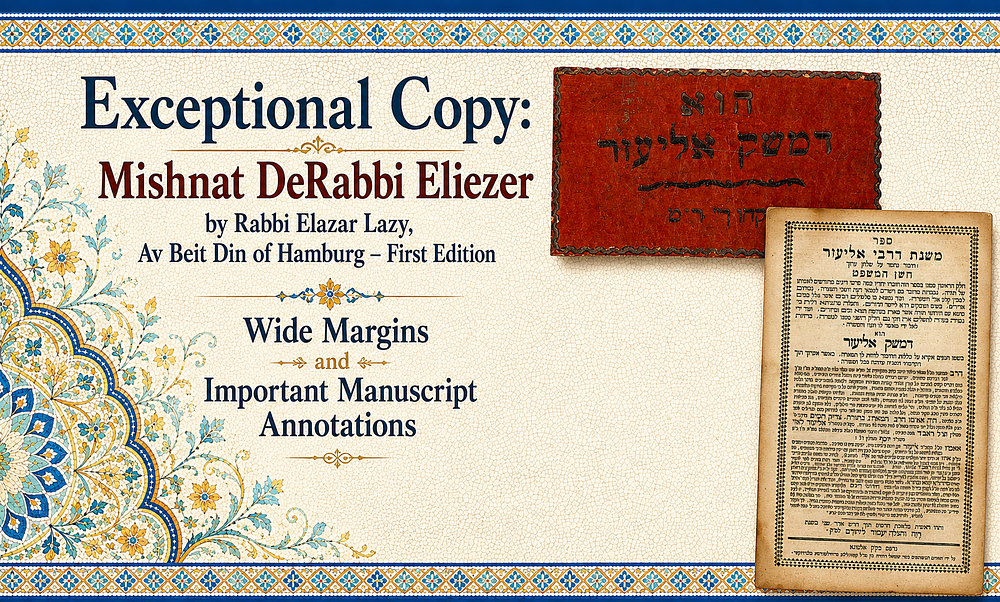
Exceptional Copy: Mishnat DeRabbi Eliezer by Rabbi Elazar Lazy, Av Beit Din of Hamburg – First Edition; Wide Margins and Important Manuscript Annotations - Mishnat DeRabbi Eliezer, also known as Dammesek Eliezer, a commentary on Shulchan Aruch, Choshen Mishpat, by Rabbi Elazar Lazy of Berlin, Av Beit Din of Hamburg. Altona, 1815–1816. First edition. Wide-margined copy. The volume contains scholarly manuscript annotations by Rabbi Baruch Yitzchak Lipshitz, Av Beit Din of Landsberg. Several of the annotations are extensive in length, and one is signed by the annotator. A complete copy, including all supplementary leaves. Fine, wide margins. [6], 82; 13; [6] leaves. 36.5 cm. Very good condition. Time staining. Original binding, worn and defective, retaining its original ties. Biographical Notes The author, Rabbi Elazar Lazy Hilbut Berlin (1741–1814), was among the leading rabbinic authorities of his generation. Born in Berlin to Rabbi Yosef Berlin, he was named after his grandfather, the revered Rabbi Lazy Halberstadt of Berlin. Following his marriage he settled in Posen, where he served as a dayan in the rabbinical court of Rabbi Raphael HaKohen (the “Hamburger”), then Av Beit Din of Posen. When Rabbi Raphael HaKohen relocated to Hamburg in 1776 to assume the rabbinate of the celebrated Triple Community of AHU (Altona, Hamburg, and Wandsbek), he brought Rabbi Elazar Lazy with him to serve on his court. Upon Rabbi Raphael HaKohen’s retirement in 1799, Rabbi Elazar Lazy was appointed head of the rabbinical courts of the AHU communities. The annotator, Rabbi Baruch Yitzchak Lipshitz (1812–1878), Av Beit Din of Landsberg, was the son of Rabbi Yisrael Lipshitz, author of the celebrated Tiferet Yisrael commentary on the Mishnah. He served as rabbi of Boskovice and Landsberg and later as Chief Rabbi of the Grand Duchy of Mecklenburg-Schwerin. Rabbi Baruch Yitzchak collaborated extensively in his father’s monumental work, and his novellae appear throughout Tiferet Yisrael, signed with the initials אב”י (Amar Baruch Yitzchak). He was renowned for his extraordinary piety, reportedly studying throughout the day while wrapped in a tallit beneath his outer garment and wearing tefillin. After serving in Landsberg and as Chief Rabbi of Mecklenburg, he moved to Hamburg in 1859, where he became renowned for his sermons and lectures and attracted many disciples. The most famous of these was Rabbi Aharon Marcus, known as “The Chassid of Hamburg, ” author of HaChassidut. Rabbi Baruch Yitzchak was widely revered as a saintly and God-fearing figure and maintained halachic correspondence with many of the leading rabbis of Poland and Lithuania. During the famous controversy over the kashrut of Corfu etrogim, those who permitted their use cited a letter in which Rabbi Baruch Yitzchak expressed his view that the Corfu etrogim were kosher, noting that he had heard the same position from his father. Rabbi Shimon Sofer of Kraków later referred to Rabbi Baruch Yitzchak as a “renowned righteous man and outstanding gaon, ” a description echoed in references to his son Rabbi Zechariah Lipshitz, who succeeded him in the rabbinate.