Bidspirit auction | “The Mourning of the Hebron
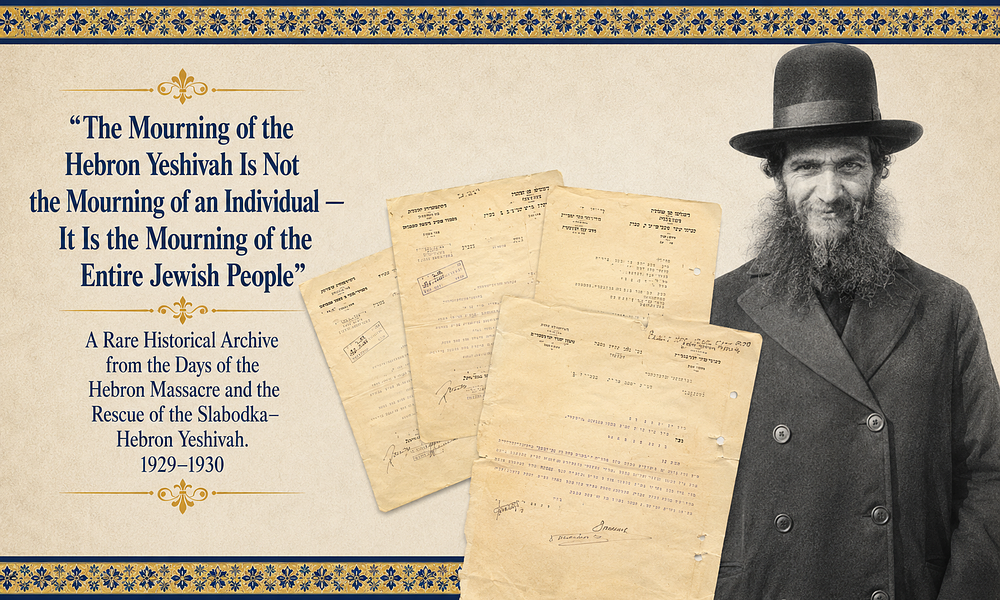
“The Mourning of the Hebron Yeshivah Is Not the Mourning of an Individual — It Is the Mourning of the Entire Jewish People” — A Rare Historical Archive from the Days of the Hebron Massacre and the Rescue of the Slabodka–Hebron Yeshivah. 1929–1930 - An extraordinary group of four highly important historical documents sent to Rabbi Moshe Mordechai Epstein, Rosh Yeshivah of Slabodka–Hebron, during the weeks and months following the 1929 Arab riots. These documents provide a real-time record of the response of the Jewish leadership in Palestine to one of the greatest tragedies in the history of the Torah world in the Land of Israel — the Hebron Massacre, the destruction of the famed Hebron Yeshivah, and the struggle over its future in the aftermath of the catastrophe. This rare collection does not describe the events retrospectively; rather, it captures the decisive moments themselves, at a time when the future of the foremost yeshivah in the Land of Israel remained uncertain and its very survival hung in the balance. On the 24th of Av, 5689 [August 1929], the horrific Hebron Massacre took place. Dozens of members of the Jewish community were brutally murdered, among them twenty-four students of the Hebron Yeshivah. The yeshivah, the direct continuation of the famed Slabodka Yeshivah, was effectively destroyed overnight. The surviving students were evacuated from the city, and the leadership of the Yishuv was forced to confront the question of how to preserve one of the most important bastions of Torah learning in the world. The first document, dated 7 Elul 5689, only weeks after the massacre, was sent by the Chairman of the Zionist Executive in Palestine to Rabbi Moshe Mordechai Epstein. It is among the earliest official letters of condolence issued in response to the tragedy. Among its most moving passages are the words: “We all know the magnitude of the loss of these young men who devoted themselves to Torah and sacred purpose. Beyond this, however, the mourning of the Hebron Yeshivah is not the mourning of an individual or of individuals, but the mourning of the entire Jewish people.” These remarkable words demonstrate how the destruction of the yeshivah was viewed by the leadership of the Yishuv—not merely as a local calamity, but as a national tragedy. The second document bears the official letterhead of the Local Council of Rishon LeZion, printed in Hebrew, English, and Arabic. It is dated 15 Tishrei 5690, barely a month after the riots. The leaders of the settlement appeal directly to Rabbi Epstein and seek to relocate the Hebron Yeshivah to Rishon LeZion. Offering land, buildings, and favorable conditions, they write: “We have heard that the Slabodka Yeshivah intends to transfer itself to one of the localities near Tel Aviv... We would be most pleased if you would permit us to open negotiations concerning the transfer of the yeshivah to our settlement, including the allocation of land for buildings, housing arrangements, and related matters.” A fascinating document revealing a little-known chapter in the story: the competition among various settlements and communities for the privilege of hosting the displaced yeshivah. The third document, dated 5 Tishrei 5690, was sent on the official stationery of Knesset Yisrael in Palestine — the Vaad Leumi (National Council). It reflects one of the most critical questions raised immediately after the massacre: would the Hebron Yeshivah return to the city where its students had been murdered, or would it establish itself elsewhere? The leaders of the Vaad Leumi write: “The Executive of the Vaad Leumi requests that Your Honor inform us of your opinion regarding the return of the yeshivah to Hebron.” Before us is therefore rare evidence of the historic moment when the question of the yeshivah’s return to Hebron still remained an open public issue. The fourth document was written approximately six months after the riots, on 9 Adar 5690, by which time the decision had already been made and the yeshivah had become established in Jerusalem. The Vaad Leumi informs the yeshivah administration that a donation had been received from the Jewish community of Vilna for the victims of the riots, and that a sum of 27 Palestine Pounds had been allocated to the Hebron Yeshivah. This document marks a symbolic transition—from letters of mourning, concern, and deliberation about the future, to the first stage of rebuilding and renewal. Presented here is a collection of exceptional historical significance. Four moments in time documenting the journey of the Hebron Yeshivah from destruction to rebirth: from the first letters of condolence after the massacre, through the intense deliberations regarding the yeshivah’s future home, and finally to the first steps of reconstruction in Jerusalem. Few collections document so directly, so close to the events themselves, and so comprehensively, the fate of the Hebron Yeshivah during its darkest hour.