Bidspirit auction | Revealed: A Fascinating Hasidic Letter
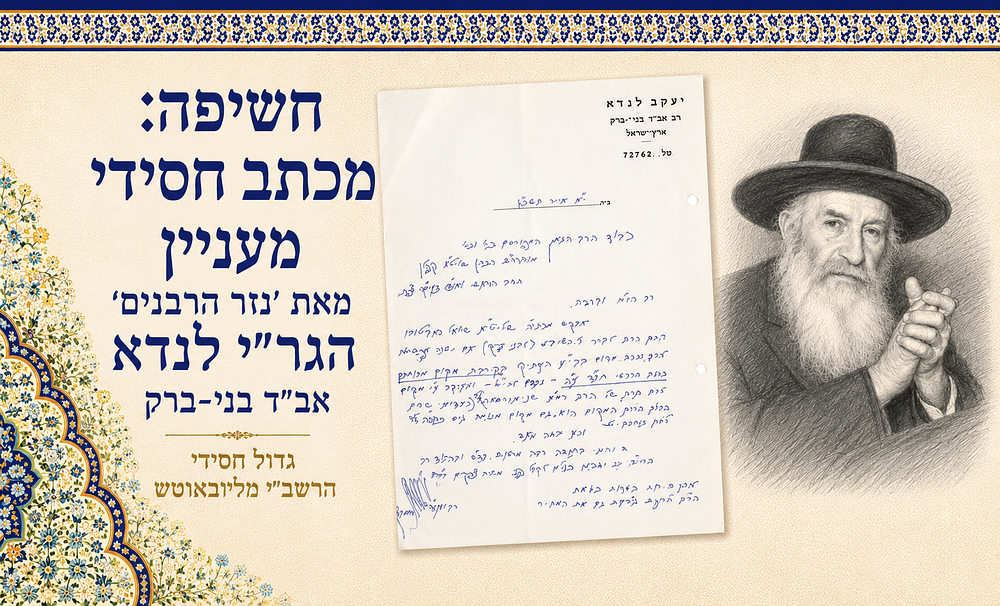
Revealed: A Fascinating Hasidic Letter by the “Crown of the Rabbis, ” Rabbi Yaakov Landau, Chief Rabbi of Bnei Brak – One of the Greatest Disciples of the Rashab of Lubavitch - Fascinating Chabad Letter by the “Crown of the Rabbis, ” Rabbi Yaakov Landau – Seeking a Burial Plot Near His Closest Chabad Colleagues in Safed A fascinating Hasidic letter by the illustrious Rabbi Yaakov Landau, known as the “Nezer HaRabbanim” (“Crown of the Rabbis”), Chief Rabbi and Av Beit Din of Bnei Brak, and one of the foremost disciples of Rabbi Shalom DovBer Schneersohn (the Rashab) of Lubavitch. The letter, entirely in his handwriting and signed by him, was written in Bnei Brak during the month of Iyar, 1963. Rabbi Yaakov Landau was among the closest associates of the Rashab and served for many years as the “court rabbi, ” overseeing religious and halachic affairs within the Rebbe’s household in Rostov. The letter is addressed to the Chief Rabbi of Safed, Rabbi Simcha Kaplan, and concerns Rabbi Landau’s request to acquire a burial plot in the ancient cemetery of Safed—a sacred resting place of Tannaim and Amoraim, the holy Ari, Rabbi Yosef Karo, numerous Hasidic rebbes, and generations of revered tzaddikim. The contents of the letter reveal that Rabbi Landau specifically wished to be buried in the Chabad section of the cemetery, and particularly near the grave of Rabbi Menachem Mendel Schneersohn, son of the Maharash and brother of the Rashab, with whom Rabbi Landau shared a close personal friendship and alongside whom he had worked in the administration of the Rashab’s court. Of particular interest is the fact that, contrary to the common practice of city rabbis throughout the generations, Rabbi Yaakov Landau—who served as Chief Rabbi of Bnei Brak for approximately fifty years, and whose rabbinic dynasty continued in the city through his son and grandson for decades thereafter—did not seek burial in the city where he spent most of his life and career. Instead, he aspired to be laid to rest among the Chabad community in Safed. In the end, Rabbi Landau was not buried in Safed. Whether this was because a suitable plot near his cherished friend could not be obtained, or for other reasons, remains unknown. One fact, however, is clear: he did not choose to be buried in Bnei Brak either. His final resting place was ultimately established on the Mount of Olives in Jerusalem. The reason for this can only be speculated upon—some matters remain between the lines and were never committed to writing. His son and successor, Rabbi Moshe Yehuda Leib Landau, was likewise not buried in Bnei Brak, but alongside his father on the Mount of Olives. The date of the letter reveals another intriguing detail: upon reaching the age of seventy, Rabbi Landau sought to purchase a burial plot for himself. Some may view this as support for the well-known tradition that acquiring one’s burial place during one’s lifetime is a segulah for longevity, as Rabbi Landau lived well into his nineties and survived for more than two decades after this letter was written. [1] paper leaf. 21 cm. Very good condition. Fold marks and filing holes.