Bidspirit auction | “Heaven Forbid That I Should
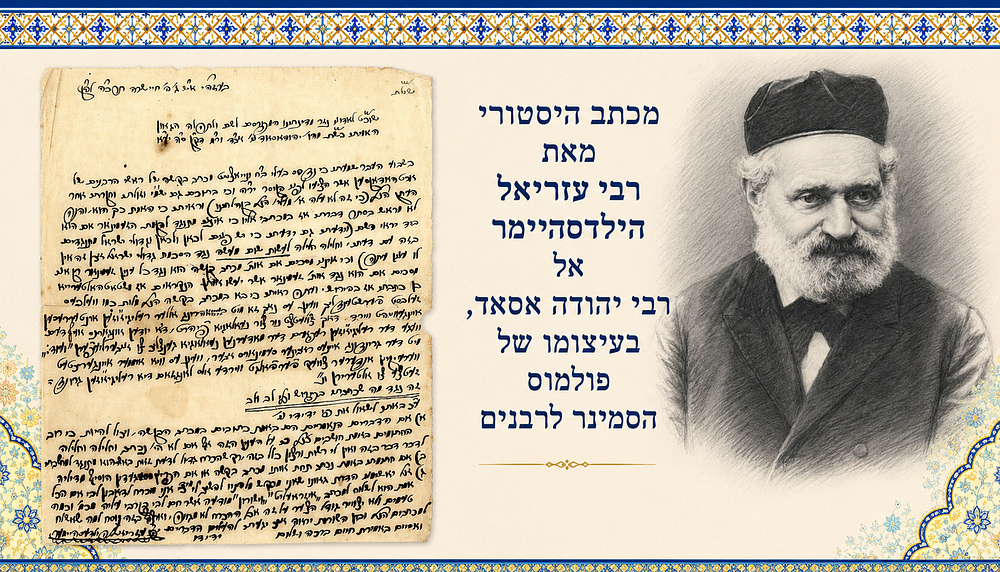
“Heaven Forbid That I Should Act Against the Gedolei Yisrael” — A Historic Letter from Rabbi Azriel Hildesheimer to Rabbi Yehudah Asad During the Rabbinical Seminary Controversy - An important and highly significant letter authored by the Gaon Rabbi Azriel Hildesheimer, one of the foremost leaders of German Orthodoxy and among the most influential Orthodox rabbis of his generation, addressed to the holy Gaon Rabbi Yehudah Asad, the spiritual leader of Hungarian Jewry and one of the greatest halachic authorities of his era. Eisenstadt, 1865. Before us is a rare document that relates directly to one of the defining controversies in the history of nineteenth-century Orthodox Judaism—the fierce dispute surrounding the establishment of the Rabbinical Seminary in Eisenstadt, which would later develop into the famed Rabbinical Seminary of Berlin, the institution that produced many of the leading Orthodox rabbis of Germany. During the 1860s, Rabbi Azriel Hildesheimer sought to establish a new framework for rabbinic training, combining advanced Torah scholarship with the practical preparation required of rabbis serving modern Jewish communities. In his view, such an institution was essential for preserving authentic Judaism in the face of the challenges of the age. The proposal, however, met with strong opposition from the leading rabbis of Hungary. Hungarian Orthodoxy, then engaged in a bitter struggle against the Reform and Neolog movements, feared that any new institution for rabbinic education might become a dangerous opening through which foreign ideas could penetrate the Orthodox camp. Among the most prominent opponents were the Gaon Rabbi Hillel Lichtenstein of Kolomyia and his son-in-law Rabbi Akiva Yosef Schlesinger, both renowned champions of uncompromising traditionalism. The present letter was addressed to Rabbi Yehudah Asad, who was widely regarded as the supreme rabbinic authority and spiritual leader of Hungarian Jewry. Following the publication in the press of a letter attributed to Rabbi Asad expressing strong opposition to the proposed seminary, Rabbi Hildesheimer writes to him in a tone of respect, friendship, and affection, seeking clarification of the matter. In the course of the letter, Rabbi Hildesheimer explains his own position and the necessity he sees in establishing the institution. At the same time, he emphasizes his profound respect for the views of the Hungarian sages. In one of the most important passages of the letter, he declares explicitly that if the leading rabbis indeed oppose the project, he will withdraw his involvement entirely, writing in essence: “Heaven forbid that I should act against the Gedolei Yisrael.” We are thus presented with a rare and original record of a direct exchange between two of the greatest rabbinic figures of the age at a pivotal moment in the history of Orthodox Judaism. The letter reflects the tensions between German and Hungarian Orthodoxy, between differing approaches to the challenges of modernity, and between two schools of leadership, each striving in its own way to preserve Torah and tradition. Beyond its historical significance, the letter sheds light on the personality of Rabbi Hildesheimer himself. Despite his firm convictions, he addresses Rabbi Yehudah Asad with humility, reverence, and a genuine willingness to defer to the judgment of the leading sages of the generation. Before us is a foundational document in the history of Modern Orthodoxy, touching upon one of the most important and influential debates in nineteenth-century Jewish life. Description Important historical letter. [1] page. 21 cm. Contemporary manuscript copy of the original letter, produced close to the time of its writing. Condition: Good. Fold marks and age stains. Biography Rabbi Azriel Hildesheimer (1820–1899) was one of the foremost leaders of German Jewry and among the founders of Modern Orthodoxy. He served as Rabbi of Eisenstadt and later as Rabbi of Berlin. He established the Rabbinical Seminary that trained generations of halachically committed rabbis throughout Germany and Europe. He was renowned both as an uncompromising opponent of Reform Judaism and as a visionary leader who sought to equip traditional rabbinic leadership to confront the challenges of the modern era. The holy Gaon Rabbi Yehudah Asad (1794–1866) was one of the greatest halachic authorities of Hungary and the foremost spiritual leader of Hungarian Orthodoxy in his generation. A disciple of the leading sages of the post-Chatam Sofer era and author of the celebrated responsa work Yehudah Ya‘aleh, he was regarded as the supreme rabbinic authority among Hungarian rabbis. His influence on the formation and character of Hungarian Orthodoxy was profound and enduring.