Bidspirit auction | Unique Historical Item – Ledger
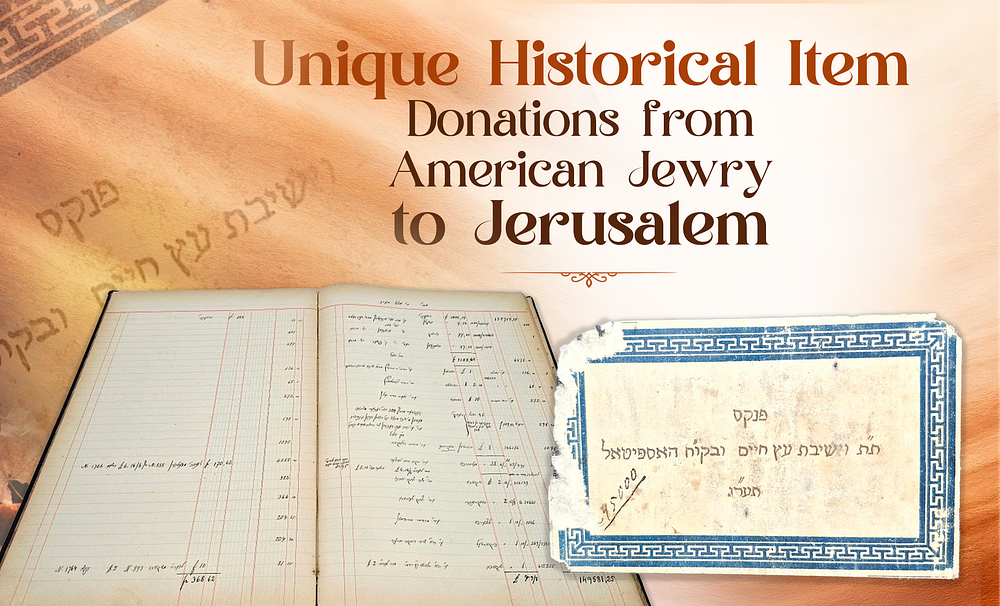
Unique Historical Item – Ledger of the Etz Chaim Talmud Torah and Yeshiva and Bikur Cholim Hospital – Donations from American Jewry to Jerusalem - Large Historical Account Ledger – Etz Chaim Yeshiva and Bikur Cholim Hospital – Jerusalem, 1913 – Hundreds of American Donors A large-format, substantial historical account ledger – a rare and valuable document recording the financial network that supported two of the oldest and most important institutions of Jerusalem’s Old Yishuv: the Etz Chaim Talmud Torah and Yeshiva and the Bikur Cholim Hospital. Jerusalem, 1913. The ledger comprises approximately 200 pages, of which some 120 are densely and meticulously filled with entries recording donations received primarily from the United States during 1913 for the maintenance of these institutions and the support of Torah scholars in Jerusalem. Across thousands of accounting entries unfolds a fascinating human and economic portrait of American Jewry in the early 20th century: the names and details of hundreds of donors from Jewish communities throughout the United States, together with the sums they contributed to the Jerusalem institutions. An exceptional record of American Jewish philanthropy on behalf of the Old Yishuv and of the close financial ties that developed between the Jews of Eretz Israel and their brethren overseas. The pages preserve the names of hundreds of donors whose contributions helped sustain Jerusalem’s institutions of Torah and charity and supported yeshiva scholars and their families through charitable distributions and stipends. The wealth of detail makes this ledger a rare historical and genealogical repository documenting members of the early American Jewish communities at the beginning of the 20th century. Alongside the donors’ names appear their places of residence, dates and amounts of contributions, and methods by which the funds were transferred – valuable primary-source material for the study of Jewish communities in the United States and their connections with Jerusalem. Etz Chaim – One of the Pillars of Jerusalem’s Torah World Etz Chaim Yeshiva, founded in 1841, and closely associated with the leadership of the Gaon Rabbi Shmuel Salant, was among the oldest and most important Torah institutions of Jerusalem’s Old Yishuv. For generations it served as one of the pillars of Jerusalem’s Torah world, encompassing a Talmud Torah, yeshiva and study frameworks for married scholars. The unique place occupied by Etz Chaim in Jerusalem Jewish life was expressed in the well-known Jerusalem saying: “One enters Etz Chaim wrapped in a tallit” – referring to the young child brought to cheder for the first time – “and leaves Etz Chaim wrapped in a tallit” – after an entire lifetime whose beginning and end were spent within Jerusalem’s world of Torah. The significance of the ledger extends far beyond its value as an accounting document. Its systematic recording of hundreds of names, locations and monetary contributions transforms it into a rich primary source for researching Jewish philanthropy and support networks in the early 20th century, the relationship between American Jewry and the Old Yishuv, and the methods by which Jerusalem’s Torah and charitable institutions were financed on the eve of World War I. A unique historical artifact – an economic, social and genealogical archive preserved within a single volume, and an important primary source for the history of American Jewish philanthropy, Etz Chaim and Bikur Cholim, and the early Jewish communities of the United States and their ties with Jerusalem’s Old Yishuv. An important document in the history of Torah life and Jewish charity in Eretz Israel and the Diaspora. Large-format ledger: 36 × 24 cm. Approx. 200 pages, of which approximately 120 are written. Several separate leaves and forms containing handwritten accounting records are preserved between the pages, apparently original records made by emissaries and fundraisers during their fundraising journeys. Very good condition. Original hardcover binding.