Bidspirit auction | Kodesh Hillulim – Stories of
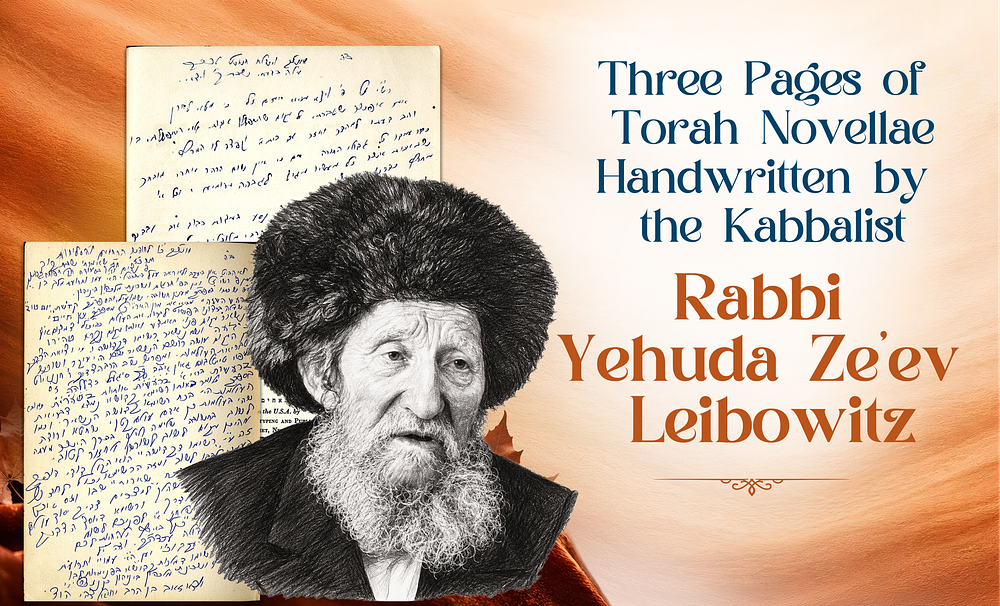
Kodesh Hillulim – Stories of Tzaddikim by the Kabbalist Rabbi Moshe Yair Weinstock. New York, 1949 – Three Pages of Torah Novellae Handwritten by the Kabbalist Rabbi Yehuda Ze’ev Leibowitz - Kodesh Hillulim – Stories of Tzaddikim by the Kabbalist Rabbi Moshe Yair Weinstock. New York, 1949 – Three Pages of Torah Novellae Handwritten by the Kabbalist Rabbi Yehuda Ze’ev Leibowitz Kodesh Hillulim, stories of tzaddikim, by the Kabbalist Rabbi Moshe Yair Weinstock. New York, 1949. An important copy with distinguished provenance: the flyleaves contain three full pages of Torah novellae handwritten by the holy hand of the Kabbalist and tzaddik Rabbi Yehuda Ze’ev Leibowitz, one of the most mysterious figures among the Kabbalists of the previous generation. Rabbi Yehuda Ze’ev signed his name several times among the writings. The connection between the owner of this copy and the author of the book is particularly significant: Rabbi Moshe Yair Weinstock and Rabbi Yehuda Ze’ev Leibowitz belonged to the circle of Kabbalists associated with the beit midrash of the great Kabbalist Rabbi Yehuda Leib Ashlag, the “Baal HaSulam, ” and studied the esoteric teachings together. Three Pages of Novellae Handwritten by Rabbi Yehuda Ze’ev Leibowitz Across three pages of the flyleaves, Rabbi Yehuda Ze’ev Leibowitz recorded lengthy Torah novellae for himself, with his signatures appearing several times throughout. Manuscripts by Rabbi Yehuda Ze’ev Leibowitz are of particular interest in light of his extraordinary character. For most of his life, he avoided publicity and remained virtually unknown outside a small circle of Kabbalists and leading Torah scholars. Only in later years did his writings begin to be collected and published in various books. The Kabbalist and Tzaddik Rabbi Yehuda Ze’ev Leibowitz The Kabbalist Rabbi Yehuda Ze’ev Leibowitz [1922–2010] was born in the Satmar region and in his youth studied under leading Hungarian rabbis, among them the Admor Rabbi Yoel Teitelbaum of Satmar and Rabbi Yehuda Rosner, Av Beit Din of Sekelheid and author of Imrei Yehuda. During the Holocaust, he endured the horrors of Auschwitz and lost his family. After the war, he immigrated to Eretz Yisrael and settled in Tel Aviv, where for many years he lived modestly and in seclusion in a small room, refusing to derive any benefit from his Torah stature. He earned his livelihood working as a road surveyor for the Tel Aviv Municipality. In Eretz Yisrael, he became close to the circle of disciples of the Kabbalist Rabbi Yehuda Leib Ashlag, the Baal HaSulam, and studied Kabbalah. He maintained Torah connections with other Kabbalists from the same school, including Rabbi Yehuda Tzvi Brandwein and Rabbi Moshe Yair Weinstock, author of the present work. Alongside his study of theoretical Kabbalah, his name also became associated with a group of hidden tzaddikim active in Tel Aviv, whose members were known by appellations such as “the Painter” and “the Shoemaker.” Like them, Rabbi Yehuda Ze’ev sought to conceal his spiritual stature and refused to derive benefit from the crown of Torah. His Connections with Leading Admors and Rabbis Despite his secluded way of life, Rabbi Yehuda Ze’ev maintained close relationships with a number of leading Torah and Chassidic figures. He had a particularly close connection with the Admor Rabbi Aharon Rokeach of Belz, who was also living in Tel Aviv at the time. He was likewise in contact with the Admor Rabbi Yekutiel Yehuda Halberstam of Sanz-Klausenburg and with the Admors of the Ruzhin dynasty who resided in Tel Aviv, including the Admors of Sadigura, Bohush and Husiatyn. In his later years, he moved to Bnei Brak. Among the rabbis who visited him and discussed matters of Halachah and Kabbalah with him were Rabbi Shmuel HaLevi Wosner and Rabbi Mordechai Gross. Numerous stories circulated about his extraordinary conduct, ruach hakodesh and salvations attributed to his blessings. Those close to him regarded him as a hidden tzaddik, and some considered him one of the thirty-six hidden righteous men of his generation. Alongside these traditions, he was known among those acquainted with him as possessing extraordinary knowledge of both the revealed and esoteric dimensions of Torah. Rabbi Yehuda Ze’ev left no descendants. Following his passing, his Torah teachings and writings were collected and published in several works, including Torat Yehuda Ze’ev, Or Levi – Ziv Yehuda, Yizal Mayim Midalyav, and additional works. His life story was extensively documented in the book Beseter Elyon. Thus, before us is a copy with an exceptional personal and scholarly association: the book of the Kabbalist Rabbi Moshe Yair Weinstock, containing three pages of Torah novellae in the actual handwriting, and bearing the signatures, of his colleague from the circle of Kabbalists, the hidden tzaddik Rabbi Yehuda Ze’ev Leibowitz. New York, 1949. Very good condition.