Bidspirit auction | “The Question of Questions of
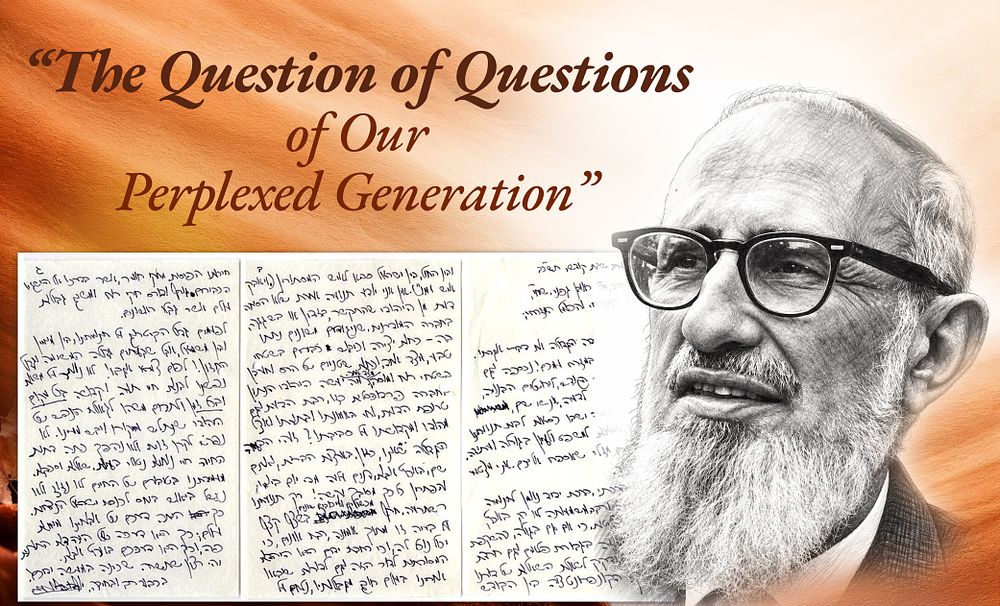
“The Question of Questions of Our Perplexed Generation” – A Seminal Historic Letter from Rabbi Joseph B. Soloveitchik to the World Convention of the Mizrachi Movement - A lengthy, important, and foundational letter extending over three pages, entirely handwritten and signed by Rabbi Joseph B. Soloveitchik of Boston, distinguished grandson of Rabbi Chaim HaLevi of Brisk and the foremost spiritual leader of Modern Orthodoxy in the United States. [Boston], Friday, Erev Shabbat, 1962. The letter was sent to the World Conference of the Mizrachi Movement, convened in Jerusalem in Av 1962. In this historic letter, Rabbi Soloveitchik sets forth his worldview regarding the path and historic mission of the Mizrachi movement in the generation of Jewish national rebirth. Before us is a foundational formulation of Mizrachi’s ideological doctrine, written by one of its foremost thinkers and most important spiritual leaders, and unquestionably its most prominent figure in the United States. With characteristic Brisker clarity – and, in a different context, employing the celebrated Brisker method of conceptual distinctions, the tzvei dinim (“two aspects”) – Rabbi Soloveitchik contrasts three forces operating within the Jewish people: on the right, separatist Orthodox Judaism, identified with the approach of Agudath Israel; on the left, the secular movements; and between them – though emphatically not as a mere compromise – the Mizrachi movement. In his view, Mizrachi alone seeks to confront directly the tension and apparent contradiction between sacred and secular, tradition and modernity, and the world of “Israel Saba” and the new reality within which the younger generation must live its Jewish life. At the beginning of the letter, Rabbi Soloveitchik apologizes for being unable to attend the conference in person despite his intense desire to be among its participants: “I am in the West, but my heart is in the East with you.” He describes the very convening of the conference in elevated language, employing expressions drawn from Psalms: “There were set thrones for our glorious movement, thrones for judgment.” He attributes profound historical and spiritual significance to the gathering; and, unable to participate in person, he commits his seminal address to writing – carefully setting forth the acute challenges facing contemporary Judaism and the solution he sees embodied in the path and mission of Mizrachi. He defines the great question confronting the generation as follows: “…with extraordinary courage, and also extraordinary trepidation, to confront the question of questions of our perplexed generation: the confrontation between the sacred and the secular – between Israel Saba and the mysterious man [‘and a man wrestled with him’].” Over many lines, Rabbi Soloveitchik analyzes the paradox confronting the younger generation: on the one hand, loyalty to Jewish tradition and the world of Torah; on the other, the unavoidable encounter with the modern world and its new realities. From there he proceeds to the solution – which, in his view, constitutes precisely the historic mission of the Mizrachi movement: “And the solution is so complex and difficult! Our movement alone, despite numerous obstacles and impediments, has thrown itself with tremendous force into this problem.” Rabbi Soloveitchik then sharpens the distinction between Mizrachi’s approach and that of separatist Orthodoxy, which he does not mention by name but whose path he describes: “We shall not withdraw into a secluded corner, nor shall we become a religious sect living a comfortable life devoid of problems, questions and doubts.” Mizrachi’s path, in his view, is the very opposite: not to flee from reality or retreat from it, but to stand at the very heart of life and confront it through Torah and faith: “We shall not retreat from our position at the very center of life… Such has been the way of our forefathers from time immemorial!” Before us is an exceptional ideological and historical document in which Rabbi Joseph B. Soloveitchik, in his own handwriting, formulates one of the central questions that occupied him throughout his life: the encounter between the world of Torah and modernity. Addressing the leaders of Mizrachi, he assigns the movement a decisive historical role in the future of Judaism – to stand “at the very center of life, ” to confront the questions of the generation rather than escape them, and to create a path through which the younger generation could remain faithful to Torah while living within modern reality. Rabbi Joseph Dov HaLevi Soloveitchik (1903–1993), son of Rabbi Moshe Soloveitchik, grandson of Rabbi Chaim HaLevi of Brisk and great-grandson of the Beit HaLevi, was among the foremost Torah scholars and Jewish thinkers of the 20th century. His personality combined the penetrating Talmudic genius of the Brisk dynasty with broad philosophical learning and profound religious thought.