Bidspirit auction | Sefer HaZichronot – The Mysterious
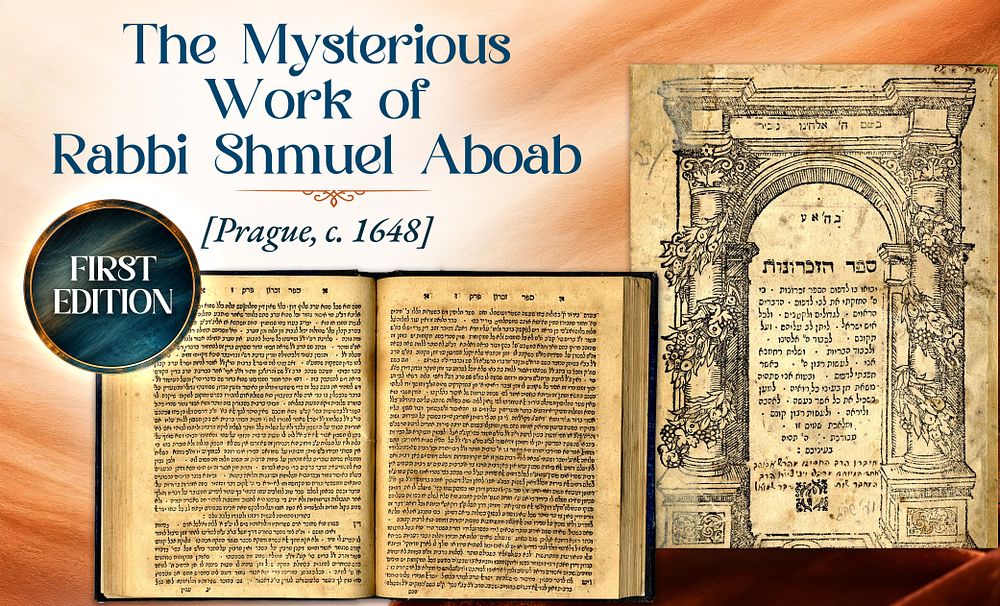
Sefer HaZichronot – The Mysterious Work of Rabbi Shmuel Aboab. [Prague, c. 1648] – First Edition - Sefer HaZichronot, words of mussar, admonition and exhortation concerning the observance of the commandments, by the Gaon Rabbi Shmuel Aboab, Rabbi of Verona and one of the foremost sages of Venice, author of Devar Shmuel. [Prague, c. 1648]. First edition. An important work of mussar and halachah, printed in complete anonymity – without the author’s name, without any indication of the place of printing, and without a date of publication. The identity of the author remained a secret for generations, and even leading halachic authorities who cited the work did not always know who stood behind it. The book is divided into ten sections, each called a “Zicharon, ” and each Zicharon is subdivided into chapters. Its primary content consists of admonition and exhortation regarding mitzvot and halachic matters whose observance, in the author’s view, had become lax among the public, with the aim of restoring proper customs and halachic practice. A substantial portion of the work is devoted to the laws of stam yeinam – an issue of particular relevance in the Italian Jewish communities of the author’s time – in which he strongly opposed the leniencies then commonly practiced. The work thus also constitutes important testimony to the religious and halachic realities of the Jewish communities of Italy in the 17th century and to the struggle of the sages of the generation against practices they regarded as breaches in halachic observance. An Anonymous Work that Entered the Halachic Literature On the verso of the title page, the author wrote a form of introduction containing an impassioned prayer that no error should result from his work. Unusually, the book was printed without approbations, and throughout the work the author carefully refrained from revealing his identity. Although the identity of its author remained unknown for a considerable period, Sefer HaZichronot attained recognition in the halachic world, and its teachings were cited and quoted in the works of later halachic authorities. “Due to his great piety, he did not mention his name upon it” The author, the Gaon Rabbi Shmuel Aboab [1610–1694], was one of the foremost Italian sages of the 17th century, Rabbi of Verona and one of the sages of Venice. He is best known to posterity for his important responsa, Shu”t Devar Shmuel. The tradition identifying him as the author of Sefer HaZichronot was recorded by the Chida in Shem HaGedolim. The Chida explicitly addresses the bibliographical mystery surrounding the book and Rabbi Shmuel Aboab’s efforts to conceal his identity: “It is not mentioned in the book who the author is… and we know that it was composed by the pious Rabbi Shmuel Aboab, one of the distinguished rabbis of Venice… and due to his great piety, he did not mention his name upon it…” According to the Chida, the concealment went beyond merely omitting the author’s name. Rabbi Shmuel Aboab refrained from having the work printed at the excellent Italian printing houses close to him and instead sent it to distant Prague for printing, making identification more difficult. The Chida even notes the book’s deliberately modest physical appearance: “And in order to conceal the matter, the paper is dark and the printing is not good…” Thus, the paper and typography themselves became part of the work’s extraordinary bibliographical story: a book by one of the greatest rabbis of Italy, deliberately printed far from his home, without the author’s name, place, or date, in an effort to keep the identity of its author concealed. Before us is the first edition of an important halachic-mussar work with an exceptional printing history, which, despite appearing anonymously, gained acceptance and was cited in halachic literature. Accompanied by an extensive research article dealing with the author, the book, and the stages that led to the discovery and identification of Rabbi Shmuel Aboab as its author. [4], 86 leaves. 17 cm. Good condition. Minor age stains. Isolated wormholes. Simple binding.