Bidspirit auction | Decorated Persian Manuscript – Astrology,
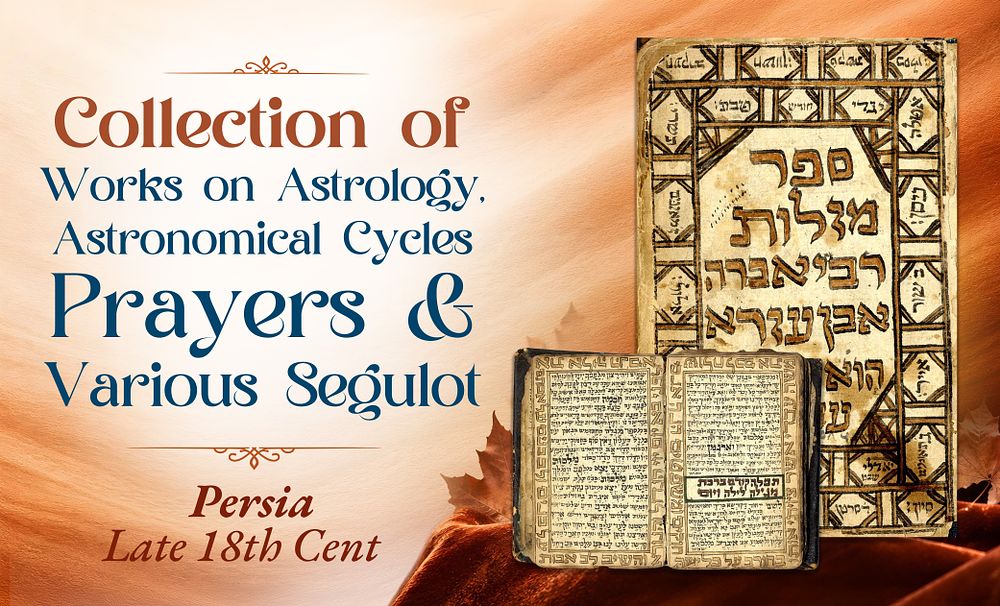
Decorated Persian Manuscript – Astrology, Amulets, Segulot and Astronomical Cycles – Writings and Forgeries of Yitzchak ben Shmuel of Persia – Late 18th Century - Decorated manuscript, a fascinating collection of astrological works, zodiac signs and astronomical cycles, amulets, segulot, angelic names and prayers – among the writings and forgeries of Yitzchak [Or] ben Shmuel of Persia. [Persia, ca. 1780s–1790s, late 18th century]. Attractive Persian manuscript in Oriental script. The title pages of the various works are decorated with borders and colored hollow lettering. Much of the manuscript – beginning with Seder Arba Tekufot Esrim VeTesha Shanah – is decorated throughout with ornamental text borders. The manuscript was thoroughly researched by Rabbi Moshe Hillel, who demonstrated that it belongs to the group of works composed, adapted or forged by Yitzchak ben Shmuel of Persia – an unusual and fascinating figure in the history of Jewish manuscripts in the East. Astrology, Remedies, Amulets and Angelic Names The manuscript contains several works: “Sefer Mazalot Rabbi Avra[ham] Ibn Ezra Hu Shneim Asar” – an astrological work attributed to Rabbi Abraham Ibn Ezra. It is followed by “Mazal Chala’im, copied from the Book of Remedies of King Hezekiah of Judah, ” containing healing segulot, formulas for amulets, tables and names of angels. “Sefer Mesharet Moshe HaLevi” – signs relating to the seasons of the year, earthquakes and thunder. The work contains passages from Mesharet Moshe by Rabbi Moshe ben Yosef HaLevi Mashan of Persia. “Seder Arba Tekufot Esrim VeTesha Shanah” – preceded by an introduction attributed to “Moshe ben Shlomo HaMa’aravi, a man of Jerusalem, may it be rebuilt and established, son of Rabbi David, the esteemed resident of Safed.” The manuscript also includes a work on astronomical cycles for the years תקנ”ד–תקצ”ט, with handwritten corrections for later years; the text of the Blessing of the Sun in Hebrew and Judeo-Persian; “Tefillat Me’arat Kevurat Tzaddikim”, a prayer to be recited at the Tomb of the Prophet Ezekiel and the tombs of Mordechai and Esther; “Ziyarat Nama Mordechai VeEsther Navat”; and “Prayer Before the Blessing over the Megillah, Night and Day, ” from Chemdat Yamim. “The Book of a Fabricator” – The Forgeries of Yitzchak ben Shmuel of Persia Rabbi Moshe Hillel’s research revealed the unusual nature of this manuscript and the methods employed by its scribe. The Sefer Mazalot attributed to Ibn Ezra is indeed known from other manuscripts, but the present version is incomplete and corrupt, with unusual additions. The work “Mazal Chala’im, copied from the Book of Remedies of King Hezekiah of Judah” is in fact an adaptation of various books of segulot and divination, attributed here to the ancient “Book of Remedies, ” which, according to Rabbinic tradition, was concealed by King Hezekiah. In the section dealing with astronomical cycles, the writer records תקמ”ה as the year of composition and even declares that תקע”ב – the next solar cycle – would be the year of Redemption. The work “Seder Arba Tekufot, ” attributed to “Moshe ben Shlomo HaMa’aravi of Jerusalem, ” is unknown from any other source and, according to Rabbi Hillel, was apparently the writer’s own creation. The text of the Blessing of the Sun was likewise copied from Sefer HaPeli’ah, a work composed by Yitzchak ben Shmuel himself. The Forger’s Hidden Allusion to His Own Name A particularly fascinating detail appears on leaf 59b. Within the text of a prayer is a partially erased name: “ושמע תפלת עבדיך השפל והמסוכן אהרן בן ק”ץ ח”י אנשיווד...” According to Rabbi Hillel, this contains a concealed reference to the writer’s identity: the Hebrew letters of “קץ חי” can be rearranged to form “יצחק” [Yitzchak], while the numerical value of “אנשיווד” is 377, equal to the numerical value of his father’s name, “שמואל” [Shmuel]. The present manuscript is discussed extensively in Rabbi Moshe Hillel’s Sifro Shel Badai: Yitzchak ben Shmuel MiParas VeChiburav HaBeduyim, Jerusalem, 2017, pp. 66–72. An inscription in fine script on the rear flyleaf reads: “…the young and humble Abba Chaim son of R. Gad Shochet, may he live and be well.” Additional inscriptions in Hebrew and Arabic, in Arabic characters, appear on the pastedowns and flyleaves. Provenance: The Gross Family Collection, Tel Aviv, PS.011.013. [69] leaves. Approx. 17.5 cm. Moderate–good condition. Stains, including dampstains. Tears and wear to margins. Several detached leaves. Old leather binding, damaged.