Bidspirit auction | Mussar Discourses and Essays –
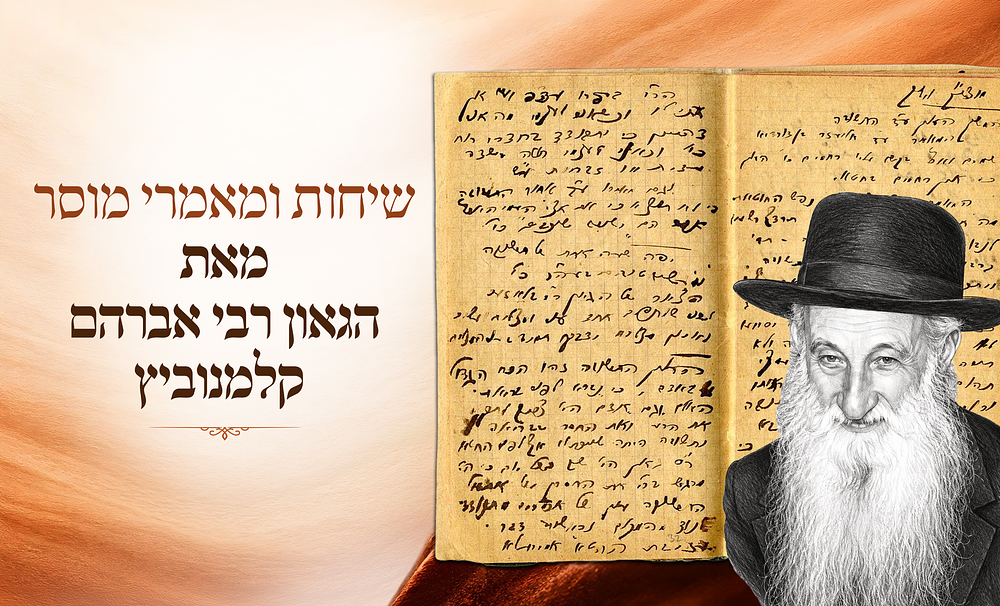
Mussar Discourses and Essays – Autograph Manuscript by the Gaon Rabbi Avraham Kalmanowitz, President of the Mir Yeshiva – 1928 - A handwritten notebook containing Mussar discourses and ethical teachings for the High Holy Days and the weekly Torah portions of the Book of Genesis, in the autograph handwriting of the Gaon Rabbi Avraham Kalmanowitz, President of the Mir Yeshiva and one of the leading rabbinic figures of the yeshiva world in the generation preceding the Holocaust and during its devastating years. The greater part of the notebook was written in 1928 and contains Mussar discourses and inspirational teachings recorded at various times. Among the headings are: ”Shabbat Kodesh Vayelech – On the Subject of Repentance”; discourses for the eve of Rosh Hashanah and Rosh Hashanah itself; ethical teachings and words of inspiration for the Ten Days of Repentance and the eve of Yom Kippur; as well as discourses written after Yom Kippur. The notebook continues with essays and discourses on Parashat Vayera, Chayei Sarah, Toldot, and other subjects. The manuscript has been identified as being in Rabbi Avraham Kalmanowitz's handwriting through comparison with his letters from the same period. The discourses are written in the distinctive style of the Lithuanian Mussar movement and address repentance, self-examination, the Days of Judgment, man's spiritual service, and the refinement of character traits. In his youth, Rabbi Avraham studied at Lithuanian yeshivas, including Slabodka, where he was among the disciples of Rabbi Nosson Tzvi Finkel, the ”Alter of Slabodka, ” whose influence is clearly evident throughout the pages of this notebook. In several places, Rabbi Avraham explicitly writes: ”And so the Alter says.” In an essay on Parashat Chayei Sarah, it appears that he recorded teachings he had heard from the Alter himself. At the conclusion of one passage, he wrote: ”And finally, he mentioned the incident involving the young married scholar from Meitzot.” Rabbi Avraham also mentions the Gaon Rabbi Yitzchak Blazer, known as Reb Itzele Peterburger, one of the foremost disciples of Rabbi Yisrael Salanter and a leading figure of the Mussar movement, writing of him: ”And on many occasions, Rabbi Yitzchak Blazer would arouse [his listeners] with tears.” Elsewhere, Rabbi Avraham records something he personally heard from Rabbi Yitzchak Izbotsky, writing: ”What Yitzchak Izbotsky told me.” Rabbi Yitzchak Izbotsky, a native of Lithuania, studied at the Mir Yeshiva. He later became the son-in-law of Rabbi Shabtai Slotnishki, rabbi of Zloczow, Poland, and succeeded his father-in-law as rabbi of the community. Rabbi Yitzchak perished in the Holocaust together with members of his congregation. See: Kehillat Zloczow, Israel, 1970, p. 71. The manuscript is not a carefully prepared transcription written in a single continuous session. Rather, the notebook was compiled over different periods, as evidenced by changes in pens, writing instruments, and shades of ink, together with deletions and corrections made during the writing process. It is evident that Rabbi Avraham used the notebook over an extended period, repeatedly adding discourses, ideas, and teachings he had heard from his teachers and members of his circle. It is possible that some of the material also served him in preparing Mussar discourses and study sessions that he personally delivered. The biographical context corresponds remarkably well with the notebook's contents and date. Rabbi Avraham studied under the Alter of Slabodka, was among the founders of the Vaad HaYeshivot, and was closely associated with Rabbi Chaim Ozer Grodzinski. In 1926, he was appointed President of the Mir Yeshiva, and in 1928 he assisted Rabbi Chaim Ozer in establishing the Ateret Tzvi Kollel in Vilna, serving as its head during its early years. The manuscript was preserved by Rabbi Avraham and subsequently sent by him to Berlin. The first page of the manuscript bears an extraordinary inscription: Rabbi Avraham Kalmanowitz himself recorded the shipping details in Latin characters, in his own handwriting. At the top of the page appears an address in Berlin: Max Calvary für Rabbiner Ka... [remainder cut off] 111 Kurfürstendamm Berlin-Halensee Beneath it appear his name and the address of the Mir Yeshiva office: Rabbi Kalmanowitz Mirer Yeshivoth Office 109 S. Broadway This inscription is of particular significance. The shipping addresses were also written in Rabbi Avraham Kalmanowitz's own hand, matching the handwriting identified throughout the notebook. Thus, the notebook, composed primarily in 1928, remained in his possession for many years. At a later date, when he was operating through the Mir Yeshiva office, he personally inscribed the shipping details for Berlin on its first page. Rabbi Avraham escaped to the United States in 1940 and subsequently headed the Mir Yeshiva established there. The purpose of the shipment to Berlin remains unknown.