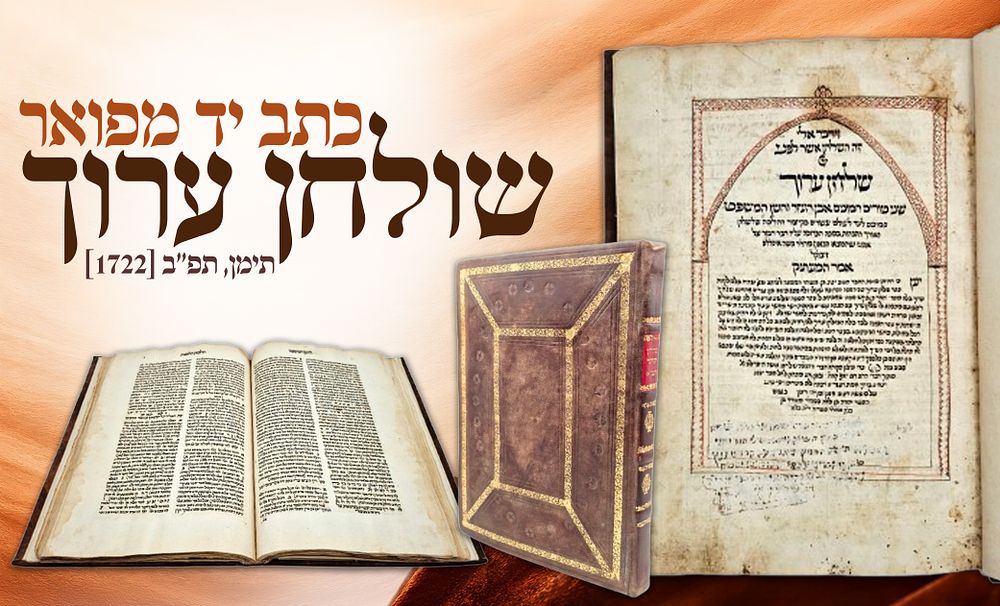
Bidspirit auction | Magnificent Manuscript – Shulchan Aruch,
Magnificent Manuscript – Shulchan Aruch, Even HaEzer and Choshen Mishpat – Yemen, 1722 – With the Remarkable Account of the Copying of the Rema’s Glosses - Large and Impressive Manuscript – Shulchan Aruch, Even HaEzer and Choshen Mishpat, with the Glosses of the Rema. Yemen, 1722. Written by the scribe Rabbi Yehuda son of Meoded Petichi Hamami. The manuscript is ornamented with an elaborate title page and large opening headings in red and black ink. At the beginning of the manuscript is a large, decorated title page surrounded by an architectural-geometric border executed in black and red ink. At its head is inscribed: “And He spoke to me: This is the table that is before the Lord, ” and beneath it, in large letters: “Shulchan Aruch, ” followed by introductory remarks and a preface. Each of the two sections is likewise introduced by a separate ornamental heading. At the beginning of Even HaEzer appears the large title “Tur Even HaEzer, ” enclosed within a geometric border in red and black ink; and at the beginning of the second section appears the large heading “Tur Choshen HaMishpat, ” similarly enclosed within a decorative geometric frame in red and black. Of particular importance is the scribe’s own testimony regarding the circumstances under which the manuscript was produced. The manuscript was written in 1722, financed by Rabbi Yefet son of Meoded Tzirab. The source describing the manuscript indicates that it formed part of a larger project to copy the various sections of the Shulchan Aruch, which were subsequently divided between two manuscripts. The present manuscript, containing Shulchan Aruch Even HaEzer and Choshen Mishpat, is part of a project encompassing all four sections of the Shulchan Aruch. The corresponding manuscript is preserved in Jerusalem and contains Orach Chaim and Yoreh De’ah. During the course of the work, however, a problem arose. The patron, Rabbi Yefet son of Meoded Tzirab, had asked the scribe to copy all four sections together with the glosses of the Rema. The scribe succeeded in obtaining the Rema’s glosses for Orach Chaim and Yoreh De’ah, but while copying Even HaEzer and Choshen Mishpat he did not have access to a volume containing the Rema’s glosses to these sections, and consequently copied them initially without the glosses. At a later date, the scribe obtained a copy of the Shulchan Aruch containing the Rema’s glosses. Rabbi Yefet therefore asked him to complete what was missing by adding the Rema’s glosses to the manuscript. This created a further difficulty for the scribe: he did not wish to copy the Rema’s glosses independently, detached from the passages of the Shulchan Aruch to which they referred. He therefore devised a distinctive method of transcription. Alongside each gloss, he also copied the beginning of the relevant halachah, or several words from the Shulchan Aruch passage to which the gloss related. Where several glosses occurred within a single halachah, he copied before each one the opening words of the appropriate passage. The result is a kind of integrated reference system, enabling the reader to identify precisely where each gloss of the Rema belongs within the text of the Shulchan Aruch, without requiring the scribe to recopy the entire text. The scribe himself explains his method: “Therefore I decided to write all the simanim, each in its proper place, according to the signs as they are written in the book of the Shulchan Aruch. And every halachah containing two or three glosses, I shall write from it only the beginning of each passage pertaining to the two or three glosses, in large script, as a sign and indication, so that the reader will not become confused. Likewise, all the short rulings from the aforementioned glosses that occur within the halachah I have enclosed within a border like this (), so that the reader may distinguish the words of the gloss of Rabbi Moshe Isserles, of blessed memory, from the words of Rabbi Yosef Karo…” Signed by the scribe: “The young Yehuda son of my father and master, the honored Rabbi Meoded son of the holy gaon, Rabbi Saadia.” These remarks constitute an exceptional firsthand account of the scribe’s professional considerations: not merely what he copied, but how he intended the reader to use the manuscript, how he distinguished between the words of the author and those of the Rema, and how he solved, both graphically and textually, the problem of integrating the glosses. It is therefore an important firsthand testimony to the availability of printed books to a Yemenite scribe, the copying of a printed book into manuscript form, and the reception and transmission of the Rema’s glosses in Yemen. Like the manuscript preserved in the National Library in Jerusalem, containing Orach Chaim and Yoreh De’ah, the present manuscript, containing Even HaEzer and Choshen Mishpat, was written for Rabbi Yefet son of Meoded Tzirab in 1722. Thus,