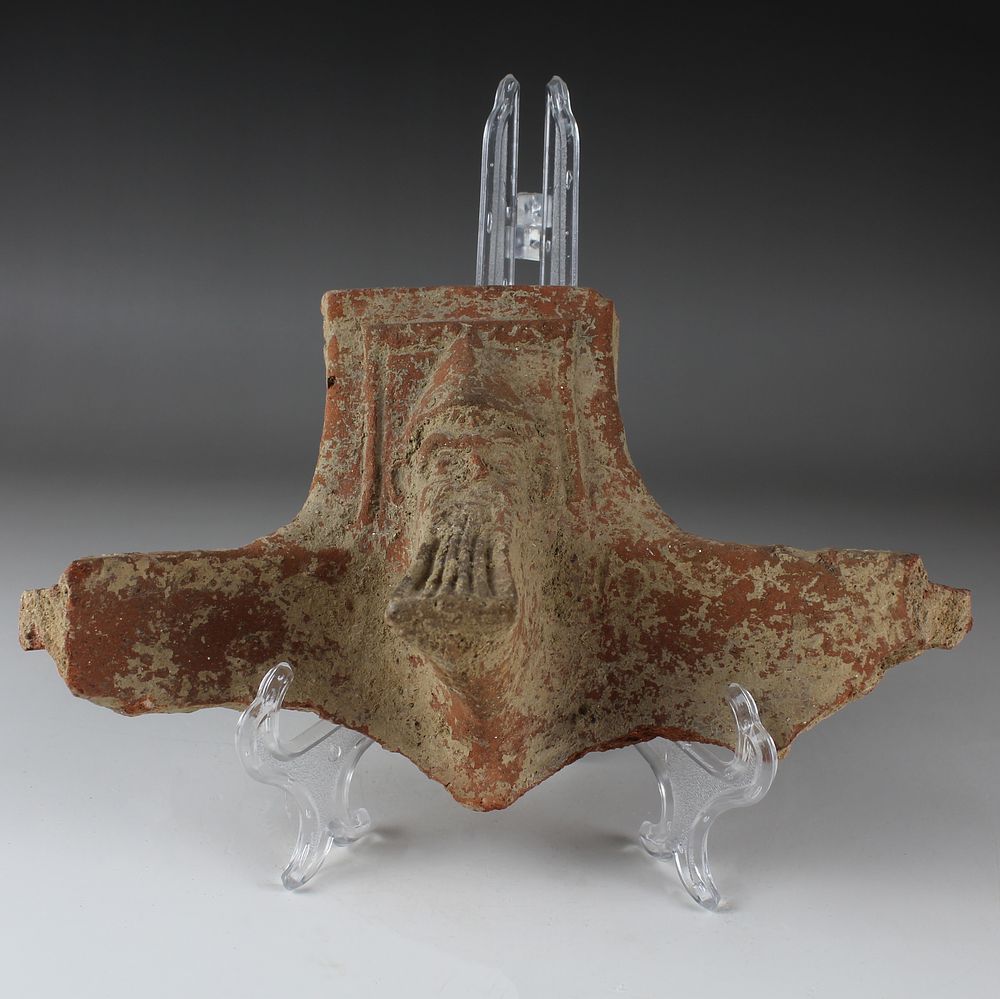
Bidspirit auction | Greek brazier fragment with Odysseus
Greek brazier fragment with Odysseus mask - ITEM: Brazier fragment with Odysseus mask MATERIAL: Pottery CULTURE: Greek, Hellenistic PERIOD: 3rd - 1st Century B.C DIMENSIONS: 122 mm x 203 mm CONDITION: Good condition PROVENANCE: Ex French private collection. Maurice Fallies (1883-1965) and thence by family descent. Fallies was an artist active in the early to mid 20th Century and known mostly for his paintings of Paris street scenes. PARALLEL: BRITISH MUSEUM Collection, Accession number 1868,0405.127 Comes with Certificate of Authenticity and Export Licence. If you are from outside the European Union, we will have to apply for the export licence again for your country, this takes 3 to 5 weeks and has a cost of 5% of the hammer price, this amount will be added to the final invoice. Odysseus, the legendary hero of Homer’s Odyssey, endured as a central figure in Greek culture long beyond the classical period, especially within the Hellenistic world, which saw a revitalized interest in mythological heroes. In this period, roughly from the 4th to the 1st centuries BCE, Odysseus' character took on new dimensions that aligned with the Hellenistic values of intellect, adventure, and resilience. Artists, poets, and historians explored his tales with renewed perspective, often portraying him as a clever strategist rather than a mere warrior. This portrayal reflected a broader Hellenistic admiration for wisdom and cleverness, qualities associated with Odysseus’ ability to navigate diverse cultural encounters, tricky political landscapes, and, famously, to outwit monstrous challenges. The Hellenistic period saw a flourishing of art and literature, where Odysseus appeared frequently in sculptural and literary works. Sculptors often depicted him in thoughtful or pensive poses, reinforcing his reputation as the “man of twists and turns.” This contrasted with earlier depictions, which often focused on heroic postures or scenes of battle. The Hellenistic reinterpretation of Odysseus spoke to the complexities of the human experience, as well as the nuanced understanding of heroism. He was no longer portrayed merely as a victorious warrior but rather as a figure of endurance and intelligence. This perspective is also seen in the expanded literature of the time, where poets and playwrights would highlight his psychological depth, his inner struggles, and his resilience in the face of the gods’ manipulation. The legacy of Odysseus in Hellenistic culture underscored the shift from the communal, martial values of earlier Greek society to the more personal, intellectual pursuits characteristic of the Hellenistic ethos. This was also a time of intense cultural exchange, and Odysseus, often seen as a ”wanderer, ” was a fitting emblem for a world increasingly interconnected by trade, politics, and philosophical exchange. His stories became a means of examining cultural identity and the nature of human resilience.