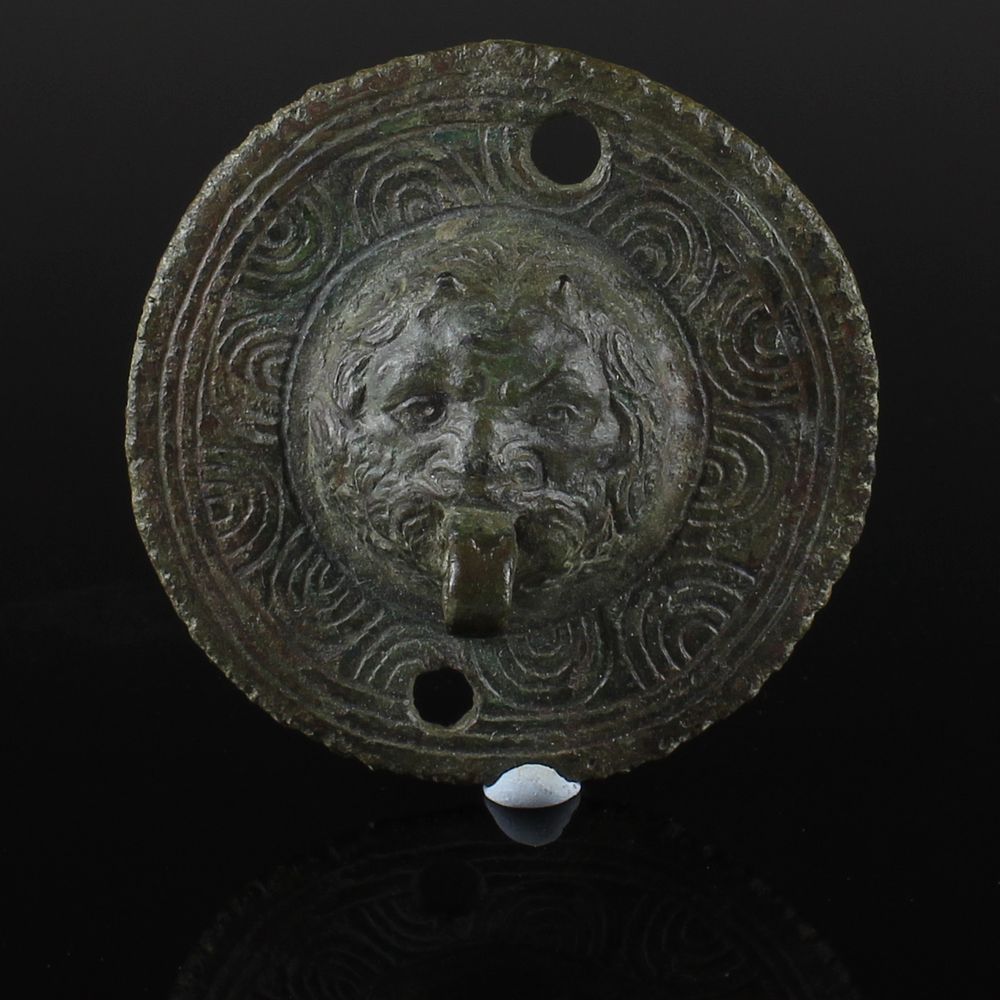
Bidspirit auction | Roman tondo / roundel depicting
Roman tondo / roundel depicting a Medusa or Silenus - ITEM: Tondo / roundel depicting a Medusa or Silenus MATERIAL: Bronze CULTURE: Roman PERIOD: 1st - 3rd Century A.D DIMENSIONS: 56 mm diameter CONDITION: Good condition PROVENANCE: Ex German private collection, acquired between 1970 - 1990 Comes with Certificate of Authenticity and Export Licence. If you are from outside the European Union, we will have to apply for the export licence again for your country, this takes 3 to 5 weeks and has a cost of 5% of the hammer price, this amount will be added to the final invoice. In Roman art and mythology, both Medusa and Silenus held distinct yet powerful symbolic roles, reflecting different aspects of the Roman worldview and cultural influences from earlier Greek traditions. Medusa, one of the three Gorgon sisters, was famously cursed with a gaze that turned onlookers to stone. Originally depicted as monstrous, with serpentine hair and a terrifying visage, Medusa’s image evolved in Roman art, where she was often portrayed as a beautiful, almost alluring figure with a haunting expression and characteristic snake hair. Romans used her likeness as a protective talisman on shields, armor, and household items, believing that her fearsome powers could ward off evil and protect from harm. This “apotropaic” function transformed Medusa into a guardian figure, fusing fear with beauty in a uniquely Roman interpretation. Silenus, on the other hand, was an embodiment of revelry, wisdom, and the pleasures of wine. Known as the teacher and loyal companion of the god Bacchus (Dionysus in Greek mythology), Silenus was often depicted as an older, rotund man with a jovial expression, typically shown in a state of intoxication. Romans associated Silenus with the festive, liberating aspects of Bacchic rites and often portrayed him in sculptures and reliefs as a merry figure surrounded by satyrs and nymphs. Despite his comic appearance, Silenus also held a deeper significance as a symbol of sagacity and insight gained from a life of indulgence, occasionally even depicted imparting prophetic wisdom. His dual role as both a figure of excess and a wise sage made him a complex and relatable character in Roman culture.