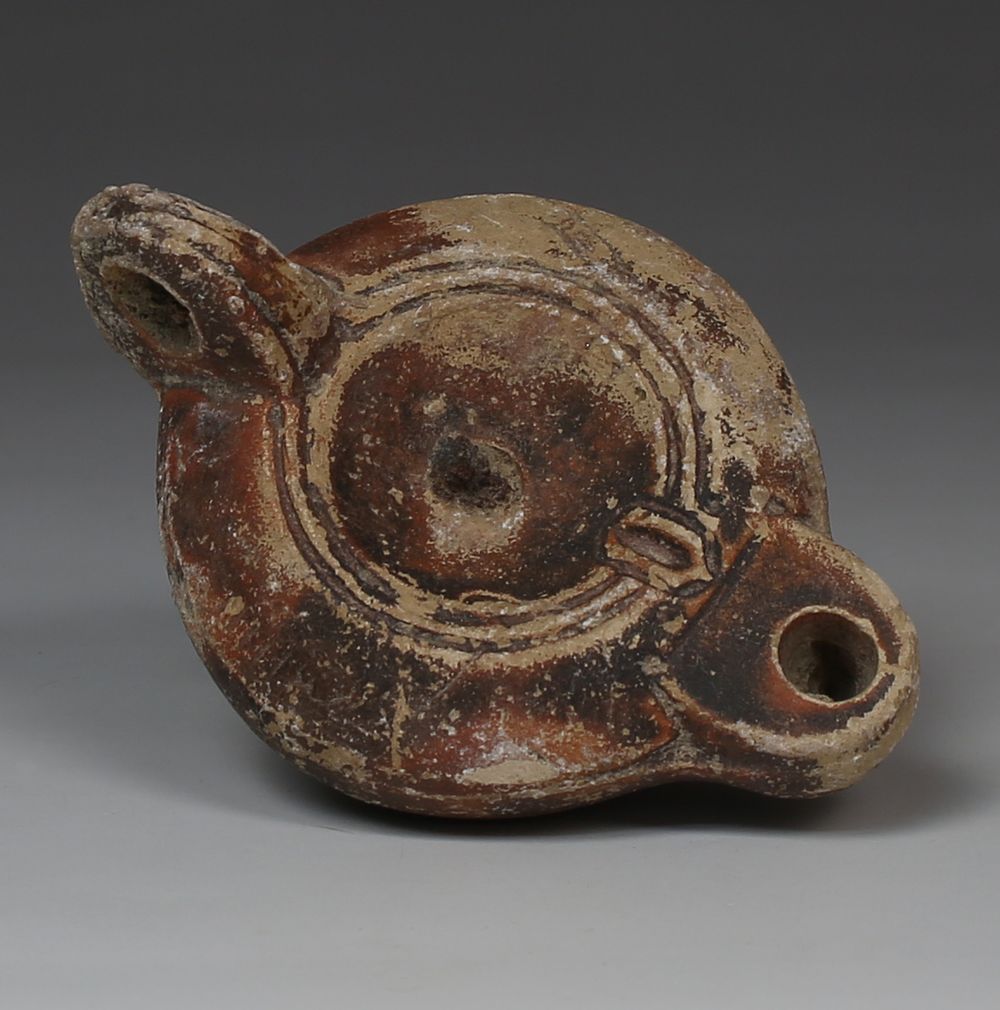
Bidspirit auction | Roman oil lamp
Roman oil lamp - ITEM: Oil lamp MATERIAL: Pottery CULTURE: Roman PERIOD: 1st - 3rd Century A.D DIMENSIONS: 36 mm x 54 mm x 77 mm CONDITION: Good condition PROVENANCE: Ex French private collection, acquired between 1970 - 1990 Comes with Certificate of Authenticity and Export Licence. If you are from outside the European Union, we will have to apply for the export licence again for your country, this takes 3 to 5 weeks and has a cost of 5% of the hammer price, this amount will be added to the final invoice. Roman oil lamps were essential everyday objects in ancient Roman society, used primarily for illumination but also serving as decorative and functional items. These lamps, typically made from clay, bronze, or terracotta, were fueled by oil, often olive oil, which was abundant in the Roman Empire. The lamps had a simple design, usually consisting of a shallow basin with a spout where a wick would be placed to burn the oil. Some lamps featured intricate designs, including depictions of gods, animals, mythological scenes, and geometric patterns, making them not only practical tools but also a form of artistic expression. Roman oil lamps were widely used in homes, public buildings, and outdoor spaces, offering a much-needed light source after sunset. The production of oil lamps was widespread, and their forms varied depending on the region and period. Early Roman lamps often featured a round or oval shape, but by the 1st century BCE, they began to take on more elaborate designs, including those shaped like animals, heads, and even miniature architectural forms. Lamps were frequently mass-produced in workshops, and many examples have been found in archaeological sites across the Roman Empire, from Britain to North Africa. Some lamps were designed with multiple spouts, allowing several wicks to burn at once, while others were simple and utilitarian. The widespread use and variety of these lamps suggest they were integral to daily Roman life, found in homes, tombs, temples, and even used for public ceremonies. In addition to their functional role, Roman oil lamps had symbolic and religious significance. Lamps were often placed in tombs as part of funerary rituals, symbolizing the continuation of life or guiding the deceased’s soul to the afterlife. They were also used in religious ceremonies and offerings to gods, particularly in the context of private worship or in the homes of wealthy Romans who could afford to have them as part of their domestic cult practices.