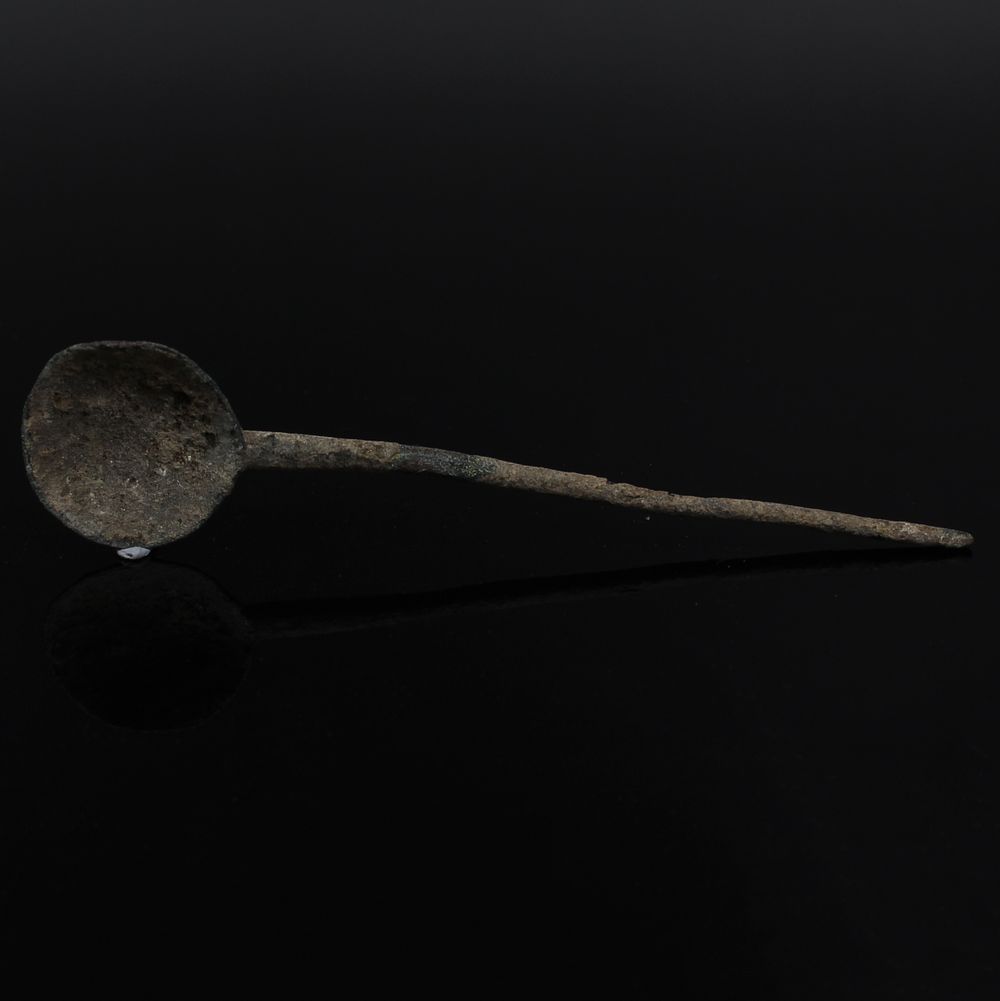
Bidspirit auction | Roman medical instrument, Spoon
Roman medical instrument, Spoon - ITEM: Medical instrument, Spoon MATERIAL: Bronze CULTURE: Roman PERIOD: 1st - 3rd Century A.D DIMENSIONS: 104 mm x 24 mm CONDITION: Good condition PROVENANCE: Ex Polish private collection, acquired from German private collection in 2003 Comes with Certificate of Authenticity and Export Licence. If you are from outside the European Union, we will have to apply for the export licence again for your country, this takes 3 to 5 weeks and has a cost of 5% of the hammer price, this amount will be added to the final invoice. Roman medical instruments reflect a sophisticated approach to healthcare and the Roman Empire's advancements in surgery and medicine. These tools, often made of bronze, iron, or occasionally silver, included scalpels, forceps, bone saws, and probes, showing remarkable similarity to modern surgical instruments. The variety and specificity of these tools suggest that Roman practitioners could perform a range of procedures, from basic wound care to complex surgeries. Excavations of Roman military and urban sites, such as those at Pompeii and Herculaneum, have uncovered sets of medical tools, revealing that medical practitioners were well-equipped and held esteemed positions in society. Roman surgeons and physicians were skilled in both trauma care—often needed for soldiers injured in battle—and routine health care for civilians. Instruments such as bone levers were used to reset fractures, while small hooks and probes were essential for cleaning wounds and removing foreign objects. Romans had a keen understanding of hygiene and frequently boiled instruments before use, showing early practices of antiseptic care. Texts from ancient medical writers like Galen and Celsus describe procedures using these instruments, such as cataract surgery and trepanation, indicating that Roman medicine was informed by Greek medical knowledge and adapted for practical use in the Empire. The discovery of Roman medical tools provides valuable insight into the professionalization of medicine in antiquity. The presence of specialized instruments for different types of procedures suggests that Roman medicine included a degree of specialization, with some practitioners focusing on specific fields like ophthalmology or battlefield surgery.