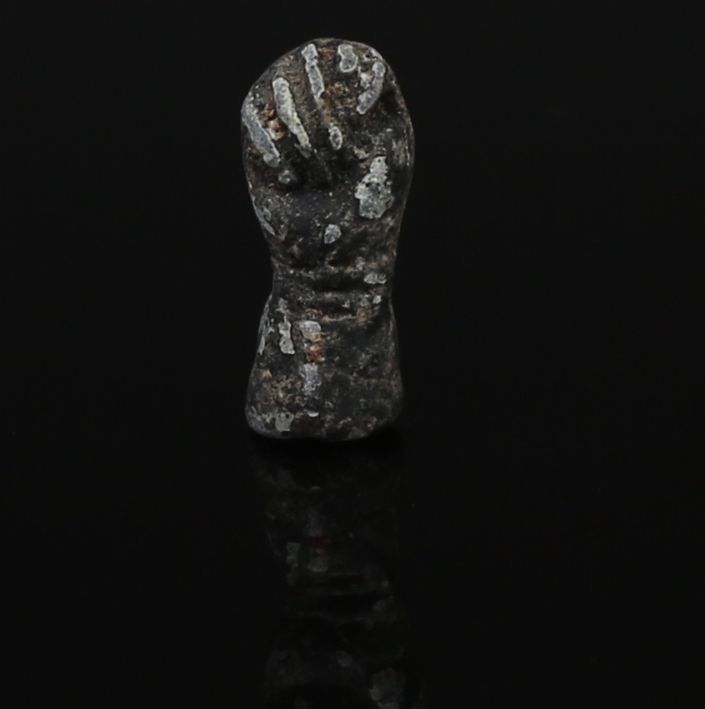
Bidspirit auction | Roman 'Manu fica' amulet
Roman 'Manu fica' amulet - ITEM: 'Manu fica' amulet MATERIAL: Faience CULTURE: Roman, Egypt PERIOD: 1st - 3rd Century A.D DIMENSIONS: 20 mm x 8 mm CONDITION: Good condition PROVENANCE: Ex German private collection, acquired between 1970 - 1990 Comes with Certificate of Authenticity and Export Licence. If you are from outside the European Union, we will have to apply for the export licence again for your country, this takes 3 to 5 weeks and has a cost of 5% of the hammer price, this amount will be added to the final invoice. The Roman manu fica amulet, also known as the ”fig sign” or ”fig-shaped hand” amulet, was a powerful and widely used symbol of protection in Roman society. Shaped to resemble a fist with the thumb placed between the index and middle fingers, the gesture is often associated with warding off the evil eye, a common belief in ancient Roman and Mediterranean cultures. The manu fica symbol was believed to protect the wearer from jealousy, misfortune, and the malevolent gaze of others, often serving as a talisman to keep away bad luck or curses. This gesture was so significant that it appeared not only in amulet form but also in various other objects like rings, pendants, and pottery, reflecting its widespread cultural importance. The use of the manu fica amulet was prevalent in both personal and public contexts. Roman soldiers, for example, often wore these amulets as protective charms during battles and long journeys, seeking divine or supernatural aid against the dangers they faced. Wealthy individuals and aristocrats also utilized these amulets to safeguard themselves from the negative effects of envy or malicious gossip, which were believed to be potent forces in Roman society. The manu fica was not only used as a protective device but also as a statement of defiance against misfortune, reflecting the Roman emphasis on resilience and control over external forces. The manu fica gesture itself, with its thumb between the index and middle fingers, was a form of folk magic that crossed cultural boundaries, appearing in Greek, Roman, and later European traditions. In Roman times, the amulet was often worn in everyday life and incorporated into a range of jewelry and personal items. In addition to its protective function, the manu fica could also be used as a sign of fertility or a symbol of good luck.