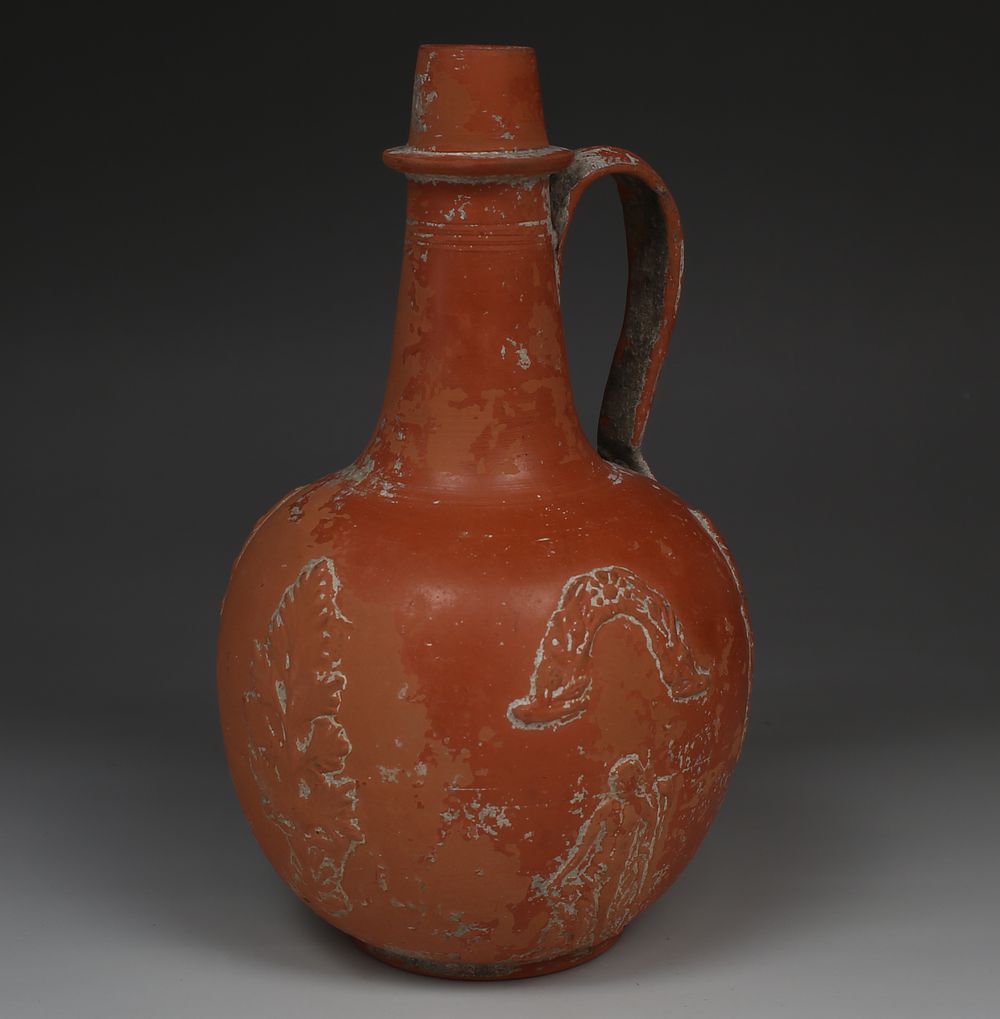
Bidspirit auction | Roman bottle
Roman bottle - ITEM: Bottle MATERIAL: Terra Sigillata CULTURE: Roman, North Africa PERIOD: 3rd - 4th Century A.D DIMENSIONS: 180 mm x 100 mm CONDITION: Good condition, handle repaired PROVENANCE: Ex French private collection, acquired between 1970 - 1990 Comes with Certificate of Authenticity and Export Licence. If you are from outside the European Union, we will have to apply for the export licence again for your country, this takes 3 to 5 weeks and has a cost of 5% of the hammer price, this amount will be added to the final invoice. Roman North African bottles, often associated with the regions of modern-day Tunisia, Algeria, and Libya, represent an important segment of Roman material culture, particularly in terms of their use in trade, daily life, and storage practices. These bottles were typically made from glass, a material that became increasingly popular in the Roman Empire during the 1st and 2nd centuries CE. Roman North African glass bottles often featured a wide variety of shapes and sizes, ranging from small, narrow-necked vessels to larger, more bulbous forms. Their primary function was for storing liquids such as perfumes, oils, and wine, though they were also used to hold medicines or scented water, depending on the contents. The craftsmanship of Roman North African glass bottles was highly advanced, with many examples exhibiting sophisticated techniques in both molding and blowing. Glassmakers in the region, particularly in the city of Carthage, were renowned for their skill in producing delicate and often finely decorated bottles. These vessels frequently featured intricate patterns, from geometric designs to depictions of mythological figures or animals. Many bottles also had decorative handles, rims, and embossed patterns, highlighting the artistry and attention to detail that went into their production. Some bottles were even tinted or colored, adding to their aesthetic appeal and distinguishing them from simpler, utilitarian vessels. Roman North African bottles played a key role in the trade networks that connected the Roman Empire, especially in the Mediterranean. North Africa, with its abundant natural resources, including sand for glassmaking, became a significant center for the production and export of glassware. The bottles made in North Africa were highly prized across the Roman world and beyond, serving as luxury items in affluent households or as practical containers for everyday use. The widespread distribution of these bottles across the empire—evidenced by their discovery in archaeological sites in Europe, the Near East, and North Africa—demonstrates the extensive trade routes and cultural exchanges that existed during the Roman period.