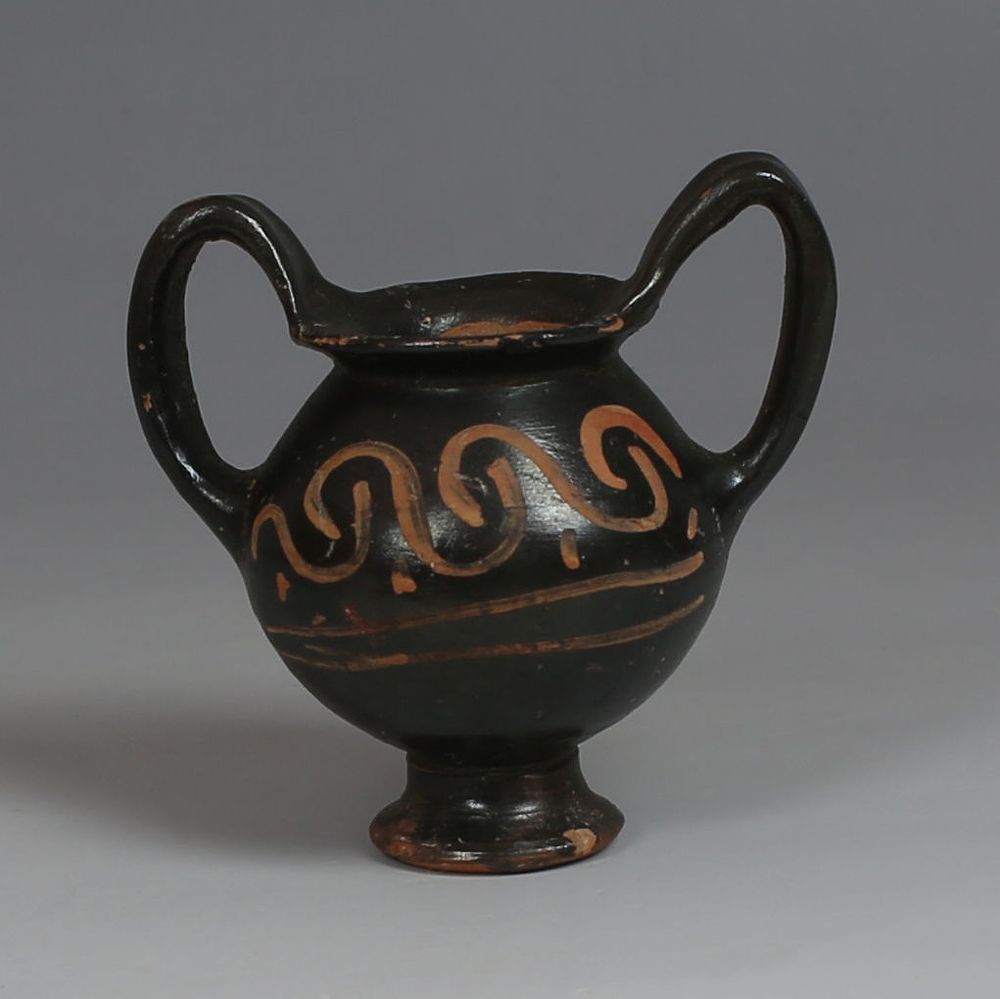
Bidspirit auction | Greek nestoris
Greek nestoris - ITEM: Nestoris MATERIAL: Pottery, Xenon-ware CULTURE: Greek PERIOD: Apulian, 4th Century B.C DIMENSIONS: 57 mm x 62 mm CONDITION: Good condition PROVENANCE: Ex Dutch private collection, acquired before 2000s Comes with Certificate of Authenticity and Export Licence. If you are from outside the European Union, we will have to apply for the export licence again for your country, this takes 3 to 5 weeks and has a cost of 5% of the hammer price, this amount will be added to the final invoice. The Nestoris is a distinctive form of ancient Greek pottery that is primarily associated with the production centers of South Italy, particularly the region of Lucania (modern Basilicata) during the Late Classical and early Hellenistic periods (roughly 4th century BCE). Unlike most South Italian vase shapes, which were directly inspired by Attic (Athenian) models, the nestoris is an indigenous shape that developed from the local Messapian trozzella vase. Its name, meaning ”belonging to Nestor, ” was a later, mistaken attribution based on a cup described in Homer's Iliad; however, the actual vessel is a tall, two-handled jar. The key distinguishing features of the nestoris are its form and handles. It is typically a deep vessel with a broad, rounded body, a narrow neck, and a flaring rim, set on a ring foot or low pedestal. Crucially, it has two sets of handles. The most prominent are the tall, upswung vertical handles that rise well above the rim, often composed of two straps connected by struts and frequently decorated with characteristic molded discs or trozzelle at the tops and sometimes halfway up. In addition to these, many nestorides have a second, smaller pair of horizontal, rolled handles on the body below the shoulder. Most surviving examples of the nestoris are decorated in the Red-figure technique, featuring figural scenes in the natural red-orange color of the clay against a black-gloss background. The decoration often covers multiple registers on both the neck and the main body, frequently depicting mythological narratives, scenes of warriors preparing for battle, or Dionysiac revelries with stock figures like satyrs and nymphs. Given that many nestorides have been found in graves, particularly in Lucanian burial contexts, it is believed that these beautifully decorated vessels served a significant funerary function, perhaps as containers for liquids or as elaborate grave goods for the deceased.