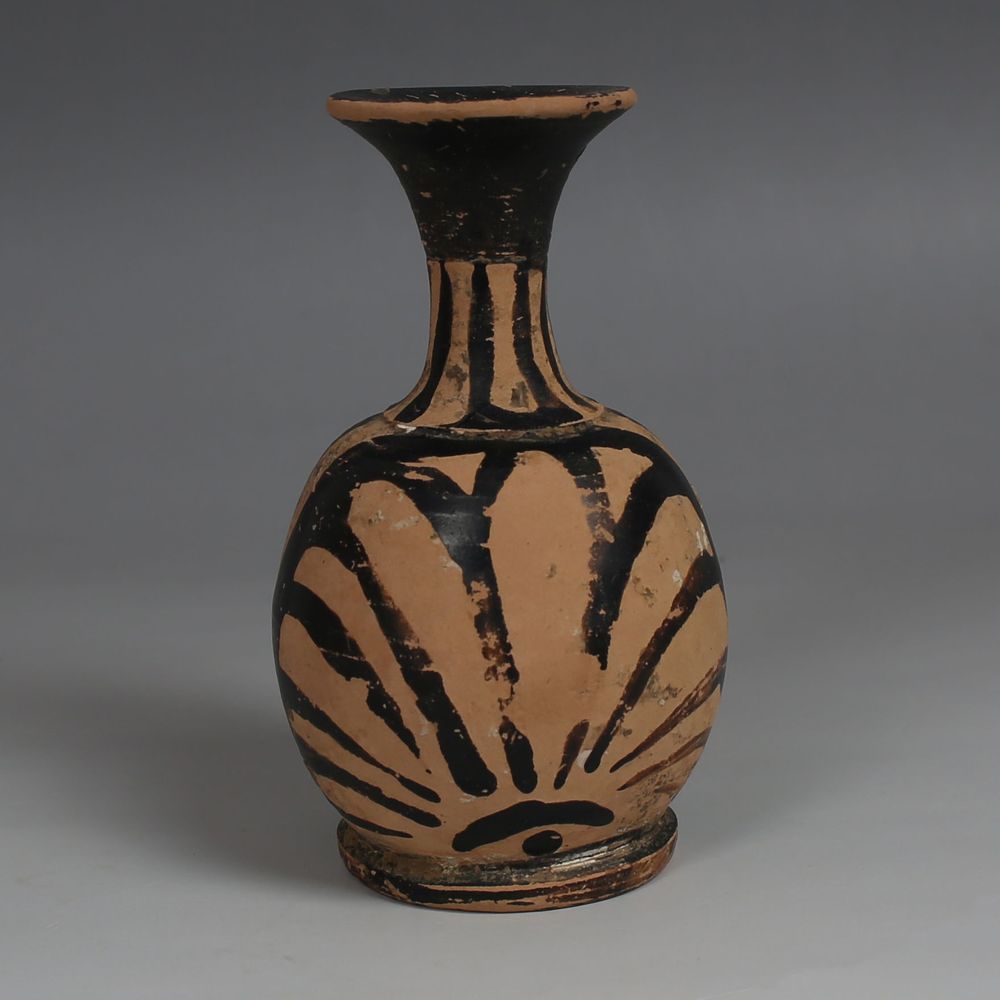
Bidspirit auction | Greek squat lekythos with palmette
Greek squat lekythos with palmette decoration - ITEM: Squat lekythos with palmette decoration MATERIAL: Pottery CULTURE: Greek PERIOD: 4th Century B.C DIMENSIONS: 90 mm x 53 mm CONDITION: Good condition PROVENANCE: Ex German private collection since the early 2000's, Ex European antiquities online auctions Comes with Certificate of Authenticity and Export Licence. If you are from outside the European Union, we will have to apply for the export licence again for your country, this takes 3 to 5 weeks and has a cost of 5% of the hammer price, this amount will be added to the final invoice. The squat lekythos is a distinct, smaller variant of the typical ancient Greek lekythos, a vessel primarily designed to hold oil (especially olive oil) or perfumed ointments. The standard lekythos is recognized for its tall, slender, cylindrical body, single handle, and narrow neck that controls the flow of its expensive contents. The squat form, however, has a comparatively short, globular, rounded belly (hence 'squat') and a flat base, while retaining the narrow neck and flaring mouth of its larger cousins. These miniature oil flasks, generally less than 20 cm in height, became particularly popular in the later phases of Greek vase painting, flourishing around the 5th and 4th centuries BCE, especially in Athens, the center of fine ceramic production.In terms of function, the squat lekythos served both ritual and cosmetic purposes. Like other lekythoi, they were used to hold oil for anointing the body at baths and gymnasiums, as well as for funerary offerings and rites. The narrow neck was an intentional design feature to dispense the oil sparingly, drop by drop, underlining the contents' value. Due to their frequent inclusion in tombs as grave goods, or offerings for the deceased, they are often associated with funerary rituals—a purpose underscored by the creation of versions with a false inner bottom or a small inner cup, which limited the amount of costly oil required to fill the vessel, making the gift symbolic rather than strictly practical.The decoration of the squat lekythos typically reflects the artistic style popular during its period of production, most commonly the Red-Figure technique. This style allowed for greater detail, showing figures in the reddish color of the terracotta clay against a black background. The scenes depicted are often focused on the domestic sphere, rituals, or mythological narratives, with examples showing women's activities, or figures associated with the rites of passage like marriage (a ritual also involving scented oils). The British Museum, the Metropolitan Museum of Art, and other collections house excellent examples, often attributed to specific workshops like those in the Manner of the Meidias Painter, demonstrating that even these smaller, arguably mass-produced items were decorated with considerable artistic skill.