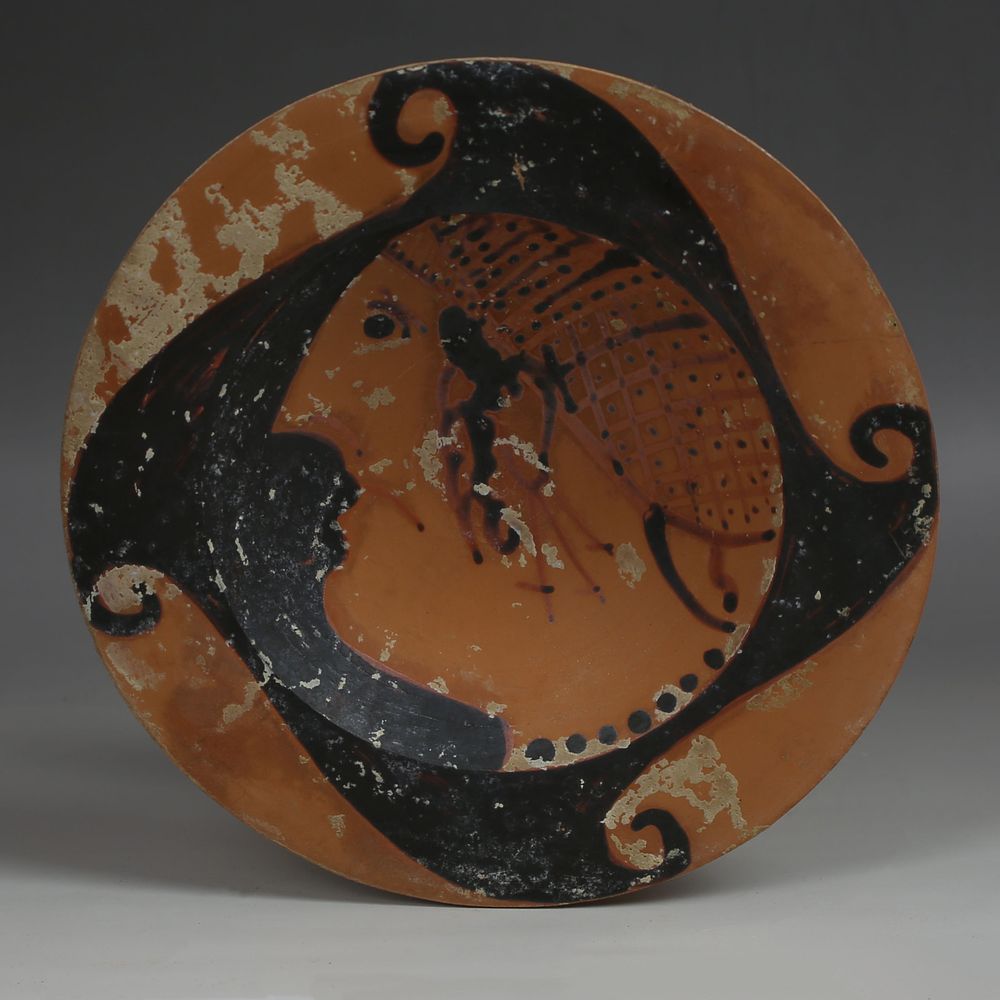
Bidspirit auction | Etruscan plate, Type Genucilia
Etruscan plate, Type Genucilia - ITEM: Plate, Type Genucilia MATERIAL: Pottery CULTURE: Etruscan PERIOD: 4th Century B.C DIMENSIONS: 65 mm x 163 mm CONDITION: Good condition PROVENANCE: Ex European private collection, Ex Lakythos S.A.R.L (1987), Ex Galerie Hydra, Geneva, Switzerland (1984) Comes with Certificate of Authenticity and Export Licence. If you are from outside the European Union, we will have to apply for the export licence again for your country, this takes 3 to 5 weeks and has a cost of 5% of the hammer price, this amount will be added to the final invoice. The Genucilia plate is a characteristic type of small, footed Etruscan ceramic plate produced in central Italy, primarily during the 4th century BCE. The name derives from a specific plate found with the painted inscription of its owner, ”P. Genucilia, ” likely a Faliscan or Latin woman. These plates are examples of local Etruscan production that was heavily influenced by contemporary Greek pottery styles, particularly the highly prized red-figure technique. Though considered a mass-produced, ”second-rate” ware by some scholars, they were exceptionally popular and were a widespread product across Etruria and Lazio. The typical Genucilia plate is a shallow dish or patera, usually measuring about 14–16 cm in diameter, resting on a low stem and a wide foot. The decoration is limited to the circular central space, or tondo, and the rim. Two primary decorative motifs dominate the interior: either a stylized female head in profile facing left, or a geometric star/cross pattern with simple dots. The female head is often interpreted by scholars as representing a deity, possibly Proserpina (Persephone), due to the plate's frequent association with funerary and votive contexts. The plates were executed using a simplified version of the red-figure technique, where the main design was left in the natural reddish color of the clay and outlined in black slip, with further details painted in black. A defining feature is the decorative border, typically a wave pattern (a spiral wave or meander) encircling the rim, which framed the central motif. Production of the Genucilia Group is thought to have begun in the city of Falerii (modern Civita Castellana), likely by an immigrant Athenian potter, before production shifted to major Etruscan centers like Caere (modern Cerveteri). They are frequently recovered from tombs and sanctuaries, suggesting they served a dual purpose as both inexpensive tableware and objects for religious offerings (agalmata).